Ceuta is slowly attempting to return to normality following one of the most serious migration crises Spain has faced in recent years. But the human toll is devastating: at least 72 people have died according to Spanish authorities, tens of thousands of migrants have entered or subsequently left the Spanish enclave, and many remain scattered across the city. At the same time, Prime Minister Pedro Sánchez is facing mounting political pressure from Europe, with 22 EU countries calling for an urgent response and openly questioning aspects of Spain’s migration policy.
Spain Expat Press Editorial Team
Ceuta struggles to return to normality
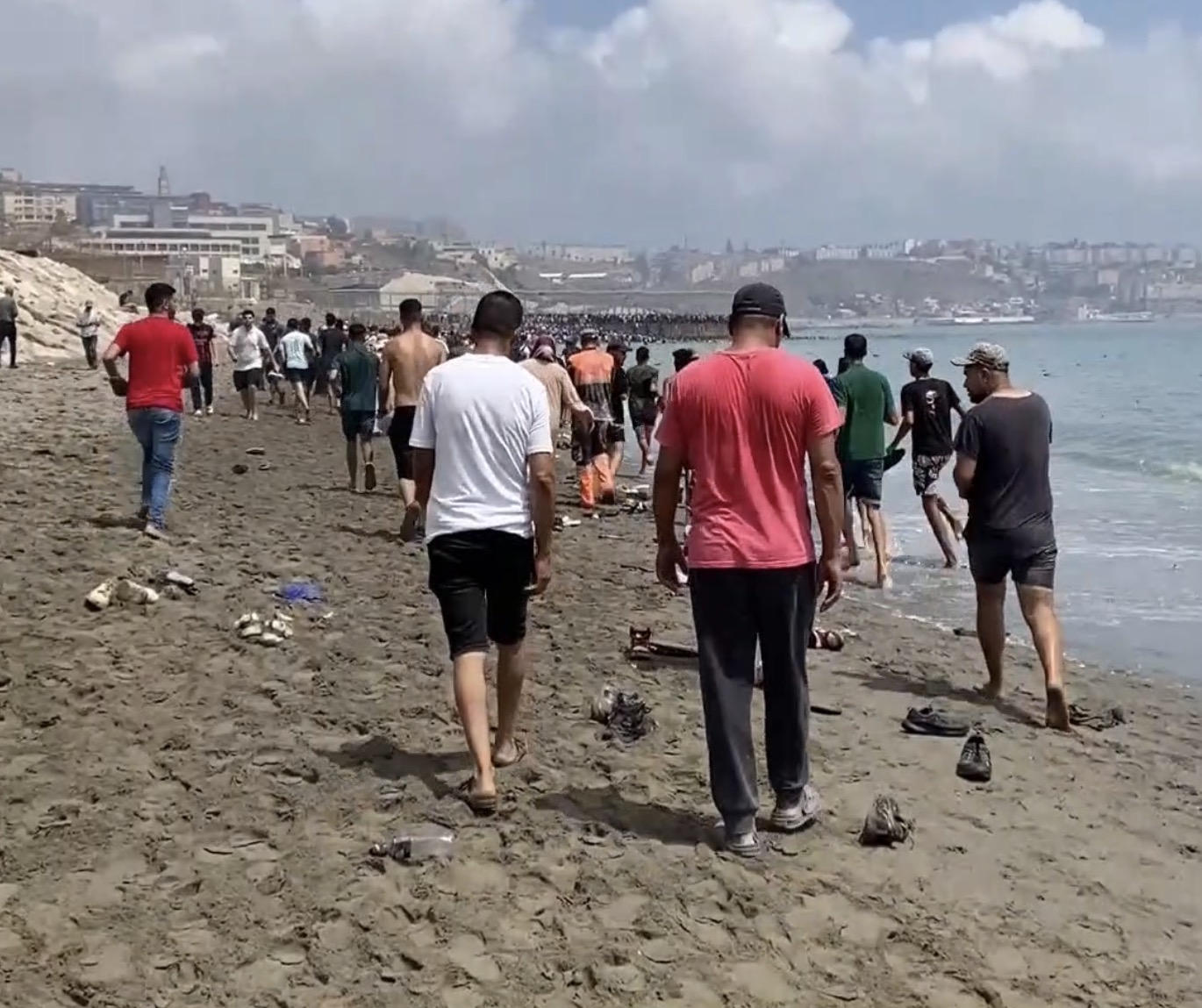
Three days after the mass influx from Morocco, most businesses in Ceuta have reopened and residents are gradually returning to their daily routines.
Yet describing the situation as normal would be premature.
Police, Guardia Civil officers and military personnel remain deployed throughout the Spanish enclave. According to the authorities, almost 3,000 members of the security forces and armed forces are currently on the ground and will remain for as long as necessary.
One crucial question also remains unanswered: exactly how many migrants are still in Ceuta?
Authorities report 73,500 returns to Morocco
Spanish security forces estimate that approximately 73,500 people have now crossed back into Morocco.
The figure has raised questions because it exceeds some of the initial estimates suggesting that between 50,000 and 60,000 people had entered Ceuta during the mass influx.
Authorities have therefore cautioned that the figures should not yet be regarded as a definitive account of the crisis.
Morocco, meanwhile, has acknowledged that around 40,000 people had made their way towards the border with Ceuta.
The considerable discrepancies between the different figures underline the scale and confusion surrounding an unprecedented movement of people across the border.
At least 72 dead as full scale of tragedy remains unclear
The most devastating consequence of the crisis is the growing death toll.
According to Spanish authorities, at least 72 people have died, many while attempting to reach Spanish territory through the sea.
Moroccan authorities have also acknowledged 11 deaths on their side of the border.
However, the final toll remains uncertain and could rise further as authorities continue to assess the events and recover bodies.
Different figures have been reported by Spanish and Moroccan authorities, making it essential to distinguish between confirmed deaths directly connected with the latest crisis and other fatalities recorded in recent weeks.
Even on the most conservative confirmed figures, the events represent one of the deadliest migration tragedies on Spain’s borders in recent years.
Migrants hiding in mountains and abandoned fortifications
Although tens of thousands are reported to have returned to Morocco, the situation inside Ceuta remains far from resolved.
Security forces are continuing to search for migrants who have dispersed throughout the enclave.
Reports from Ceuta indicate that several hundred people are believed to be hiding in mountainous areas, abandoned fortifications and other locations that are difficult for the authorities to access.
Others continue to sleep in parks, on streets and beaches or close to the Temporary Migrant Stay Centre, known as the CETI.
Claims that “thousands of migrants are hiding” cannot currently be substantiated. Available reports specifically document several hundred people in hiding, although the overall number of migrants remaining across different parts of Ceuta is considerably higher.
CETI operating far beyond capacity
Pressure on Ceuta’s migrant reception infrastructure remains intense.
The CETI officially has capacity for 512 people, but reports indicate that more than 700 migrants are currently being accommodated there.
Hundreds more have gathered outside or in the surrounding area hoping that spaces will become available as residents are transferred to mainland Spain.
Police and military personnel have established security measures around the facility, while members of the armed forces have also been distributing drinking water.
Humanitarian organisations operating in Ceuta say many migrants have little or no money and are primarily requesting food, water and somewhere safe to sleep.
The Ceuta crisis reaches Brussels
What began as an extraordinary border crisis between Spain and Morocco has rapidly developed into a wider European political issue.
A total of 22 EU countries have called for an urgent European response to the events in Ceuta.
European interior ministers are expected to address the crisis and discuss measures aimed at strengthening the protection of the European Union’s external borders.
For Pedro Sánchez’s government, however, the most politically sensitive development is that Spain’s own migration policy has now become part of the European debate.
22 EU countries question Spain’s migration approach
Several European governments have warned that large-scale regularisation programmes could potentially act as a “pull factor” for irregular migration.
The argument places the policies pursued by Sánchez’s government directly under scrutiny.
Italy and Denmark are among the countries pushing for a tougher European approach to migration and stronger controls at the EU’s external borders.
Madrid has defended its policies and has instead called for European solidarity and a coordinated response to the pressure facing Spain.
The disagreement exposes an increasingly significant political divide.
While Sánchez is demanding greater European support, a broad group of EU governments is simultaneously calling for tighter border controls and questioning whether decisions taken by Madrid could have consequences beyond Spain itself.
Sánchez faces growing pressure at home
The political fallout is also intensifying within Spain.
Opposition leader Alberto Núñez Feijóo has challenged the government’s suggestion that Ceuta is returning to normality following a visit to the enclave.
The opposition argues that it is difficult to speak of normality while migrants continue to sleep outdoors, people remain hidden in remote areas and thousands of police officers, Guardia Civil personnel and soldiers are still deployed.
Vox has gone further, blaming the government’s migration policy for contributing to the crisis.
There is, however, an important distinction to make.
There is currently no reliable opinion poll conducted after the Ceuta crisis demonstrating that PSOE voters are abandoning Pedro Sánchez specifically because of these events.
Claims of a significant loss of Socialist voters as a direct consequence of Ceuta would therefore be premature.
A crisis whose consequences extend far beyond Ceuta
Major questions remain unanswered.
Authorities still do not know precisely how many migrants remain in Ceuta. The final death toll has yet to be established, while the political consequences for both Spain and Europe are only beginning to emerge.
What is already clear is that the events have moved far beyond a local emergency on the Spanish-Moroccan border.
Within days, Ceuta has become the centre of a European migration and political crisis.
For Pedro Sánchez, the reaction from Spain’s European partners may prove particularly significant. The debate is no longer confined to how Spain protects its border with Morocco. It increasingly concerns whether Madrid’s wider migration strategy has consequences for the rest of the European Union.
Ceuta may be attempting to return to normality, but the political crisis surrounding it appears to be far from over.