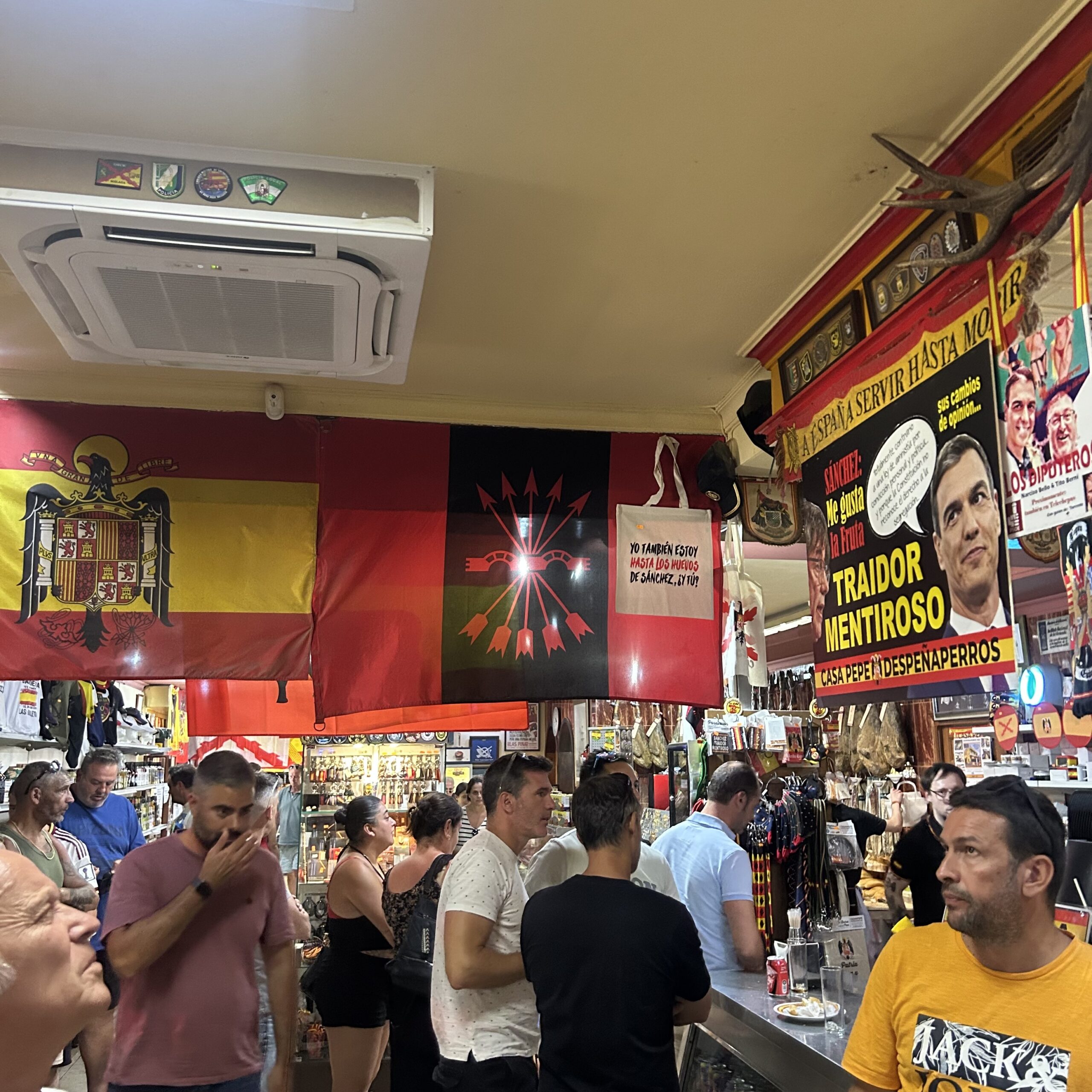
Franco portraits on the walls, Falange memorabilia, historic flags, political messages and a souvenir shop unlike almost anything you would expect to find at a motorway stop in modern Europe. Casa Pepe, close to Despeñaperros on the main route between Madrid and Andalusia, has been attracting travellers for decades. For some, stopping here is simply part of the journey south. For others, it represents political nostalgia for a Spain that disappeared half a century ago. Spain Expat Press stopped to see for ourselves what all the fuss is about.
An institution on the road to Andalusia
At first glance, Casa Pepe has many of the characteristics of a traditional Spanish venta.
It is located at Venta de Cárdenas, near Almuradiel in the province of Ciudad Real, just before or after Despeñaperros depending on which direction you are travelling.
For generations, this has been one of the principal routes connecting Madrid and central Spain with Andalusia.
That location helped turn Casa Pepe into an institution among travellers.
Families, lorry drivers, holidaymakers and generations of Spaniards have stopped here on their journeys north and south.
The car park is frequently busy and thousands of online reviews make one thing clear: Casa Pepe is certainly no forgotten relic beside an old road.
But it was not the coffee or the bocadillos that made the restaurant famous.
Walk through the door – and suddenly Franco is everywhere
For anyone arriving without knowing Casa Pepe’s reputation, stepping inside can come as quite a shock.
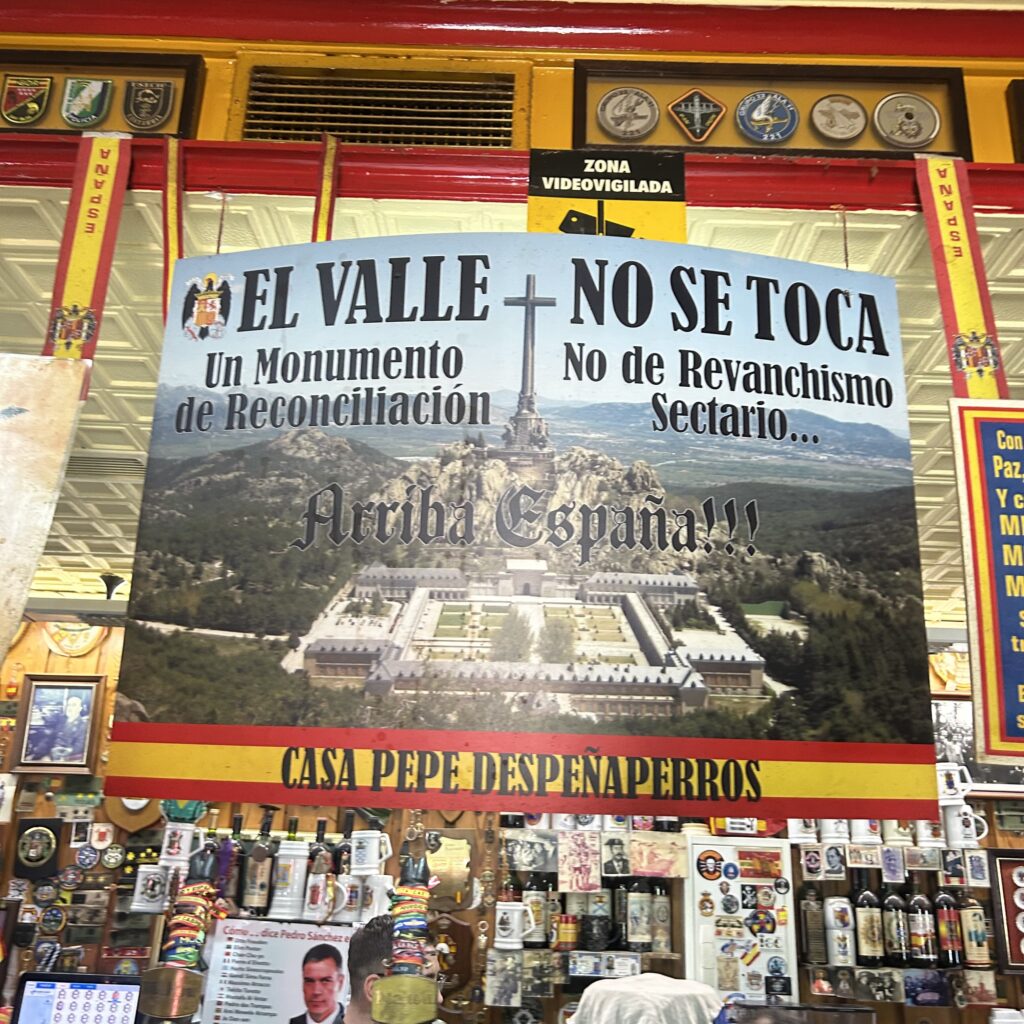
Portraits of dictator Francisco Franco hang on the walls.
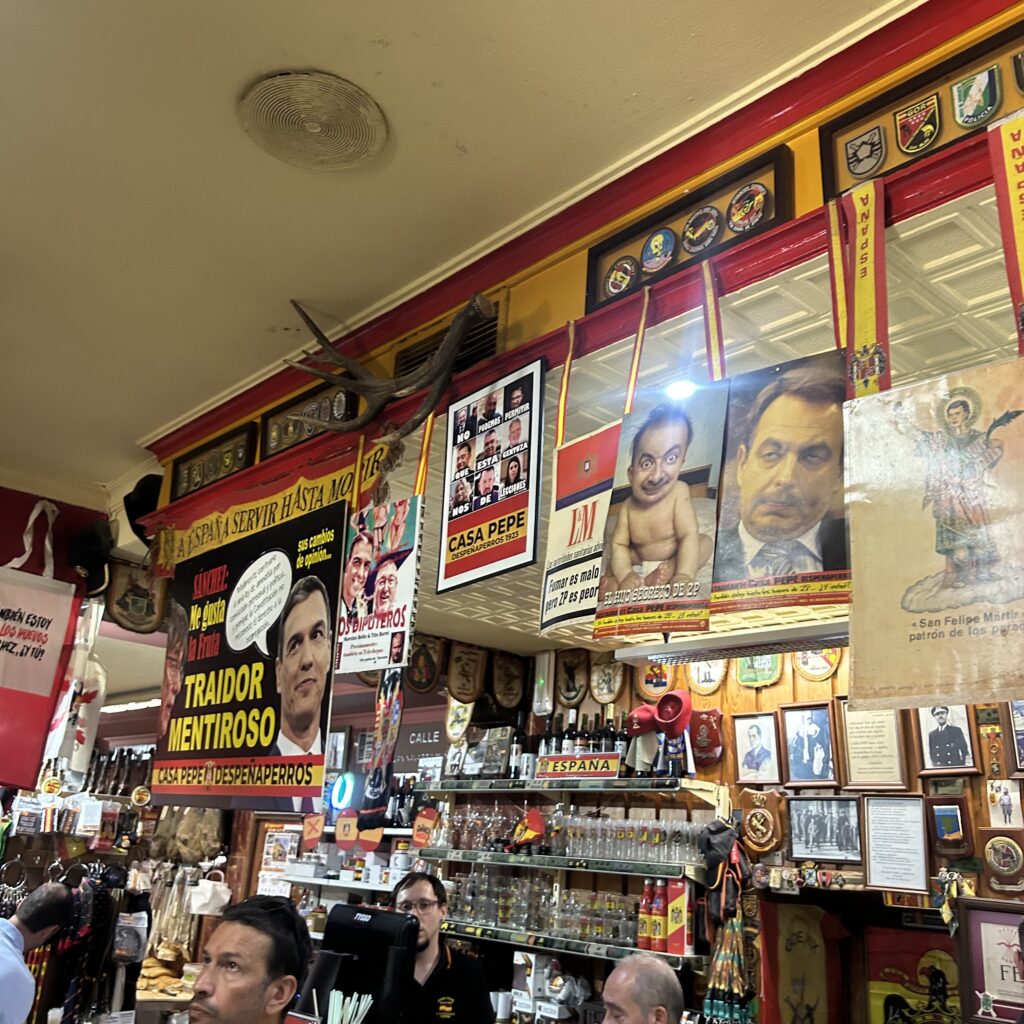
There are historic Spanish flags, the former coat of arms featuring the eagle, Falange symbols and an extraordinary collection of memorabilia associated with Franco’s dictatorship.
Over the decades, the restaurant has effectively developed into a privately run museum of Franco nostalgia.
As far back as 2014, El País described Casa Pepe as a restaurant that appeared almost to have skipped Spain’s transition to democracy.
In 2026, even Britain’s The Guardian returned to the question of how places displaying Francoist symbolism can continue to operate in modern Spain.
More than half a century after Franco’s death, Casa Pepe is still here.
It all began in 1923
The story of Casa Pepe actually began in remarkably ordinary circumstances.
In 1923, José Navarro Valero opened a grocery shop at the site.
The family business was later taken over by his son, Juan Navarro.
Under Navarro, Casa Pepe gradually became the establishment for which it is known today.
He made no secret of his political beliefs and publicly described himself as a committed supporter of Franco.
The decoration of the restaurant increasingly reflected those convictions.
Following his death in 2013, the family continued running the business.
Much of its distinctive character remained.
Nostalgia for some, political conviction for others
Perhaps the most fascinating aspect of Casa Pepe is not simply what hangs on its walls.
It is the extraordinary mixture of people who stop here.
There are undoubtedly visitors who identify with Francoism or who regard the establishment with political nostalgia.
But assuming that everyone drinking a coffee or eating lunch at Casa Pepe shares those views would be misleading.
For many people, stopping here has simply become a tradition.
Some remember visiting as children when their parents stopped on the long drive between Madrid and the Andalusian coast.
Others arrive purely out of curiosity.
They have heard about “that Franco restaurant near Despeñaperros” and want to see whether it really is as extraordinary as people claim.
Casa Pepe has consequently become several things at once: restaurant, curiosity, political statement, historical time capsule and – whether intentionally or not – tourist attraction.
Perhaps Spain’s strangest souvenir shop
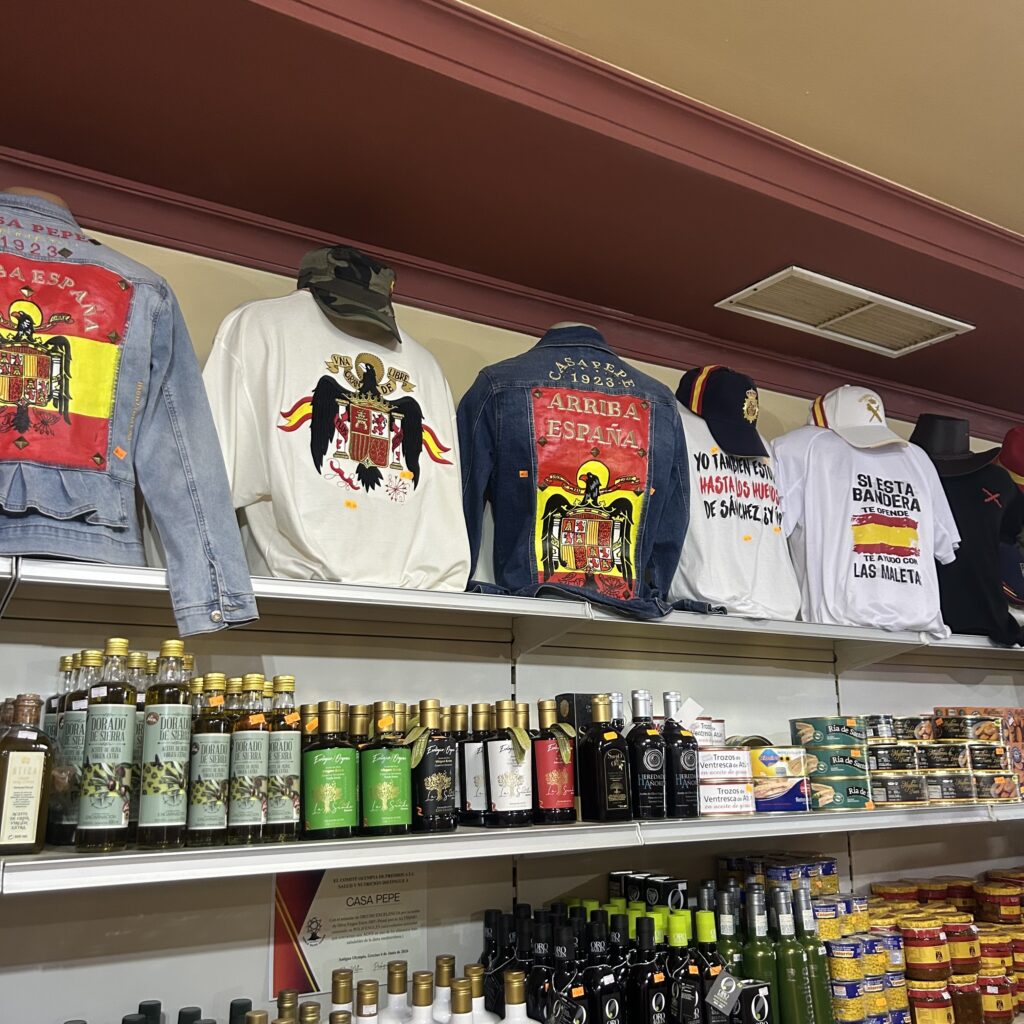
There is also a shop attached to the restaurant.
At first, much of what is on sale looks exactly like what you would expect from a traditional Spanish roadside venta.
There are hams, chorizo, cheeses, pâtés, olives, local honey and other regional products.
But alongside them, visitors have also encountered national memorabilia and products carrying historical or Francoist imagery.
International media have previously reported everything from bags bearing Franco’s portrait to products decorated with historic Spanish flags.
At Casa Pepe, the boundaries between restaurant, museum, political memorabilia shop and roadside attraction become increasingly difficult to define.
Could somewhere like Casa Pepe exist in Britain?
For British visitors, this may be the question that immediately comes to mind.
Imagine a busy roadside restaurant in Britain decorated extensively with portraits and memorabilia celebrating an authoritarian ruler from the country’s recent past.
Would it even be possible?
The legal comparison is not as straightforward as it might initially appear.
Unlike Germany, where the use of many Nazi symbols is specifically prohibited except in contexts such as education, historical documentation, science and art, Britain does not operate a blanket ban on displaying every fascist or Nazi symbol simply because of the symbol itself.
Context matters.
British legislation can criminalise conduct involving the stirring up of racial or religious hatred, threatening behaviour and, in certain circumstances, displays connected with proscribed terrorist organisations.
So it would be inaccurate to claim that a British equivalent of Casa Pepe would automatically be illegal.
Socially, however, the picture would be rather different.
A popular British roadside restaurant openly filled with memorabilia celebrating a 20th-century dictatorship would almost certainly provoke intense controversy.
And that is perhaps what makes Casa Pepe so striking to British eyes.
It is not hidden away in a private collection.
It is a functioning restaurant where travellers stop for breakfast, lunch or simply a coffee before continuing their journey.
But isn’t this illegal in Spain?
That was another question that immediately occurred to us.
Spain introduced its Democratic Memory Law in 2022, strengthening measures dealing with the legacy of the Civil War and Franco dictatorship.
The legislation provides for the removal of certain symbols and elements when they constitute glorification of the 1936 military uprising or the dictatorship.
The situation becomes more complicated when items are privately owned.
Under certain circumstances, the law can also affect elements on private property when they have a public projection or are visible or accessible to the public.
That does not mean that every individual object displayed inside Casa Pepe is automatically illegal.
Whether a particular item breaches the law depends on what it is, how it is displayed, its context and whether authorities consider it to constitute glorification of the dictatorship.
Nevertheless, the fact that Casa Pepe remains famous for precisely this imagery more than 50 years after Franco’s death makes the establishment particularly unusual.
A place that divides opinion
Perhaps that contradiction explains why Casa Pepe continues to attract so much attention.
For some visitors, it represents memories of the Spain in which they grew up.
For others, it reflects genuine political conviction.
Others regard the open display of memorabilia associated with a dictatorship as deeply offensive.
And then there are the simply curious.
They stop, order a coffee, wander around, look at the walls, perhaps take photographs and then continue towards Madrid or Andalusia.
Casa Pepe has therefore achieved something few roadside restaurants ever manage:
it has become a destination in its own right.
Spain Expat Press stops at Casa Pepe
That is precisely why Spain Expat Press decided to stop and see what was actually behind the hype.
Why is a roadside business that began as a grocery shop more than a century ago still attracting so much attention?
Who comes here?
Is it nostalgia, political conviction, curiosity – or has stopping at Casa Pepe simply become a tradition in itself?
And what does it actually feel like to walk into a place in Spain in 2026 where images and symbols associated with a dictatorship that ended more than half a century ago remain part of the everyday surroundings?
There is another detail that becomes difficult to ignore once inside.
Casa Pepe is not only about Spain’s past. Modern Spanish politics is very much present too.
Alongside the historical memorabilia are flags and symbols associated with Spain’s nationalist and far-right political milieu.
Messages attacking Spain’s current government can also be seen, including crude insults directed at Prime Minister Pedro Sánchez.
The result is an extraordinary mixture: Franco nostalgia alongside contemporary political protest, all inside a functioning roadside restaurant where people are ordering coffee, buying ham and taking a break from the motorway.
It is strange.
Very strange, in fact.
And perhaps that is ultimately why people keep stopping.
Spain Expat Press visited Casa Pepe to see it first-hand – and to understand why one of Spain’s most controversial roadside institutions continues to fascinate, anger and attract visitors more than a century after it first opened its doors.