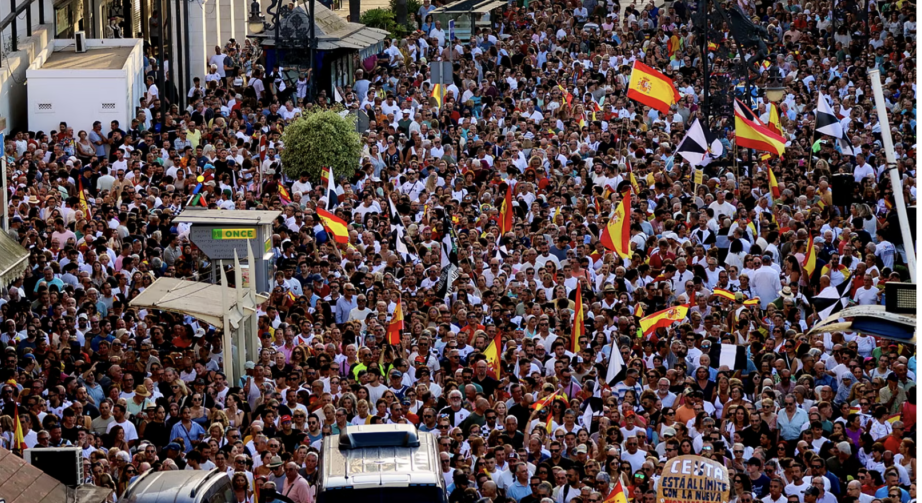
Thousands of Christians, Muslims, Jews and Hindus took to the streets of Ceuta on Sunday in a striking show of unity and Spanish identity. Following the mass arrival of migrants from Morocco, concern over border security has been accompanied by a growing sense that the city has been left to cope largely on its own. Prime Minister Pedro Sánchez’s decision to begin his summer holiday in Lanzarote shortly after the crisis erupted, while sharing music and cultural recommendations on social media, has added to the political anger. Meanwhile, renewed calls on Moroccan social media claiming Ceuta and Melilla for Morocco are fuelling further unease.
Spain Expat Press Editorial Team
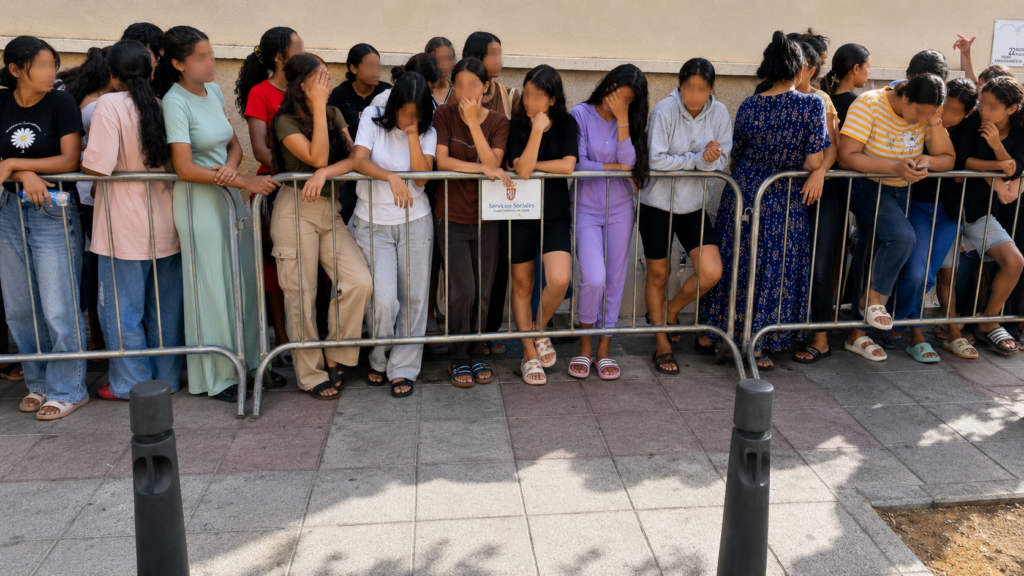
After days in which Ceuta appeared in the international headlines largely through images of crowds at the border, overstretched reception facilities and a heavy security presence, the Spanish city on the North African coast offered a very different picture on Sunday evening.
At 8pm, thousands of residents took to the streets. Among them were members of Ceuta’s Christian, Muslim, Jewish and Hindu communities, the four faiths that have shaped the city’s distinctive social fabric for generations.
Spain’s National Police estimated attendance at around 5,000, while organisers put the figure at more than 10,000. Whatever the precise number, the composition of the demonstration was significant. At a moment when a migration crisis could easily deepen religious and social tensions, representatives of all four communities stood together in defence of the city, peaceful coexistence and Ceuta’s place within Spain.
The demonstration was about more than sovereignty. Protesters called for tighter control of the border, additional resources for the security services and a rapid solution for the thousands of migrants who remain in the city. With a population of roughly 85,000 and an area of just 20 square kilometres, Ceuta argues that it cannot be expected to manage a crisis of this scale indefinitely without substantial help from Madrid and the European Union.
Anger increasingly directed at Madrid
Much of the political frustration on Sunday was aimed at Spain’s central government. Calls of “Pedro Sánchez, dimisión” — “Pedro Sánchez, resign” — could repeatedly be heard during the demonstration, reflecting the extent to which anxiety over the border has now become entangled with a wider political argument over Madrid’s handling of the crisis.
Many residents believe that the gravity of what has happened in Ceuta has not been felt with the same urgency in the Spanish capital. Their demands therefore go beyond additional police officers and stronger border controls. They want a more visible government presence and a clear strategy for dealing with any further attempt at a mass crossing.
Sánchez’s actions in the immediate aftermath of the crisis have added to that frustration. The Prime Minister began his summer holiday in Lanzarote at the beginning of August, staying with his family at La Mareta, the state residence on the island. At around the same time, he used social media to share his personal summer playlist and other cultural recommendations.
There is, of course, nothing inherently unusual about a prime minister taking a holiday or recommending music and books. The political problem has been one of timing and perception.
While Sánchez began his summer break, police officers, local authorities, charities and residents in Ceuta were still dealing directly with the consequences of the mass arrivals. Questions remained over the transfer of migrants to mainland Spain, the pressure on reception facilities and, above all, whether similar scenes might soon be repeated.
Against that background, the Prime Minister’s holiday and social-media posts acquired a significance far beyond a harmless playlist. For some in Ceuta, they reinforced an already deepening sense of political and emotional distance between the city and Madrid.
Sunday’s calls for Sánchez to resign showed how quickly that perception has turned into political anger.
Ceuta is also looking towards Morocco
While frustration is directed north towards Madrid, concern is simultaneously focused southwards, across the border with Morocco.
Relations with Rabat have long been among the most sensitive issues in Spanish foreign policy. For residents of Ceuta, however, Morocco is not an abstract diplomatic matter. The border lies only minutes from their homes, schools and businesses, and changes in security on the Moroccan side can have an immediate impact on everyday life.
There is also the longstanding sovereignty dispute. Spain considers Ceuta and Melilla integral parts of its national territory, while Morocco has historically laid claim to both cities.
Following the latest crisis, maps, videos and messages have again circulated on Moroccan and North African social media portraying Ceuta and Melilla as Moroccan territory or openly calling for their incorporation into the kingdom.
An important distinction must be made between such material and the official position or actions of the Moroccan government. A post circulating on social media does not in itself represent a statement by Rabat, and there is currently insufficient publicly available evidence to conclude that the Moroccan authorities organised the latest mass crossings.
Nevertheless, public concern in Ceuta cannot be separated from the experience of previous crises or from Morocco’s crucial role in controlling migration towards Spain’s southern borders. The question of whether migration can become a source of political leverage in the complicated relationship between Madrid and Rabat has therefore returned to the centre of the debate.
For residents of Ceuta, this is not simply a theoretical geopolitical question. They experience the consequences directly whenever thousands of people gather close to the border. Messages questioning Spanish sovereignty over Ceuta and Melilla inevitably carry greater weight when they appear against the backdrop of a major border crisis.
Fears that the crisis may not be over
The immediate security concerns have not disappeared. Calls are already circulating on social media for another attempt to reach Ceuta in large numbers on 15 August.
It is impossible at this stage to predict whether those calls will result in anything approaching the scale of the recent events. Their existence alone, however, is enough for the security services to take them seriously and for residents to remain uneasy.
The crisis has also demonstrated the growing influence of social media on migration routes. Information about possible crossing points, timings and perceived weaknesses in border controls can reach thousands of people within hours.
For a city as small as Ceuta, even the prospect of another large movement towards the frontier creates considerable logistical and security pressure.
That is why residents are increasingly looking not only to Madrid but also to Brussels.
Ceuta may be Spanish territory, but it also forms one of the European Union’s most unusual external frontiers: a European city on the African continent sharing a land border with Morocco.
A crisis on this scale is therefore not merely a local matter, nor even exclusively a Spanish one. It raises wider questions about European border security, migration policy and the EU’s relationship with Morocco.
Four faiths send a powerful message
Yet amid the anger and anxiety, perhaps the most significant feature of Sunday’s demonstration was the decision of Ceuta’s four main religious communities to stand together.
Christians, Muslims, Jews and Hindus joined the same march and explicitly rejected attempts to turn the migration crisis into a religious or ethnic confrontation.
That distinction matters particularly in Ceuta. A substantial proportion of the city’s Muslim population are Spanish citizens, and many families have lived there for generations. Equating migration with Islam would therefore not only misrepresent the reality of the crisis but alienate a significant part of Ceuta’s own Spanish population.
The manifesto read during the demonstration sought to combine two positions that are too often presented as incompatible. Organisers demanded effective border controls and greater security while at the same time insisting on humane treatment for migrants and rejecting hatred and social division.
The political significance of Sunday’s march lies partly in that balance. Demanding stronger borders does not necessarily mean rejecting migrants or Muslims, just as defending Spanish sovereignty over Ceuta need not be linked to any particular religion or ethnic background.
Ceuta’s identity is considerably more complicated — and more diverse — than that.
Ceuta wants to belong to Spain — and to feel protected by it
Sunday’s demonstration was ultimately about more than migration. It reflected a growing sense of vulnerability in a city geographically separated from mainland Spain and situated on one of Europe’s most politically sensitive borders.
On one side lies Morocco, whose relationship with Spain combines close economic and security cooperation with recurring diplomatic tensions. On the other is Madrid, from which many residents say they expected a more visible response during the past few days.
Between the two stands a population that deliberately chose unity on Sunday. Christians, Muslims, Jews and Hindus marched together, combining demands for security with a defence of the city’s cultural and religious diversity.
That may ultimately be the strongest message to emerge from Ceuta.
Its residents are not asking to choose between security and coexistence, between border control and humanitarian responsibility, or between cultural diversity and Spanish identity. They are demanding that all of these things remain possible at the same time.
After the events of recent days, their message is directed both across the border and towards the Spanish capital.
The people of Ceuta do not merely want to be told that their city is part of Spain. In moments of crisis, they want to feel that Spain stands behind them.