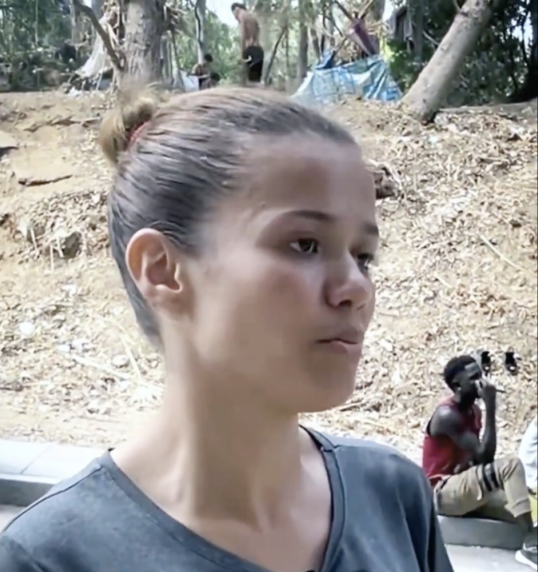
Wafae reached Ceuta by swimming across the sea and spoke of her desire for freedom and equality. Her story prompted enormous sympathy in Spain, with some people even offering to help her. But after her social media accounts came to public attention, the picture of her previous life appeared considerably more complex.
Spain Expat Press Editorial Team
Her story moved thousands of people across Spain.
A 28-year-old Moroccan woman swims to Ceuta and, after reaching Spanish territory, says she does not want to return to her home country. She speaks of freedom, equality and a desire to escape a life in which she felt restricted by family and social pressures.
Wafae Atid quickly became one of the most recognisable faces of the events unfolding on the border between Morocco and Ceuta.
The first reports prompted widespread sympathy. People praised her courage, expressed concern for her situation and, in some cases, even offered to help her personally.
It was a powerful and emotional story: a young woman apparently prepared to risk her life at sea in search of a freer existence.
Then Wafae’s own social media accounts came to public attention – and the picture became considerably more complicated.
🚨PROPAGANDA. Descubre la extraña historia de Wafae Atid. El País la presentó como una chica humilde que huía de una familia marroquí. De padres que no la dejaban estudiar ni viajar.
Pero sus redes mostraban algo muy distinto: viajes a Qatar, estudios en Dubái… salidas a… pic.twitter.com/xAIEVTt99h
— Capitán Bitcoin (@CapitanBitcoin) August 20, 2026
Travel, work and a more independent life
Wafae’s Instagram account shows her travelling to different countries, revealing another side of her life before she reached Ceuta.
Her posts show a young woman who travelled internationally, worked, was interested in fashion and documented significant parts of her life on social media.
For many people, this was difficult to reconcile with the impression they had formed from the initial reports.
It was not only the perception of a young woman in desperate financial circumstances that began to be questioned. The image of someone whose life had been entirely controlled by an oppressive family also appeared far less straightforward.
Wafae’s own posts show that her life before reaching Ceuta included international travel, work and a degree of personal mobility that many people had not expected after reading the first reports.
🇪🇸🇲🇦 | El País y otros medios españoles de izquierdas han difundido la historia de una joven musulmana, Wafae, que asegura haber sufrido malos tratos por parte de sus padres, por querer vivir al modo occidental, motivo por el que habría huido a Ceuta.
Sin embargo, las redes… pic.twitter.com/gjdXzF5YO3
— ʜᴇʀQʟᴇs (@herqles_es) August 20, 2026
Her explanations acquired a different emphasis
After her social media history attracted wider attention, another aspect of her story moved more clearly into focus:
Wafae just wants to live legally and permanently in Europe.
She has stated that she did not come to Spain because of economic hardship. She had worked and travelled internationally. At the same time, she spoke about wanting a permanent legal future in Europe.
Whether her individual circumstances meet the requirements for international protection is a matter for the relevant authorities to determine.
By then, however, the public conversation in Spain had already begun to change.
Sympathy turns to criticism
Reactions on social media have since become considerably harsher.
One recurring criticism is that Wafae appears to have enjoyed opportunities that many young Spaniards themselves cannot afford: international travel, stays abroad and a degree of personal mobility that is far from commonplace.
Some users have put it more bluntly, arguing that she appeared to have lived better than many young people in Spain.
Others have criticised what they perceive as an attempt to use a protection procedure to secure permanent residence in Europe when the underlying objective is to be able to live here legally. Some reactions have gone as far as describing such an approach as “indecent”.
These are public opinions, not conclusions about Wafae’s legal situation. Nevertheless, they illustrate how dramatically perceptions of her story have changed within a matter of days.
A case with consequences for others
This is where the wider significance of the story lies.
People arrive at Europe’s borders in profoundly different circumstances. Among them are women fleeing violence, people escaping political or religious persecution, unaccompanied minors and others who genuinely fear serious consequences if they are forced to return to their countries of origin.
Cases in which the initial public image later becomes considerably more complex as additional information emerges can have consequences far beyond the individual concerned.
They create mistrust. And that mistrust can quickly spread to other asylum seekers whose circumstances may be entirely different.
The danger is that people who genuinely need international protection then find themselves facing not only the challenge of demonstrating the persecution or danger they have experienced, but also a growing climate of public scepticism.
None of this proves whether Wafae did or did not experience family or social pressure. Her Instagram photographs cannot answer that question.
What her own social media accounts do show is that she had already travelled to several countries and that her life before arriving in Ceuta was more international and mobile than the initial public image suggested.
That distinction matters.
Because when highly publicised cases create doubt, the consequences may ultimately fall on the very people who genuinely depend on asylum: those fleeing persecution, violence or serious danger, whose circumstances deserve to be assessed fairly and without the additional burden of suspicion created by somebody else’s story.