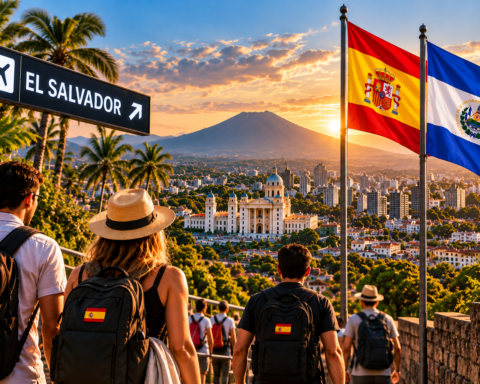
August may be Spain’s undisputed month of beaches and holidays, but September belongs to the fiestas. As the summer crowds begin to thin, towns and cities across the country prepare for grape harvests, centuries-old traditions, historical re-enactments and some of the most spectacular celebrations of the year.
Spain Expat Press Editorial Team
September in Spain is not so much the end of summer as the beginning of another season of celebration.
From the vineyards of Andalusia and La Rioja to the streets of Cartagena, the country offers foreign residents and visitors an opportunity to discover a Spain that has relatively little to do with sun loungers and beach bars.
And some of the traditions require a little explaining.
Jerez celebrates the grape harvest
In Jerez de la Frontera, September begins with the Fiestas de la Vendimia, a celebration of the grape harvest and of the city’s centuries-old relationship with sherry.
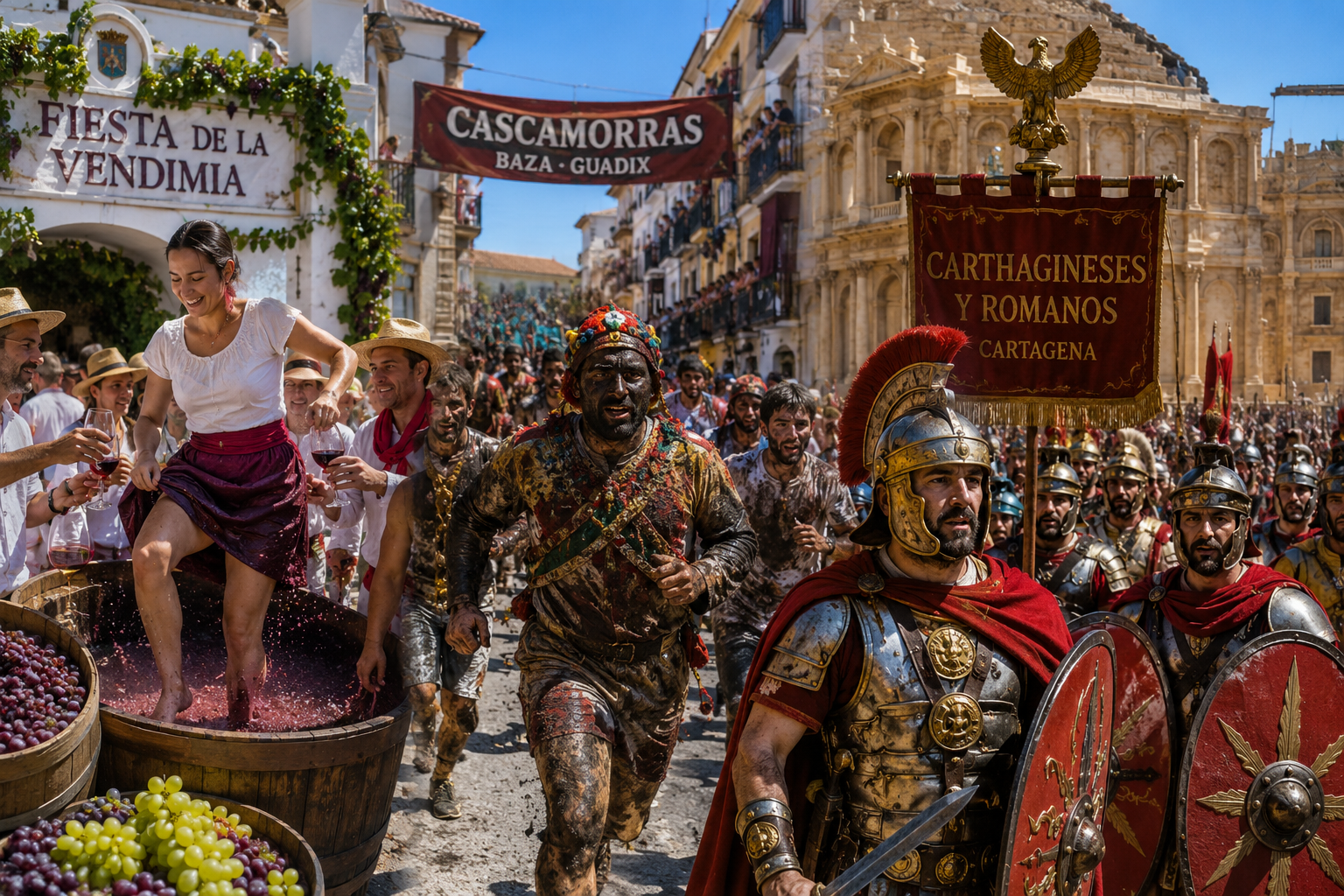
Wine tastings, gastronomy, music and cultural events take place across the city, but one of the most symbolic moments is the traditional Pisa de la Uva – the pressing of the first grapes of the harvest.
For anyone living in Andalusia, it is also one of the easiest ways to discover just how deeply wine remains connected to the region’s history and identity.
Nearby Montilla, in Córdoba province, holds its own harvest celebrations from 4 to 8 September, bringing together wine, flamenco, food and traditional grape pressing.
Cascamorras: Spain at its messiest
A few days later comes something entirely different.
Between Baza and Guadix, in Granada province, thousands of people take part in Cascamorras, one of Spain’s most extraordinary popular traditions.
The central character, Cascamorras, sets off on his mission surrounded by crowds who cover themselves – and inevitably him – in dark paint and oil.
The origins of the celebration stretch back centuries and are linked to a dispute between Baza and Guadix over an image of the Virgen de la Piedad.
Today, the result is an enormous, chaotic and spectacular street celebration.
Visitors expecting to remain clean would be well advised to reconsider.
¡Increíble lo que estamos viviendo en el #Cascamorras! 💚
Una fiesta que une a Baza y Guadix y que quiere (debería) ser Patrimonio de la Humanidad.
🎙 @DeliaPuerta lo ha vivido en primerísima primera persona@AytoBaza @Aytoguadix1 @canalsurgranada pic.twitter.com/FMd4o5Ghu5
— Andalucía Directo ❎ (@adirecto) September 6, 2024
Ten days of partying in Albacete
From 7 to 17 September, Albacete holds one of Spain’s great traditional ferias.
For 10 days, much of the city’s social life revolves around the fair, with concerts, food, entertainment, traditional events and celebrations continuing late into the night.
The heart of proceedings is the historic fairground, whose distinctive entrance becomes one of the city’s most recognisable images every September.
For outsiders, it offers an immersion in a very Spanish institution: the feria as a temporary city within a city.
Rioja raises a glass to the new harvest
Wine returns to centre stage later in the month in Logroño, capital of La Rioja.
The grape harvest festivities are among the highlights of the regional calendar, combining wine culture with food, music and street celebrations.
For wine lovers, September is arguably one of the best moments of the year to visit Rioja. Vineyards approach harvest time and the entire region seems to revolve around the arrival of the new grapes.
Cartagena goes back 2,000 years
Then there is Cartagena, where September takes a decidedly more martial turn.
From 18 to 27 September, Romans and Carthaginians reclaim the streets for the spectacular Carthagineses y Romanosfestivities.
Inspired by events surrounding the Second Punic War more than two millennia ago, the festival transforms the Mediterranean city with historical camps, elaborate costumes, processions and battle re-enactments.
Roman legionaries march through the streets, Carthaginian troops assemble and thousands of residents take part.
It may be historical re-enactment, but Cartagena takes it very seriously.
El día 20 de este mes darán comienzo las Fiestas de Cartagineses y Romanos en Cartagena. Hay que prepararse para diez días de pasión, orgullo, espectáculos, actos, eventos, historia viva, NUESTRA HISTORIA…
Fotografías Cartagineses y Romanos. pic.twitter.com/dwUmKKBnLY
— Turismo de Cartagena (@TuriCartagenaES) September 2, 2024
Cinema takes over San Sebastián
September’s celebrations are not confined to folk traditions.
From 18 to 26 September, San Sebastián hosts its International Film Festival, turning the elegant Basque seaside city into one of the centres of European cinema.
International actors, directors and filmmakers arrive for premieres and screenings, while the city’s hotels, restaurants and streets acquire a distinctly cinematic atmosphere.
It is a very different kind of September festival – but one of Spain’s most internationally recognised cultural events.
Barcelona celebrates La Mercè
Towards the end of the month comes one of Spain’s largest urban celebrations: La Mercè in Barcelona.
The Catalan capital fills with concerts, performances and traditional events in honour of its patron saint.
It is also an opportunity to encounter some of Catalonia’s most spectacular traditions, from castellers building extraordinary human towers to correfocs, in which fire-breathing dragons and groups of devils race through streets filled with sparks.
For the uninitiated, seeing people apparently running enthusiastically towards showers of fireworks can be slightly bewildering.
For Barcelona, it is simply La Mercè.
And that is only the beginning
Murcia, Salamanca, Valladolid, Villena and countless smaller Spanish towns also hold major celebrations during September.
There are wine festivals, patron saint festivities, Moros y Cristianos, concerts, historical celebrations and local ferias taking place across the country.
For foreigners living in Spain, they provide something that a summer spent beside the Mediterranean cannot quite offer: an introduction to the extraordinary variety of traditions that still define individual Spanish towns and regions.
So while August may belong to the beach, September belongs to the streets – preferably with a glass of local wine, a Roman legion somewhere in the distance and, in Baza at least, clothes you do not mind ruining.