They are writers, actors, musicians, intellectuals and former politicians. They do not form a political movement, nor do they necessarily share the same views. Yet a number of well-known figures who identify with the left, have voted Socialist for years or have longstanding ties to Spain’s progressive tradition are now voicing criticism of Pedro Sánchez, his government or the direction taken by the Spanish left more broadly.
Spain Expat Press Editorial Team
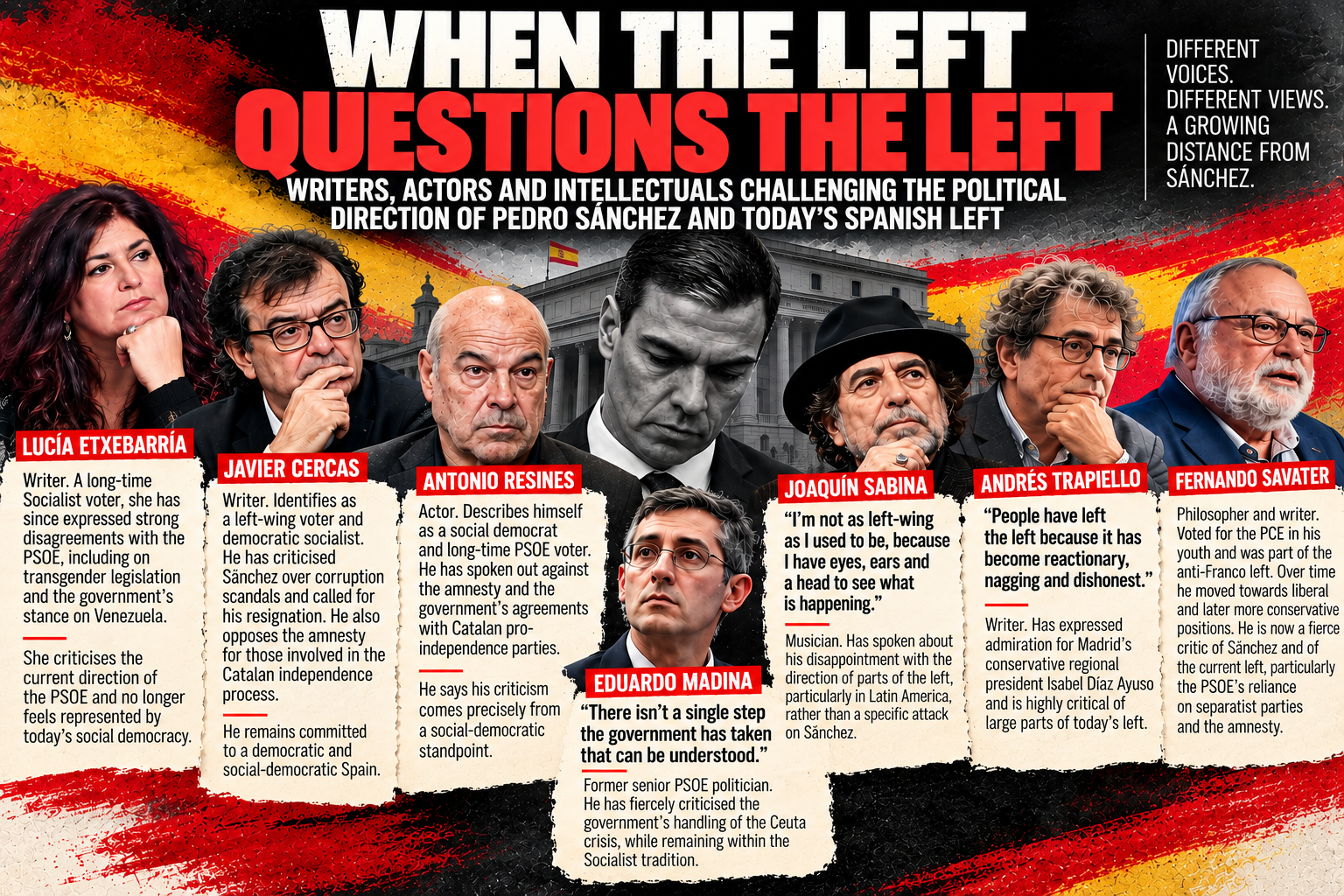
Lucía Etxebarría, Javier Cercas, Antonio Resines, Joaquín Sabina, Andrés Trapiello and Fernando Savater represent very different political journeys. Former senior Socialist politician Eduardo Madina offers another example from within the PSOE tradition itself.
Some still explicitly describe themselves as left-wing or social democratic. Others have moved considerably further away from the political world with which they were once associated.
It would therefore be misleading to portray them as a single anti-Sánchez camp. What is more interesting is the wider change their individual positions illustrate: the traditional affinity between much of Spain’s cultural establishment and the political left no longer necessarily translates into support for the Sánchez government.
Lucía Etxebarría: from Socialist voter to outspoken critic
Writer Lucía Etxebarría is one of the clearest examples of this political estrangement.
Her shift did not happen overnight. Etxebarría has said that she continued voting Socialist for years despite growing disagreements, and has cited issues including Spain’s transgender legislation and attitudes towards Venezuela as important points of rupture.
She has nevertheless continued to describe herself in progressive and feminist terms, while rejecting the idea that those labels belong exclusively to the parties of the contemporary left.
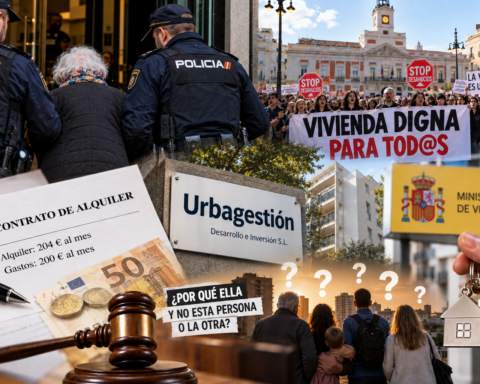
More recently, Etxebarría attracted considerable attention for her comments on the case of Maricarmen, the 87-year-old Madrid woman whose eviction has become a rallying point for Spain’s tenants’ movement.
Her interpretation was markedly different from that of Sánchez and campaigners who have presented the case as emblematic of Spain’s housing crisis.
Etxebarría therefore represents a relatively advanced process of political estrangement: someone who says she voted Socialist for years but who now openly challenges significant elements of the PSOE’s current political direction.
Javier Cercas: criticism from within the democratic left
The case of novelist Javier Cercas is rather different.
Cercas has publicly identified himself as a left-wing voter and democratic socialist. His criticism of Sánchez therefore does not amount to a rejection of the left itself.
That distinction is important.
Cercas has become increasingly critical of the government, particularly over scandals affecting the Socialists and the political response to them. He has also criticised attempts to portray controversies surrounding the government as the result of conspiracies and has expressed concern about attacks on journalists and prosecutors.
His position illustrates a central point in this debate: criticism of Pedro Sánchez does not necessarily mean abandoning the political left.
For Cercas, it is criticism articulated from within a continuing social-democratic outlook.
Antonio Resines: a Socialist voter who opposed the amnesty
Actor Antonio Resines offers another particularly interesting example.
Resines has described himself as a long-standing social democrat and PSOE voter. At the same time, he has made clear his unease over the government’s approach towards Catalan pro-independence parties.
He was particularly critical of the amnesty for those involved in the Catalan procés, having already expressed reservations over the earlier pardons. In an RTVE interview, he spoke about the issue specifically from the perspective of someone who regarded himself as a social democrat and Socialist voter.
His position therefore demonstrates something that can easily become lost in Spain’s increasingly polarised political debate: identifying as social democratic does not necessarily entail supporting every decision made by a Socialist-led government.
Resines has not turned his criticism into a political campaign. That is precisely what makes his case relevant: it is the criticism of a prominent cultural figure who has not abandoned his political self-identification, but no longer treats it as requiring automatic loyalty to the government.
Joaquín Sabina: ‘I’m not as left-wing as I used to be’
Perhaps the most symbolically significant name is Joaquín Sabina.
Few Spanish musicians of his generation have been as closely associated with the cultural world of the left.
Yet Sabina himself acknowledged a change in his political outlook in 2022, saying that he was “not as left-wing” as he had once been. His comments were principally about the failure of communism and his disappointment with the trajectory of parts of the Latin American left, rather than a specific attack on Pedro Sánchez.
That distinction matters.
Sabina should not simply be portrayed as a Sánchez opponent. His comments point instead to something broader: the changing relationship with the left of a cultural figure who had long been strongly identified with it.
Andrés Trapiello: a much deeper break
Writer Andrés Trapiello represents a considerably more pronounced political shift.
His position can no longer reasonably be described simply as criticism of Sánchez. Trapiello has become fundamentally critical of substantial parts of Spain’s contemporary left.
In an interview published in July 2026, he said he liked Madrid’s conservative regional president Isabel Díaz Ayuso and argued that people had left the left because, in his view, it had become “reactionary, nagging and dishonest”.
His trajectory therefore differs significantly from that of Cercas or Resines.
Where they retain an explicitly left-wing or social-democratic identity while criticising the government, Trapiello represents a much wider political and intellectual estrangement.
Fernando Savater: from the anti-Franco left to fierce criticism of Sánchez
The political evolution of philosopher and writer Fernando Savater goes further still.
Savater has a long political biography that began on the anti-Franco and libertarian left. His distancing from the contemporary Spanish left, however, began long before Pedro Sánchez became prime minister.
His opposition to Basque nationalism and ETA played an important role in that evolution, and over the years Savater moved increasingly towards liberal and subsequently more conservative positions.
He is now an outspoken critic of Sánchez’s political strategy, particularly the PSOE’s reliance on nationalist and separatist parties and the amnesty associated with the Catalan independence process.
Savater should therefore not be presented as a recently disillusioned Sánchez supporter. His political evolution has taken place over decades and represents something much broader: a journey from the anti-Franco left through liberal positions to a fundamental rejection of significant parts of Spain’s contemporary left.
Eduardo Madina: fierce criticism from within the Socialist tradition
Then there is Eduardo Madina, whose case is different again.
Madina is not a cultural figure but a former senior PSOE politician who challenged Pedro Sánchez for the party leadership in 2014.
His recent criticism is therefore particularly notable.
During the current crisis in Ceuta, Madina delivered an unusually severe assessment of the government’s handling of events, saying that he could not understand a single step it had taken. He nevertheless drew a distinction between the PSOE itself and the structure and actions of the current coalition government.
Madina also warned about the growth of xenophobic rhetoric and a broader shift towards the far right in Spain and Europe.
His case represents yet another strand of the same phenomenon: strong criticism of the Sánchez government from within the Socialist political tradition, without abandoning that tradition.
No common front — but a visible change
It would be inaccurate to place all these figures in the same political camp.
Etxebarría has increasingly distanced herself from the Socialist establishment after years of voting PSOE. Cercas continues to identify with democratic socialism. Resines describes himself as a social democrat while opposing important government decisions.
Sabina’s disillusionment concerns a much broader evolution of the international left. Trapiello has moved considerably further away. Savater’s break stretches back decades. Madina, meanwhile, remains rooted in the Socialist tradition while sharply criticising specific decisions by the present government.
There is no organised movement of these figures against Pedro Sánchez, nor do these individual examples establish a wholesale exodus of Spain’s cultural establishment from the left.
What they do show is that a number of prominent people with very different left-wing or social-democratic backgrounds are now willing to articulate their disagreements publicly — and sometimes forcefully.
Their reasons vary considerably: the amnesty and agreements with separatist parties, corruption scandals, the handling of institutional crises, social policy or, in Sabina’s case, a much broader disappointment with the direction taken by parts of the left.
Some have travelled a long way from their former political home.
Others have not left it at all.
What their different stories illustrate is that, in Spain today, a left-wing or social-democratic background does not necessarily translate into support for Pedro Sánchez and his government.