Eighty German cruise passengers gathering outside a traditional delicatessen in A Coruña may seem like an ordinary holiday scene. Yet the incident illustrates a growing concern across Spain: the impact of mass tourism on everyday life. Cruise tourism brings additional revenue, but it also places increasing pressure on city centres, local businesses and public spaces. The question of how many visitors a city can accommodate is no longer confined to Barcelona, Málaga or Mallorca.
Spain Expat Press Editorial Team
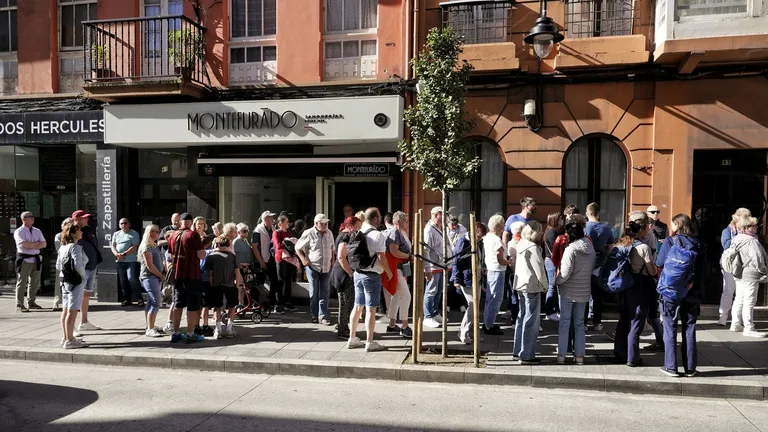
An unusual scene unfolded on Friday in Calle de la Torre, a street in the Galician city of A Coruña. Around 80 German tourists gathered outside Montefurado, a traditional delicatessen specialising in Spanish cured ham and regional products.
The visitors arrived in two groups of 40. While the first group filled the premises, the second was left waiting outside in the street.
According to the regional newspaper La Voz de Galicia, the tourists were passengers aboard the German cruise ship Mein Schiff 7, which had docked that day in Ferrol, approximately 50 kilometres away.
The incident illustrates how the effects of cruise tourism are increasingly being felt far beyond the ports where the ships themselves arrive.
When a Traditional Shop Becomes a Stop on the Cruise Itinerary
Montefurado has been part of A Coruña’s commercial life for almost 80 years. Today, the family-run business has also become a regular destination for organised cruise excursions.
Its third-generation owner, Óscar López, told La Voz de Galicia that approximately 4,000 cruise passengers visit the establishment every year.
Tour operators have arranged a set gastronomic experience with the business, offering visitors a selection of regional specialities, including Galician tuna empanada, chorizo from Celanova, local cheeses and Spanish cured ham.
For the shop, these organised visits provide an additional source of income. At the same time, they illustrate how traditional businesses are increasingly adapting their operations to accommodate large groups of international visitors.
A shop that once primarily served local customers is now, at certain times, a scheduled stop on international tourist itineraries.
Tourism Is Spreading Beyond the Ports
What makes the incident particularly noteworthy is that the German visitors had not even arrived by cruise ship in A Coruña itself.
The Mein Schiff 7 was docked in Ferrol, where it arrived alongside another cruise vessel. Together, the two ships brought more than 3,000 passengers to the port that Friday.
Some of those passengers were subsequently transported to nearby destinations on organised excursions.
The effects of cruise tourism are therefore no longer confined to the immediate surroundings of the ports. Neighbouring cities, historic districts and traditional shopping streets are increasingly incorporated into excursion programmes.
For local authorities, this can mean sudden concentrations of visitors in particular streets, attractions and restaurants, often within the space of just a few hours.
For Local Residents, Even Everyday Errands Can Become an Ordeal
For business owners, the arrival of large tourist groups can be financially attractive. Restaurants, cafés and retailers benefit from additional customers, particularly outside the traditional holiday season.
For residents, however, the situation raises a rather different question: what happens when the city in which they live increasingly becomes a destination for organised tourist excursions?
For ordinary people, the growth of tourism can mean one thing above all: everyday life becomes more complicated.
Someone hoping to shop at their usual delicatessen may suddenly find the entire premises occupied by a tour group. A quick purchase becomes an exercise in patience, or has to be postponed altogether.
On their way to work, the supermarket or a medical appointment, residents may find themselves navigating crowds, stepping around groups gathered on pavements and allowing extra time for traffic delays.
What represents a leisurely excursion for holidaymakers can become a recurring inconvenience for those who live in the city.
Shopping takes longer, streets become busier and even the simplest errands demand more time and patience. Sometimes the only options are to take a different route, return later or simply put up with the disruption.
There is another concern. As businesses increasingly cater for large tourist groups, their products and services may begin to change.
Traditional shops that once primarily served the local community can gradually become more focused on the preferences and spending habits of international visitors.
There is no evidence that the particular gathering outside Montefurado prompted complaints from residents. Nevertheless, the scene highlights a broader tension between the commercial benefits of tourism and the practical needs of the people who live and work in a city.
The economic contribution of tourism is undeniable. Yet the everyday inconveniences are often borne by those who remain long after the visitors have departed.
How Much Money Actually Stays in the City?
Another contentious issue is the real economic contribution of cruise tourism.
Cruise ships can bring thousands of passengers to a region within a matter of hours. Yet many travellers have already paid for full-board accommodation and spend relatively little time ashore.
In A Coruña, this has prompted questions about how much of the money generated by cruise tourism actually reaches local businesses.
Local tour guide Iria Prendes raised the issue in a report by Spanish radio station Cadena SER earlier this year, arguing that the economic benefits of large cruise ships should be assessed more carefully.
While certain shops and hospitality businesses undoubtedly benefit from visiting passengers, a substantial proportion of holiday spending remains with the cruise operators themselves.
Local restaurateurs have also pointed out that many cruise passengers spend relatively modest amounts on drinks or snacks, while restaurants offering full meals do not necessarily enjoy the same level of business.
Visitor numbers alone, therefore, provide only a partial picture of the economic value that cruise tourism brings to a destination.
A Coruña Has Already Introduced a Tourist Tax
The Galician city has also responded to growing visitor numbers through taxation.
Since introducing a municipal tourist levy, A Coruña has generated additional revenue from overnight stays and cruise ship visits.
According to figures released by the city council, the tax raised approximately €1.04 million during the first six months of 2026, of which around €215,000 came from cruise tourism.
The revenue is intended to help fund services including street cleaning, public safety, lighting and the maintenance of public spaces.
The local authority considers the measure a success and has pointed to continued growth in visitor numbers.
However, a tourist tax does not necessarily resolve the wider consequences of increasing tourism.
Even when visitors contribute financially, crowded pavements, additional traffic and the temporary loss of access to certain shops remain problems that cannot be addressed through taxation alone.
No Longer Just a Problem for Spain’s Major Tourist Destinations
For years, the debate surrounding overtourism in Spain has centred largely on Barcelona, the Balearic Islands, the Canary Islands and the Costa del Sol.
Increasingly, however, attention is turning to cities and regions that have traditionally been less associated with excessive visitor numbers.
Galicia benefits from its distinctive cuisine, cultural heritage and growing international appeal. Yet this popularity also creates new challenges for urban planning, transport and the management of public spaces.
The gathering outside Montefurado does not, in itself, prove that A Coruña is suffering from overtourism. It does, however, demonstrate how organised groups can transform the atmosphere of an ordinary shopping street in a matter of minutes.
Nor is the issue the nationality of the visitors. Whether cruise passengers are German, British or American, the underlying concern is the concentration of large groups in places that must continue to function as residential and commercial neighbourhoods.
The challenge facing Spanish cities is to benefit economically from tourism without allowing everyday life to become increasingly dictated by cruise ship schedules.
A city, after all, is not merely a holiday destination. It is first and foremost a place where people live.
For tourists, it is a holiday experience lasting a few hours. For residents, it is everyday life – and that cannot simply be postponed until another day.