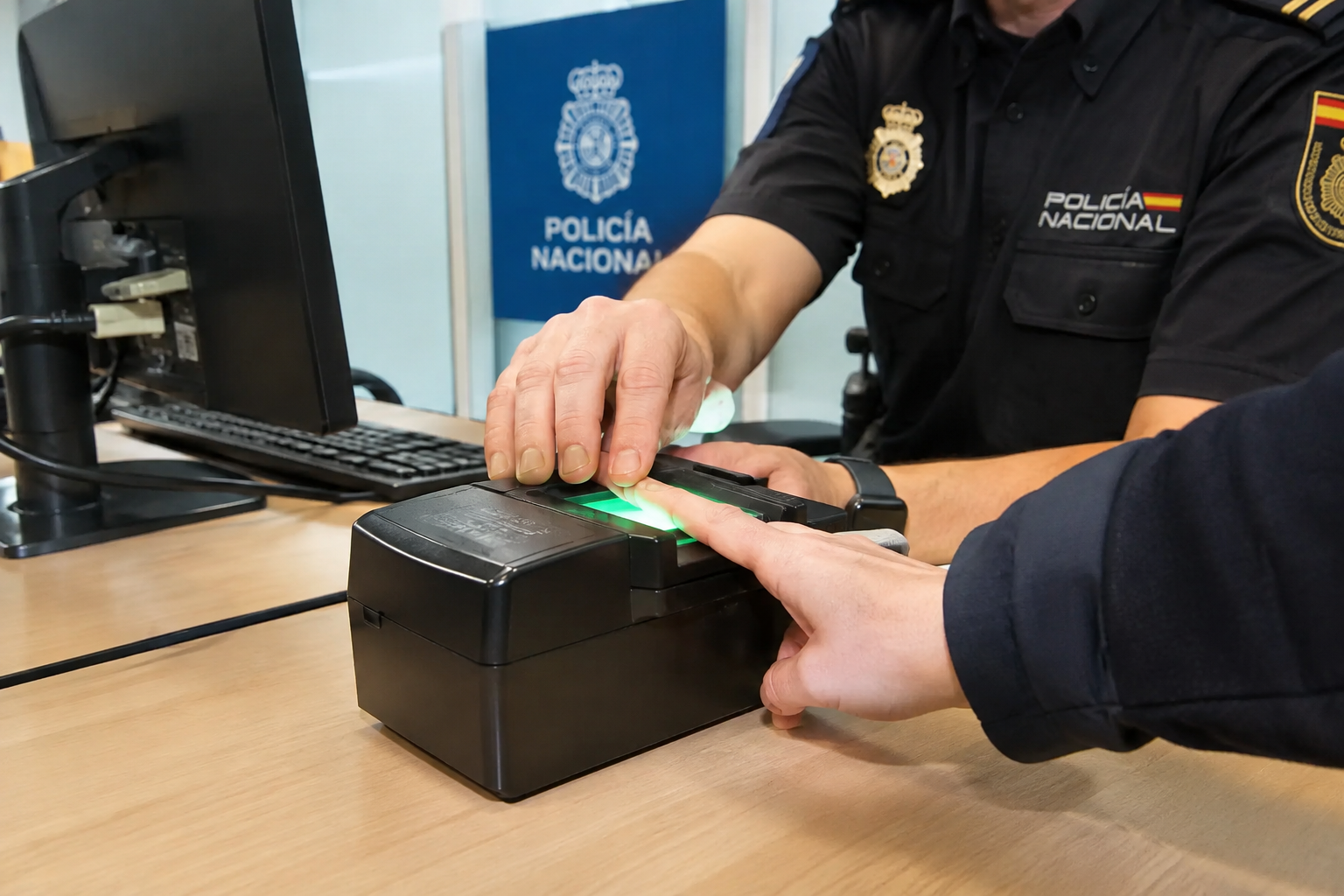
The Spanish National Police is expanding a pilot project for the automated scheduling of appointments for residence cards. The initiative covers locations including Málaga, Alicante, Barcelona, Murcia, and Valencia. However, initially, only selected applicants will benefit from the new system.
Spain Expat Press Editorial Team
by Marlon Gallego Bosbach
The Spanish National Police is introducing a new procedure to reduce long waiting times when applying for residence cards. In several regions of Spain, appointments for fingerprinting will henceforth be assigned automatically. This measure aims to make it easier for foreign residents to secure an appointment for their so-called TIE card.
The pilot project has been extended to other key provinces, including Alicante, Barcelona, Málaga, Murcia, and Valencia. This measure is part of efforts to address the growing backlog in the processing of residence documents.
Automated appointments are intended to reduce waiting times
To date, applicants generally have to find an available appointment for fingerprinting themselves via the authorities’ online portal. This can prove difficult, particularly in larger cities. High demand, limited staffing capacity, and technical issues with appointment booking have led to significant delays in recent months.
The new procedure is intended to simplify this process. Instead of waiting for affected individuals to find an available appointment themselves, the police automatically assign an appointment to selected applicants. The relevant information is sent via SMS and email.
The pilot project was initially tested in the Catalan provinces of Girona, Tarragona, and Lleida. Since October 9, 2026, it has been expanded to additional regions. With the extension to Alicante, Barcelona, Málaga, Murcia, and Valencia, other areas with high demand are now set to benefit as well.
However, a nationwide rollout has not yet been confirmed. The authorities intend to first gather experience with the process and assess the extent to which it helps alleviate the burden on the appointment scheduling system.
Only a portion of the applicants benefit
The automated appointment scheduling system does not initially apply to everyone applying for a TIE card; for the time being, only around ten percent of the relevant cases are included in the pilot project. Those selected for the process receive their appointment details automatically, while other applicants must continue to use the standard online portal.
Affected individuals should also remain vigilant while waiting for a notification. If no automated appointment is received within 20 days of the notice regarding the processing of the application, they must schedule an appointment themselves using the standard booking system.
In the event of technical difficulties with the platform, the police refer users to the responsible user service center. According to the report, local police stations cannot directly resolve issues related to online appointment scheduling.
These regions have not been included so far
The current expansion covers several major metropolitan areas and important coastal regions. Nevertheless, the system is not yet available nationwide.
The Balearic and Canary Islands, as well as the mainland provinces of Almería and Cádiz, are not among the newly included areas so far. Anyone needing to apply for a TIE card there should therefore continue to use the existing appointment scheduling system.
Whether and when further provinces will be added depends on the further development of the pilot project. No firm deadline for the nationwide rollout was announced.
What is the TIE card?
The Tarjeta de Identidad de Extranjero (TIE) is a Spanish identity document for certain foreign nationals holding the corresponding residence status. The card contains, among other things, personal details and biometric data, and serves as proof of the holder’s residence status.
To have the card issued, applicants generally need to make an appointment with the police following the decision regarding their stay. During this appointment, fingerprints are recorded, among other things. The card can then be issued.
The TIE is particularly relevant for non-EU nationals living in Spain. Many British residents also require it due to the regulations in force since Brexit. However, the specific documents required depend on the individual’s residency status.
High demand places a strain on the authorities
Automated appointment scheduling is part of a broader challenge facing the Spanish authorities. A plan of action aimed at reducing the backlog in the processing of residence cards was announced as early as August.
The measures announced at the time included additional staff, extended opening hours, and operations on afternoons and Saturdays. In addition, the automatic scheduling of appointments was already planned as a pilot measure in many provinces.
A key factor driving the increased demand is the high number of new residence applications. Nearly 1.2 million applications have been submitted in connection with the Spanish regularization process. Many successful applications subsequently necessitate the issuance of a TIE card. At the same time, numerous foreign nationals already living in Spain are due to renew their residence documents.
The automated appointment scheduling system is therefore intended not only to facilitate access to available appointments but also to better organize the work of the responsible authorities.
No guarantee of shorter waiting times yet
It is not yet possible to conclusively determine whether the new system will actually significantly reduce waiting times. Since only a limited proportion of cases are initially being assigned automatically, many applicants must continue to search for available appointments themselves.
For foreign residents in the newly incorporated provinces, it is therefore worth keeping an eye on both text messages and emails. Anyone who does not receive an automatic notification should not assume that an appointment has already been scheduled.
Expanding the pilot project is another attempt to alleviate the difficulties surrounding the scheduling of TIE appointments. Whether this develops into a permanent, nationwide procedure depends on how successfully the authorities evaluate the new method in practice.