Almost a month after thousands of young Spaniards occupied one of Madrid’s most famous squares to demand affordable housing, the protest has taken a markedly different turn. Many of the original demonstrators have gone home, the tenants’ union that helped launch the movement has withdrawn from running the camp, and growing concerns over sanitation, security and homelessness are overshadowing its original political message.
Spain Expat Press Editorial Team
It began as a demonstration of frustration among a generation increasingly priced out of Spain’s housing market. Now, almost four weeks later, Madrid’s Puerta del Sol has become the setting for a rather different debate: not simply whether people have the right to affordable housing, but how long a protest camp can remain in one of the capital’s busiest public spaces as conditions deteriorate.
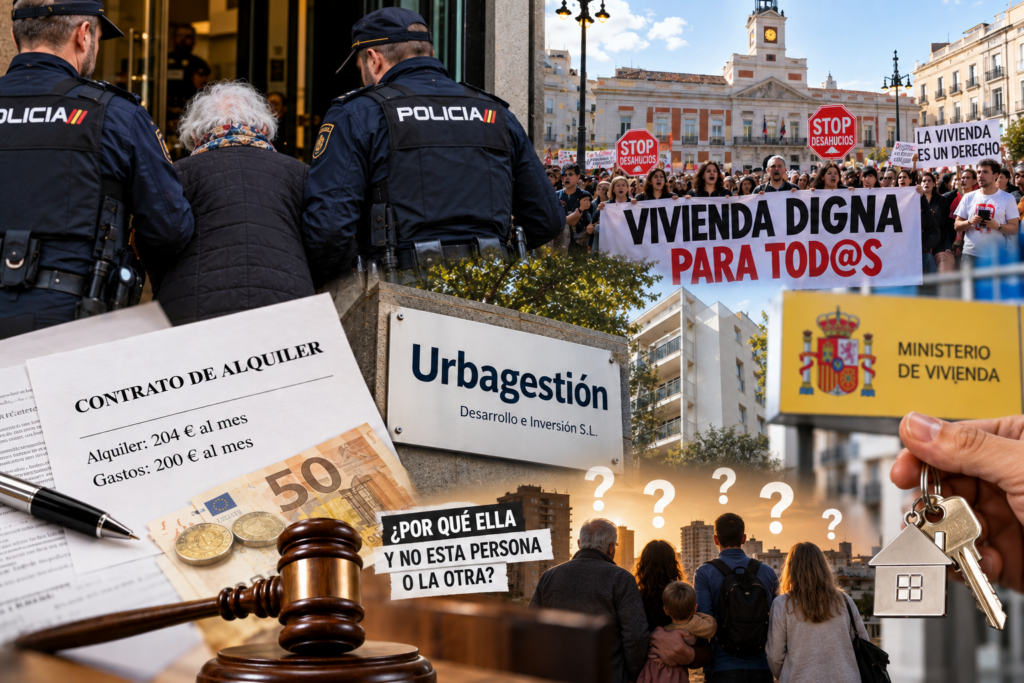
The occupation, which began on 26 September following protests against the eviction of an elderly woman known as Maricarmen, is approaching a symbolic milestone. This weekend, the camp is expected to match the 28 nights spent in the square by the Indignados, the anti-austerity movement that emerged on 15 May 2011 and went on to reshape Spanish politics.
Yet the similarities between the two movements are becoming increasingly difficult to sustain.
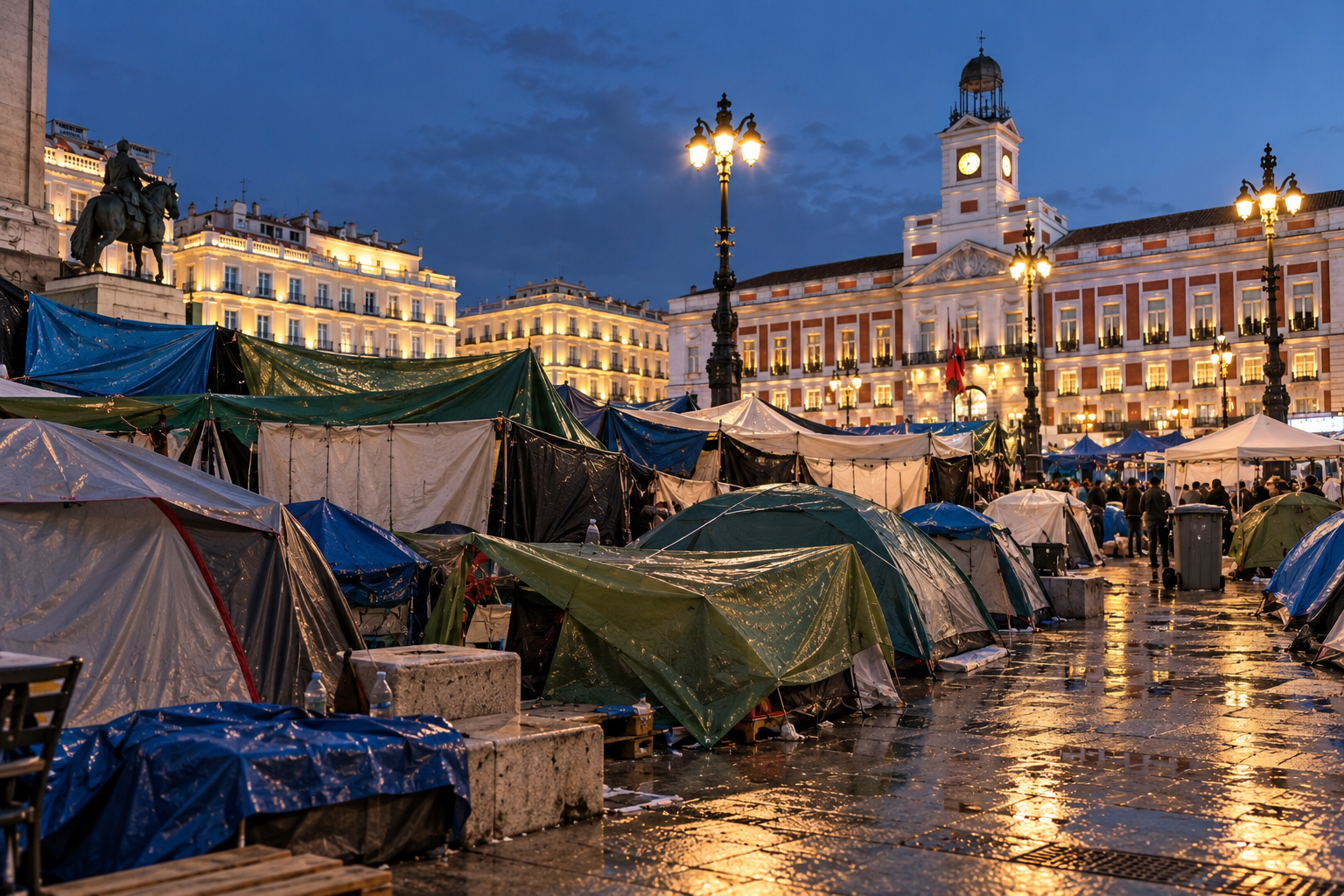
Where the early days of the latest occupation were characterised by crowds of students, young workers and campaigners demanding action on soaring rents, the square is now dominated by a sprawling collection of tents, tarpaulins and makeshift shelters.
The once-open camp has become increasingly enclosed, with plastic sheeting shielding its interior from public view. Organisers say the barriers are necessary to protect residents from worsening weather and external attacks. Critics argue that the encampment has lost much of its original purpose.
From political protest to concerns over sanitation
The physical condition of the camp has become one of the most contentious aspects of the occupation.
Complaints about rubbish, poor hygiene and unpleasant smells, including reports of urine odours, have intensified scrutiny of the makeshift settlement in the heart of the Spanish capital.
Madrid’s regional government has cited technical findings of substances consistent with the decomposition of urine in ventilation facilities at Sol metro station. The station was temporarily closed for cleaning, although the decision and the circumstances surrounding it were disputed.
The allegations have fuelled a wider argument about public health, the management of shared urban spaces and the responsibilities of authorities towards those occupying them.
Rain, strong winds and falling temperatures have added to the difficulties faced by those remaining in the square.
Large sheets of plastic now cover sections of the camp, creating a maze of narrow passageways between tents. What began as a highly visible demonstration has gradually become a more enclosed and less accessible settlement.
Organisers insist that these changes are primarily about safety. They say residents have faced hostility, intimidation and attacks, including attempts to set fire to parts of the encampment.
Nevertheless, the increasingly improvised appearance of the site has become a powerful symbol of the movement’s uncertain direction.
The tenants’ union has stepped away
Perhaps the most significant change is the departure of the organisation that helped turn the initial demonstrations into a nationwide political issue.
The Madrid tenants’ union, Sindicato de Inquilinas, played a central role in mobilising protesters following the controversial eviction of Maricarmen, whose case became a rallying point for campaigners demanding stronger protections for tenants.
But on 2 October, barely a week after the occupation began, the union announced that it was leaving the camp to concentrate on neighbourhood organising and preparations for a general strike scheduled for 11 November.
The decision came as housing measures introduced by the government failed to secure parliamentary approval.
Although union representatives have continued to defend the wider protest publicly, the organisation has not resumed responsibility for the day-to-day running of the encampment.
Its departure left a collection of activists, student groups and other participants attempting to maintain the movement through a decentralised structure of assemblies, committees and smaller neighbourhood-style sections within the camp.
The arrangement has allowed the occupation to continue, but it has also raised questions about leadership, accountability and the movement’s longer-term objectives.
Young protesters leave as homeless people move in
The most striking transformation, however, concerns the people now living in the square.
During the first week, organisers claimed that as many as 4,000 people were sleeping in approximately 1,000 tents.
Those numbers have since fallen sharply.
Many of the young demonstrators who initially spent their nights in Sol have returned home, citing exhaustion, illness, worsening weather and the demands of everyday life.
In one section of the camp, where up to 150 people reportedly slept during the opening days, the number has dwindled to around 30, according to reporting by the Spanish newspaper 20minutos.
But the empty tents have not necessarily remained unoccupied.
Increasing numbers of people experiencing homelessness, including migrants without accommodation and individuals struggling with addiction, have moved into the settlement.
Camp organisers acknowledge that the changing population initially created serious tensions, with some participants fearing that the situation was becoming unmanageable.
At one point, an early withdrawal from the square was reportedly considered.
Organisers now say that conditions have improved after efforts to involve the new residents in the daily running of the camp. Some help with cleaning, maintenance and security, while volunteers and social workers have sought to address conflicts.
Those remaining insist that the camp is providing an essential service to vulnerable people who were already living on Madrid’s streets before the protests began.
Some residents, they say, are now receiving regular meals and a degree of support that they previously lacked.
It is an argument that highlights an uncomfortable contradiction at the heart of the occupation.
A movement established to protest against the impossibility of securing affordable housing has, in part, become a refuge for people who have no housing at all.
Madrid’s mayor questions how many protesters remain
The changing nature of the camp has prompted increasingly pointed criticism from Madrid’s city authorities.
The mayor, José Luis Martínez-Almeida, has suggested that there may now be more tents than people actually sleeping in them.
He has called for a census of those occupying the square, arguing that the authorities need a clearer understanding of the situation.
Camp organisers have rejected the proposal, questioning its legality and insisting that the authorities should engage with their assemblies rather than impose measures from outside.
The police union Jupol has gone further, claiming that the occupation bears little resemblance to the original housing protest.
Its representatives allege that many participants leave the camp at night and that violent groups have gained influence within the settlement.
The union has also raised concerns about security and policing arrangements.
Organisers strongly deny that extremist or terrorist groups control the camp and reject suggestions that violence is representative of the movement.
They argue that such allegations are intended to discredit a legitimate campaign for social rights.
The competing accounts have turned the occupation into a broader political dispute over policing, public order and the limits of protest in shared public spaces.
A housing crisis that has not disappeared
For all the controversy surrounding the camp, the underlying issue that brought protesters to Sol remains unresolved.
Spain continues to face a severe housing shortage in many of its major cities and coastal regions.
In Madrid and Barcelona, as well as in popular destinations along the Mediterranean coast, rising rents and property prices have placed home ownership and independent living increasingly beyond the reach of younger generations.
The difficulties are not confined to those on low incomes. Even people in full-time employment can struggle to find accommodation that does not consume an unsustainable proportion of their salaries.
The original protesters sought to draw attention to precisely this imbalance.
Their demands for stronger tenant protections, more affordable housing and government intervention reflected a frustration that extends well beyond the capital.
Yet the longer the occupation continues, the greater the risk that its political message will be eclipsed by the problems of maintaining the camp itself.
Public discussion is increasingly focused not on rents or housing policy, but on sanitation, abandoned tents, security and the growing number of homeless residents.
For a movement that began by demanding urgent political action, the shift in attention presents a considerable challenge.
Until the general strike, the election – or New Year’s Eve?
After almost a month in the square, the question of when to leave has become increasingly pressing.
Some participants favour remaining until the general strike planned for 11 November. Others would prefer to continue until the general election scheduled for 29 November.
A few have even suggested staying until New Year’s Eve, when thousands traditionally gather in Puerta del Sol to celebrate the arrival of the new year.
Organisers acknowledge that fatigue is taking its toll and that preparations for an eventual withdrawal are under discussion.
They hope to conclude the occupation with a public event that would symbolically return attention to the housing crisis and the demands that brought the movement together.
Whether such an ending can restore its original momentum remains uncertain.
The contrast with the 15-M movement is difficult to ignore.
Fifteen years ago, the occupation of Puerta del Sol became the starting point for a political awakening whose consequences were felt across Spain for years afterwards.
The latest camp may soon equal its predecessor’s duration, but its legacy is far less clear.
The tenants’ union that helped initiate the protests is no longer running the occupation. Many of the young demonstrators have departed. Those who remain are increasingly confronted with the practical realities of supporting vulnerable people in a makeshift settlement.
The result is a movement caught between two very different purposes: campaigning for structural change in Spain’s housing market and providing immediate shelter for people who have nowhere else to go.
The housing crisis that brought protesters to Puerta del Sol has not gone away. But unless the movement can reclaim its original political focus, there is a growing risk that this occupation will be remembered less for the demands it made than for the deteriorating conditions in which it ended.