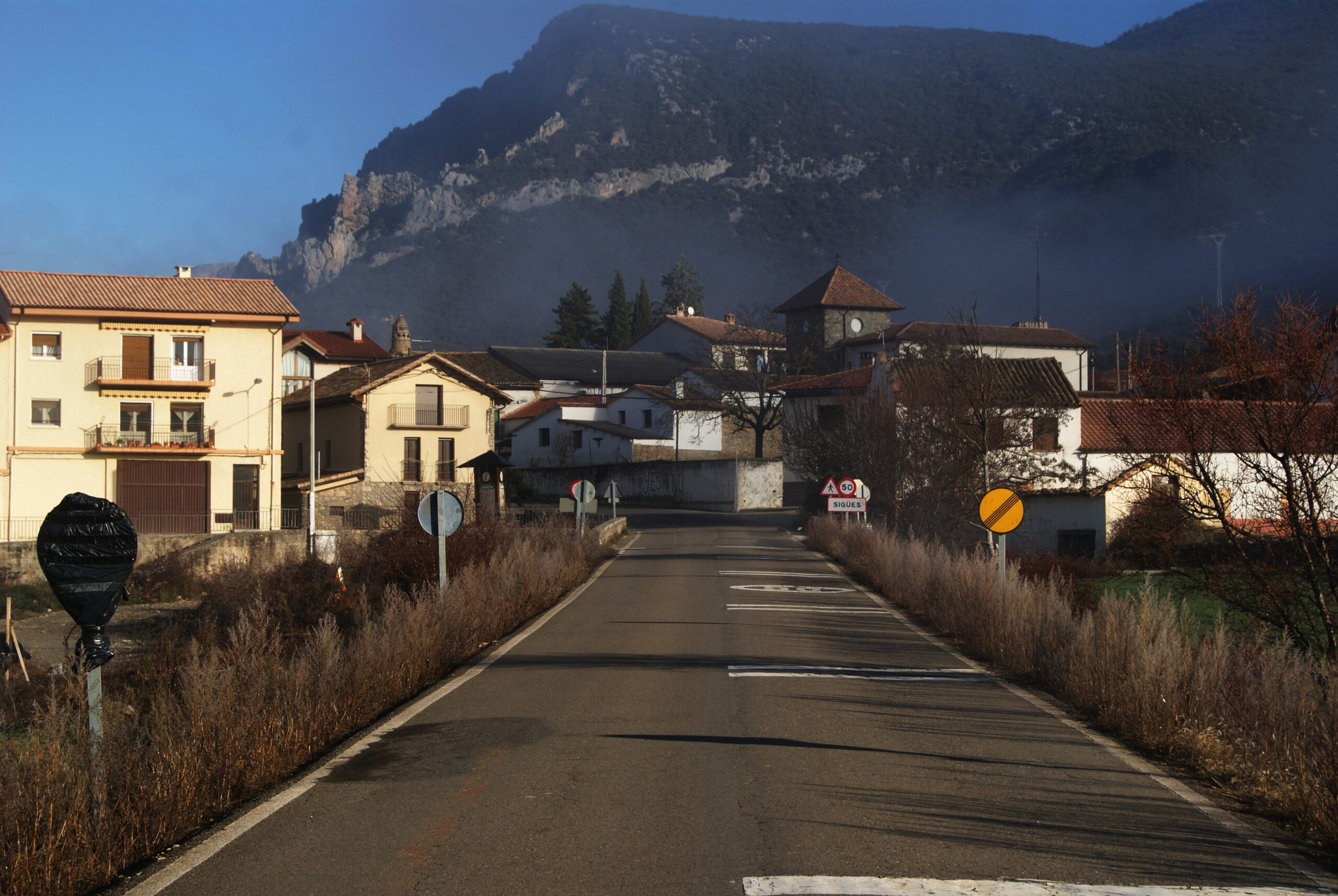
Since 1977, the party that tops the vote in Sigüés, in the province of Zaragoza, has also topped the vote across Spain. Thirteen days before the general election on 29 November, the question is a different one: do you need to wait until the end of election night – or is a glance at this corner of the Aragonese Pyrenees enough?
Spain Expat Press Editorial Team
A tiny village with a reputation as an oracle
Sigüés is a municipality in the La Jacetania district of Zaragoza province, on the banks of the river Esca and close to the Yesa reservoir. It has around 72 inhabitants, 66 of whom are eligible to vote – and some of those do not live there all year round.
Yet at every general election, its name turns up in the papers. The reason is as simple as it is remarkable: since the first elections of the democratic era in 1977, whoever wins in Sigüés wins in Spain. It happened with Adolfo Suárez and the UCD, and again with Felipe González, José María Aznar, José Luis Rodríguez Zapatero, Mariano Rajoy, Pedro Sánchez and, in 2023, Alberto Núñez Feijóo.
Sigüés is not alone: 27 other towns and villages in Spain share the same record. But it is the smallest of them all – and that has made it the most famous.
Almost half a century of getting it right
The numbers tell two stories. The first is of a village emptying out: in 1977 the UCD won with 104 votes; in 2023, 21 were enough for the PP. The second is that the compass comes with a small asterisk: in 2011, when Rajoy won nationally, Sigüés produced an exact tie between the PP and the PSOE, with 31 votes apiece.
At the last general election, in July 2023, the PP took 21 votes, the PSOE 16, Sumar 5, Vox 4 and the Partido Aragonés 3. Fifty people voted, a turnout of 75.8 per cent.
Coincidence or barometer?
Experts urge caution. With so few voters, it only takes one or two people to change their minds for the percentages to swing wildly, so Sigüés cannot be treated as a reliable predictor. It is, rather, a statistical curiosity that has held for almost fifty years.
It is also worth remembering that winning the most votes does not always mean governing. In 2023 the PP was the largest party, but it was Pedro Sánchez who secured investiture as prime minister, thanks to the backing of other parties in Congress.
Ahead of 29 November, residents are speaking frankly. In a report by El País, several admit they cannot remember which party runs the town hall. Some former Socialist voters say they are disillusioned: one plans to spoil his ballot, while others are thinking of switching. A woman who votes in Madrid says she will not risk a protest vote this time. As in the rest of the country, there is no single mood in Sigüés.
What do the polls in Sigüés say today?
There is no formal poll for the village, but there are the voices El País gathered on the ground. One former PSOE voter says he is more disappointed than angry and will spoil his ballot. Another man who has voted PSOE says he will vote for change, possibly for Vox, and blames Sánchez for the country’s problems. A woman who used to vote PSOE now leans towards a party further to the right, while another, who votes in Madrid, does not want to risk a protest vote. From these conversations, El País draws a clear conclusion: on 29 November the right will win in Sigüés, and within the right, the PP. It is, however, a reporter’s reading after a handful of interviews – not a poll, and not a result.
Life in Sigüés, beyond the ballot box
Behind the electoral fame lies a village fighting depopulation. Sigüés has lost around 90 per cent of its inhabitants in a century. Several neighbouring villages were abandoned or disappeared beneath the waters of the Yesa reservoir; some, such as Tiermas and Escó, are now part of its municipal area.
Daily life has its challenges. Children travel to school by taxi, to Salvatierra or Berdún. The doctor holds surgery twice a week, and an ambulance can take between 20 and 40 minutes to arrive. A mobile shop calls on Tuesdays, and many residents do their shopping in Jaca, Sangüesa or Pamplona, or order online. Since 2024, the La Fragua bar has been the village’s meeting point.
The mayor, Eduardo Abadía Mainer, 43, has led the council since 2015 for Ciudadanos-Tú Aragón and works in road maintenance. He told El País he would rather get things done than waste time in meetings.
Worth a visit
Politics aside, Sigüés is a village with plenty of charm. Its parish church of San Esteban has been declared a Site of Cultural Interest (Bien de Interés Cultural). Its streets are home to the tower of the Pomar family, the village’s former lords, and the old pilgrims’ hospital of Santa Ana – a reminder that the Aragonese branch of the Camino de Santiago passes this way.
The setting is spectacular: the municipality stretches from the Sierra de Leyre and Peña Orba down to the banks of the river Aragón and the Yesa reservoir. The Monastery of Leyre is close by, and the ruins of Escó, clinging to a hillside beneath its old castle, are an arresting sight.
Why wait until the end of election night?
Here is the crux. Sigüés has only 66 voters, so its count is over in a matter of minutes. While the big cities are still counting ballots, the Sigüés result may already be on the Ministry of the Interior’s website, which publishes the provisional count that same night, municipality by municipality.
In other words: if tradition holds, there will be no need to stay up into the small hours to find out which party has won the most votes in Spain. It will be enough to look up a village of 72 people in La Jacetania. If Sigüés gets it right again, it will have given away the outcome of election night hours before anyone else.
There are, however, two caveats. First, the compass points to the party with the most votes, not to the one that will end up governing – that depends on alliances in Congress. Second, with so few votes, a single ballot could end a run of almost half a century. That is why, on Sunday 29 November, half of Spain will be watching Sigüés. If it gets it right, it will add another chapter to its legend. If not, it will remain what it has always been: a beautiful corner of the Pyrenees that, every few years, becomes the centre of Spanish politics for a few hours.