What began as a migration emergency in Ceuta has, within days, developed into an unusually bitter dispute between two of the European Union’s largest member states. Italy imposed checks on travellers arriving from Spain; Madrid responded in kind. The Italian press is now speaking of an “all-out clash”. Brussels, increasingly concerned about the implications for Schengen, is trying to bring the temperature down.
Spain Expat Press Editorial Team
What began on Spain’s border with Morocco has travelled remarkably quickly to the heart of Europe.
Spain and Italy – two major EU states, Mediterranean neighbours and supposed partners in managing Europe’s migration challenge – are now carrying out reciprocal checks on passengers arriving by air and sea.
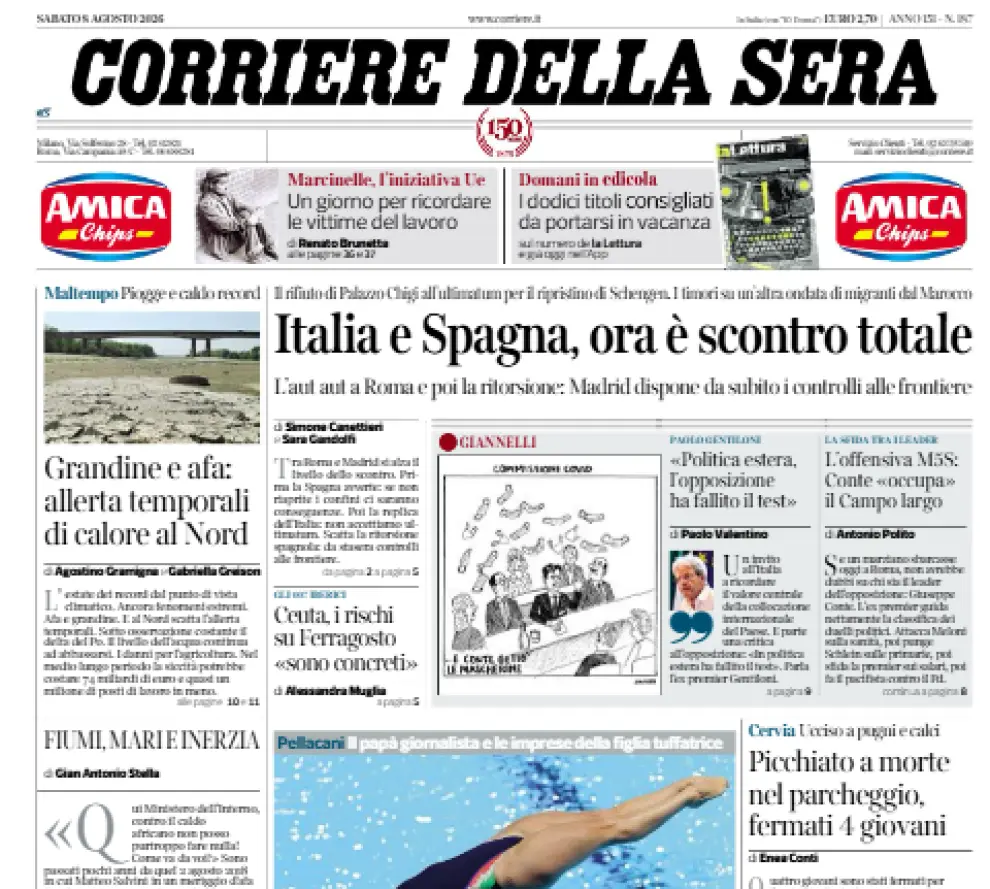
Italy’s Corriere della Sera has described relations between the two countries as an “all-out clash”. La Repubblica speaks of a crisis between Rome and Madrid, while the Italian news agency ANSA has portrayed the confrontation as a political stand-off in which neither side appears willing to give ground.
Brussels has now stepped in.
At stake is more than an inconvenience for holidaymakers travelling between two of Europe’s most popular summer destinations. The dispute touches one of the foundations on which the Schengen area depends: trust between its members.
It began in Ceuta
The immediate cause of the confrontation was the extraordinary migration crisis that unfolded in late July in Ceuta, Spain’s enclave on the North African coast.
Tens of thousands of people attempted to cross from Morocco into Spanish – and therefore European – territory within a remarkably short period.
According to Madrid, around 72,000 people entered Ceuta irregularly during the crisis, with roughly 70,000 subsequently returned to Morocco.
The sheer scale of the events alarmed European governments.
Few reacted as forcefully as Giorgia Meloni’s administration in Rome.
Italy initially raised the broader question of whether Spain’s participation in the Schengen system should be restricted in response to the situation in Ceuta. The proposal, however, failed to attract sufficient support among other European governments.
During an extraordinary video conference of EU interior ministers, a majority instead backed Spain. According to reporting by ANSA, one of the central conclusions was that the Schengen area itself had not been placed in danger by the events in Ceuta.
Rome nevertheless decided to act.
Italy introduces checks on travellers from Spain
From 1 August, Italy temporarily reintroduced controls on its internal air and maritime borders with Spain.
Rome justified the decision by pointing to the possibility of so-called secondary movements: migrants entering Spain irregularly and subsequently travelling onwards to other countries within the border-free Schengen area.
The Italian measures have officially been notified until 1 September and appear on the European Commission’s register of temporary internal border controls.
Madrid was furious.
Spanish and European officials argued that precisely the onward movement feared by Rome had so far been prevented. According to the European Commission, irregular movements from Ceuta to mainland Spain and onwards into the rest of Europe had been successfully contained.
What began as an argument about migration management was rapidly becoming a political dispute between two governments.
Madrid issues an ultimatum – and Rome refuses
Pedro Sánchez’s government demanded that Italy withdraw the controls.
Rome refused.
Meloni’s government was unwilling to accept what amounted to an ultimatum from Madrid and pointed, among other things, to warnings of a possible renewed attempt to cross the Moroccan border into Ceuta on 15 August.
Spain then reached for precisely the instrument it had criticised Italy for using.
Madrid introduced checks on passengers arriving from Italy.
The Spanish measures are currently due to remain in force until 7 September and affect both air and maritime connections.
For the moment, however, the controls do not appear to amount to systematic checks on every passenger. Reports from the first day suggested that Spanish authorities were carrying out spot checks rather than inspecting everyone arriving from Italy.
ANSA reported that roughly five to 15 per cent of passengers were being checked, with particular attention being paid to third-country nationals.
Spain turns Italy’s argument back on Rome
Perhaps the most striking feature of Madrid’s response is its justification.
Spain has pointed to migration pressure along the central Mediterranean route into Italy and the potential consequences for Spanish public order and internal security.
In other words, Madrid has effectively turned Rome’s argument back on itself.
Italy fears secondary migration from Spain. Spain now invokes the possibility of secondary migration from Italy.
What might have remained a technical security measure has consequently become something altogether more political: a test of wills between Rome and Madrid.
And that is precisely what is beginning to concern Brussels.
Brussels steps in
EU Commissioner for Internal Affairs and Migration Magnus Brunner has now spoken to both Spain’s Interior Minister Fernando Grande-Marlaska and his Italian counterpart Matteo Piantedosi.
His message was pointed: trust between member states is Europe’s “most valuable currency”.
Both ministers, according to Brunner, have stressed that their respective controls are temporary.
More significantly, the Commission believes there are signs that Italy may be prepared to lift its measures relatively soon.
Piantedosi has himself said that he hopes the circumstances justifying the controls will disappear as quickly as possible.
The key date is currently 15 August, when Italian authorities will be watching closely for any renewed attempt at a mass crossing into Ceuta. If the feared incident fails to materialise, Rome could find itself under considerable pressure to remove the restrictions – potentially even before then.
Brussels is therefore mediating in practice, even if this has not yet been formally presented as an official mediation process.
The Commission has every reason to prevent a bilateral quarrel from becoming a precedent for tit-for-tat border controls across Europe.
Schengen has not been suspended
One distinction is particularly important amid the increasingly heated rhetoric.
Spain and Italy have not left Schengen, nor has Schengen itself been suspended between the two countries.
European rules allow member states to reintroduce temporary controls at internal borders when there is a serious threat to public order or internal security.
But such measures are supposed to remain exceptional. Under the Schengen Borders Code, they must be necessary, proportionate and restricted to the shortest period considered essential.
That is where the legal and political argument may now shift.
Was Italy’s response to the Ceuta crisis genuinely necessary and proportionate? And, if Madrid disputes that premise, how easily can Spain justify responding with almost exactly the same measure?
The contradiction is difficult to ignore.
From Ceuta to Sánchez versus Meloni
Yet this dispute is about considerably more than border law.
Pedro Sánchez and Giorgia Meloni represent sharply different approaches to one of Europe’s most politically explosive questions.
Meloni has built much of her political identity around tougher external borders, deterrence, faster returns and closer cooperation with third countries to prevent irregular migration reaching Europe in the first place.
Sánchez has traditionally pursued a different course and has defended, among other measures, Spain’s approach to regularising migrants already living in the country without legal residence.
Ceuta has brought those differences abruptly into the open.
Rome sees the crisis as a warning of what can happen when a sudden influx at Europe’s external frontier creates the possibility of onward movement through the continent.
Madrid, by contrast, regards Italy’s decision as something close to a vote of no confidence in Spain’s ability to protect an external EU border.
The argument is therefore no longer merely about additional passport checks.
It is about trust.
Italy’s newspapers are already calling it a crisis
The language appearing in the Italian press illustrates how dramatically the dispute has escalated.
Corriere della Sera has spoken of an “all-out clash” between Italy and Spain.
La Repubblica portrays Italy’s border policy as a “wall” that has triggered a crisis with Madrid.
ANSA describes the situation as a stand-off between the two governments.
There is also an increasingly visible debate within Italy over whether Meloni’s original security response has now produced an unnecessary diplomatic confrontation with one of the country’s most important European partners.
That question will become harder to avoid if the situation in Ceuta remains calm.
Why 15 August matters
Attention is now turning to 15 August.
Italy wants to establish whether warnings of another large-scale attempt to cross from Morocco into Ceuta amount to a genuine threat.
If nothing happens, the political case for maintaining the Italian controls is likely to weaken considerably.
Brussels appears to be counting on precisely that outcome.
For the European Union, however, the deeper concern may no longer be the checks themselves but the logic that produced them.
Schengen does not survive simply because barriers have been removed from borders. It survives because its members trust one another to protect the external frontier and manage the consequences collectively.
If one member state responds to doubts about another by restoring internal controls – and the second then retaliates with controls of its own – that principle begins to fray.
A crisis that began at the gates of Ceuta has already become a confrontation between Spain and Italy.
Brussels is now trying to ensure it does not become something larger: a crisis of confidence in Schengen itself.