To a first-time visitor to Spain, the distinction can seem almost irrelevant. A small plate of food, a glass of wine or a beer, a crowded bar – surely it is all tapas?
Not quite.
Spain Expat Press Editorial Team
Tapas and pintxos – or pinchos in Spanish – belong to the same broad culture of informal eating, sharing and moving from one dish to another. Yet they are not interchangeable. Their origins, presentation and even the way they are ordered and paid for differ considerably. And, as is so often the case in Spain, geography matters.
The tapa: small, informal and closely linked to the drink
Few culinary traditions are as instantly associated with Spain as tapas. Yet the precise origins of the custom remain uncertain, surrounded by stories in which history and legend have become almost impossible to separate.
One of the best-known explanations lies in the word itself. Tapa means a “cover” or “lid” in Spanish. According to the traditional story, a piece of bread, cheese or cured ham would once have been placed over a glass of wine to protect it from dust and insects.
The food, quite literally, covered the drink.
But there is another, rather more colourful version of the story.
According to legend, a Spanish king once ordered taverns not to serve wine unless it was accompanied by something to eat. The reasoning was decidedly practical: drinking alcohol on a full stomach would slow its effects and, in theory at least, reduce drunkenness among his subjects.
Precisely which king was responsible depends on who is telling the story.
The name most frequently mentioned is Alfonso X, known as “the Wise”, who ruled Castile and León in the 13th century. Other versions attribute similar measures to later Spanish monarchs.
There is not enough historical evidence to establish any such royal decree as the definitive birth of the tapa. It remains a legend rather than proven history. But it has endured for centuries and neatly captures something that remains central to Spanish bar culture today: food and drink traditionally belong together.
Andalusia and the tradition of the free tapa
Nowhere is that relationship more obvious than in parts of Andalusia.
Granada is particularly famous for preserving the custom. Order a beer or a glass of wine in many of the city’s traditional bars and a tapa will arrive with it, often without the customer having ordered any food at all.
That does not mean tapas are free everywhere in Spain – far from it.
In many cities, tapas are ordered and paid for separately. The word increasingly describes the size and style of a dish rather than something automatically included with a drink.
And almost anything can become a tapa: olives, jamón, Spanish tortilla, ensaladilla rusa, croquettes, anchovies, meatballs, garlic prawns or even a small serving of a traditional stew.
There is no requirement for it to be served on bread, nor does it need to come with a cocktail stick.
And that is where the distinction with the traditional pintxo begins.
The pintxo: when a small bite becomes an art form
Travel north and another word begins to dominate the bar counter: pintxo.
The term is the Basque spelling of the Spanish pincho and derives from pinchar, meaning “to pierce” or “to skewer”.
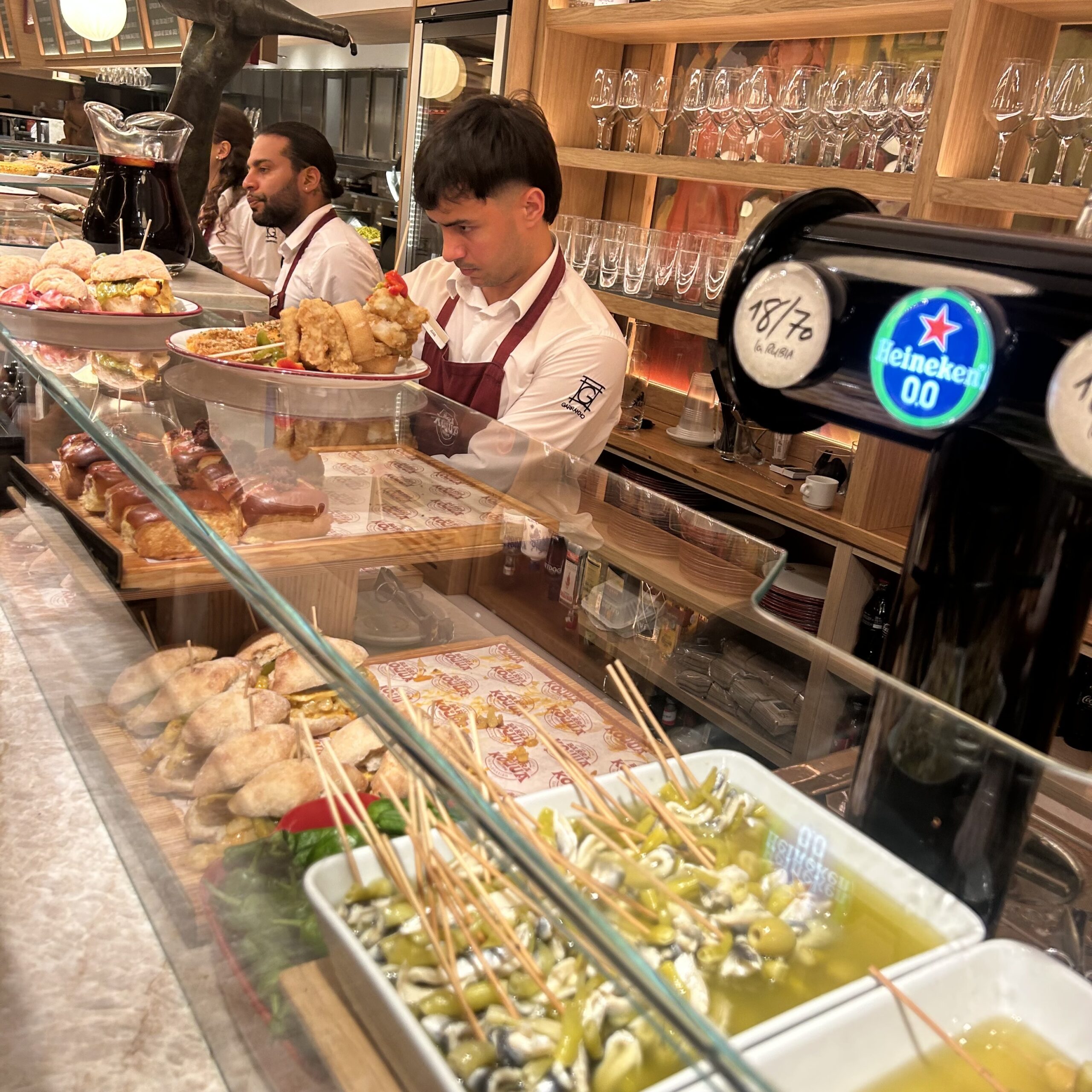
Traditionally, a pintxo often consisted of a slice of bread topped with meat, fish, cheese, vegetables or other ingredients, held together with a small wooden skewer or cocktail stick.
Hence the name.
But anyone walking through San Sebastián, Bilbao or Vitoria today will quickly discover that the old definition no longer tells the whole story.
Modern pintxos can be hot or cold, served with or without bread and range from an uncomplicated bite to an elaborate miniature dish worthy of a fine-dining restaurant.
San Sebastián in particular has turned the pintxo into an internationally recognised culinary institution. Bars display counters filled with carefully prepared creations, while others are known for individual hot pintxos that regulars know to order directly from the kitchen.
In this part of Spain, the food itself is often the reason for choosing a particular bar.
The ritual is different too
The distinction is not simply about what appears on the plate.
Pintxo culture is also about moving on.
A typical evening might involve visiting one bar, ordering one or two pintxos with a glass of wine or a small beer, and then heading to another establishment.
And then another.
Rather than sitting at one restaurant table for an entire meal, the evening becomes a small gastronomic journey through several bars.
Eat, drink, talk and move on.
It is one of the defining rituals of Basque social life.
So what is the actual difference between tapas and pintxos?
In simple terms, a tapa is primarily a small portion of food with a tradition historically linked to drinking.
A pintxo is more closely associated with the distinctive culinary and bar culture of northern Spain, particularly the Basque Country and Navarra.
A tapa will often arrive on a small plate and can essentially be a miniature version of almost any Spanish dish.
The traditional pintxo, by contrast, developed as an individual bite, frequently arranged on bread and held together with the little skewer that gave it its name.
There is also traditionally a difference when the bill arrives.
In some regions, a tapa may still be included in the price of a drink. Pintxos, on the other hand, are generally selected and paid for individually.
But the boundaries have become increasingly blurred.
Spain’s modern food scene has transformed both traditions. There are now sophisticated gourmet tapas and elaborate pintxos without either bread or the skewer from which their name originated. In contemporary bars, even the terminology can be used rather loosely.
Granada and San Sebastián: two cities, two philosophies
Perhaps the easiest way to understand the distinction is to compare Granada with San Sebastián.
In Granada, you order a beer and, in many traditional establishments, the tapa comes with it. The drink effectively triggers the food.
In San Sebastián, the relationship is often reversed. People may walk into a particular bar specifically because there is a pintxo there they want to try. The food becomes the destination and the drink accompanies it.
Two different traditions, yet both express something deeply characteristic of Spanish life.
It was never only about the food
For many foreign visitors, tapas are initially understood simply as “small Spanish dishes”. That is not wrong, but it misses much of the point.
Tapas and pintxos are as much social customs as culinary ones.
The idea is not necessarily to order one plate and keep it to yourself. People share, taste, order something else, perhaps move to another bar and invariably spend considerably longer talking than they had originally intended.
Food becomes part of a social ritual.
That may explain why both traditions have survived Spain’s extraordinary culinary transformation so successfully.
The country now boasts some of Europe’s most ambitious restaurants, yet one of its most enduring ways of eating still follows a remarkably simple formula:
a small bite, a drink and someone to share them with.