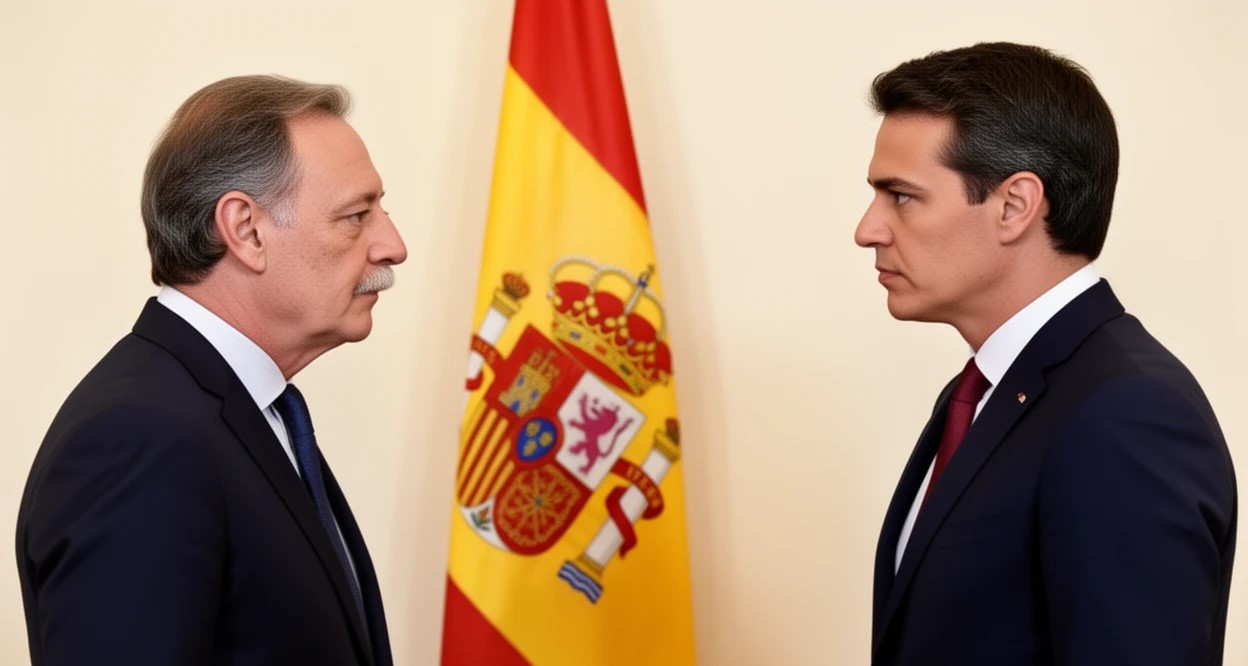
The president of the Spanish enclave of Ceuta is taking a tougher stance towards the government in Madrid. Juan Jesús Vivas accuses the central government of inaction and says he is prepared to take legal action if necessary. At the same time, the government is creating 1,500 additional temporary accommodation places for migrants.
Spain Expat Press Editorial Team
by Marlon Gallego Bosbach
The migration crisis in Ceuta is escalating politically. The president of the autonomous city, Juan Jesús Vivas, is increasing pressure on the Spanish central government and has effectively issued Madrid with an ultimatum: if the situation does not improve significantly within the next 30 days, he says he will take legal action and involve further national and European institutions. Vivas criticises what he considers an inadequate response from the government and accuses the central government of showing “absolute passivity”.
The dispute comes just weeks after the extraordinary migration movement at the end of July. Tens of thousands of people attempted to reach Ceuta from Morocco at the time. Many were pushed back or subsequently returned to Morocco. At the same time, a large number of migrants remain in the city, many of them living in difficult conditions.
Vivas gives the government a 30-day ultimatum
Following an extraordinary meeting of the Ceuta government, Vivas made it clear that he does not consider Madrid’s response so far to be sufficient. The president is particularly critical of what he sees as the central government playing down the true scale of the crisis.
If no tangible solution is reached within 30 days, Vivas intends to take the dispute to further institutional levels. This would include the courts, as well as other national institutions and European bodies.
Vivas is calling above all for cases to be processed more quickly, for pressure on accommodation facilities to be eased, and for a clear strategy for those migrants who remain in Ceuta. In his view, it is not enough to stabilise the immediate situation temporarily. Instead, the government must find a lasting solution to the consequences of the mass border crossings.
Dispute over the true scale of the crisis
One of the biggest challenges at present is determining how many migrants are actually still in Ceuta. Figures provided by different authorities and political actors vary considerably. Based on the information available to him, Vivas believes the number remains substantial and criticises the lack of a sufficiently clear overview of how many people are still in the city and how many cases have already been initiated.
Other recent reports put the number of migrants still in Ceuta at several thousand. The situation is particularly difficult for those staying outside regular reception centres or living in makeshift camps or in the surrounding areas of the city.
The issue is therefore no longer simply about the number of new arrivals. The key question now is how to deal with those who have remained in Ceuta following the mass arrival at the end of July.
Government creates 1,500 additional reception places
While Vivas is increasing the pressure, the central government announced a concrete measure on Monday. Spain’s Minister for Inclusion, Social Security and Migration, Elma Saiz, announced the creation of 1,500 additional temporary reception places. Four sites in Ceuta are to be used for this purpose.
The sites include a car park in Loma del Colmenar, an equestrian facility near the CETI, a former football pitch at a military barracks, and another state-owned site.
The additional facilities are intended to ease pressure on existing structures and provide temporary accommodation. According to the government, this is an exceptional and time-limited measure.
An additional €6.5 million has been allocated to address the current situation. The support measures are intended, among other things, to help provide humanitarian assistance.
1,500 reception places are apparently not enough
However, the announced reception places are not without controversy. According to media reports, there is still a significantly greater need. Some sources, for example, report a need for more than 4,000 additional places.
The creation of the 1,500 places is therefore likely to provide some short-term relief, but the fundamental issue of accommodation remains unresolved.
Vivas is also calling for more than simply additional sleeping places. He is demanding faster processing of cases and the consistent application of existing legal provisions.
Vivas calls for more staff to process cases
According to Ceuta’s president, the authorities could work considerably faster if additional staff were deployed. Vivas has suggested, among other measures, bringing in around 50 staff members from the immigration authorities. In his view, they could help process up to 15,000 cases within a month.
His criticism therefore focuses primarily on the administrative side of the crisis. In Ceuta’s view, it is not enough simply to provide people with temporary accommodation. At the same time, it must be determined what legal status or options each individual has. This includes returns, asylum procedures and the special protection afforded to minors.
Healthcare system also under pressure
The political dispute has recently also extended to the healthcare sector. During her visit to Ceuta, Health Minister Mónica García drew attention to the difficult conditions. According to the Health Ministry, there has been no complete collapse of the healthcare system, but the exceptional situation is nevertheless placing significant strain on the city’s medical and social services.
The situation is particularly difficult for people who are not housed in suitable facilities and are in some cases living in poor hygienic conditions.
An open political dispute subsequently developed between García and Vivas. Ceuta’s president rejected criticism of the city government and, in turn, accused the central government of shifting responsibility for the situation onto Ceuta.
The crisis began at the end of July
The current situation began with an extraordinary migration movement on 30 and 31 July. According to various published estimates, tens of thousands of people reached Ceuta at the time. The Spanish government says that the vast majority subsequently returned to Morocco or were sent back. At the same time, several thousand people remained in the city.
The scale of the event placed considerable strain on existing reception and support capacities. The situation is particularly challenging for unaccompanied minors, who are afforded special protection under Spanish law and cannot simply be treated in the same way as adult migrants.
The border remains under close watch
The security situation at the border has also changed since the mass arrival. Morocco has stepped up its security measures. In mid-August, at least 111 people were arrested after allegedly attempting to reach Ceuta from Morocco again. Spain, for its part, increased the security presence in the enclave by more than 500 officers.
This means the risk of further large-scale border movements remains a key concern. Spanish authorities are therefore monitoring not only the situation in Ceuta itself, but also developments on the Moroccan side of the border.
Political conflict between Ceuta and Madrid
The dispute has now taken on a distinctly political dimension. Vivas is a member of the People’s Party (PP), while the Spanish central government is led by Prime Minister Pedro Sánchez. Although Ceuta and Madrid have worked closely together on many issues in the past, the tone has now become considerably more confrontational.
Vivas accuses the government of failing to respond decisively enough to the situation. A particularly contentious issue is whether Madrid is adequately acknowledging the true scale of the crisis. The president of the enclave has therefore announced that he will, if necessary, involve further institutions, potentially including the courts as well as national and European bodies.
Why the next 30 days will be crucial
The deadline set by Vivas significantly increases political pressure on the government. By then, it will become clear whether the additional 1,500 reception places will provide any meaningful relief. At the same time, authorities will need to determine how to deal with the migrants who remain in Ceuta and which procedures can be expedited.
Another key issue is cooperation with Morocco. Without effective coordination with its neighbouring country, it is likely to be difficult to stabilise the situation at the border in the long term. At the same time, Spain must comply with legal requirements governing returns, asylum procedures and the protection of particularly vulnerable people.
No solution in sight yet
The Spanish government has responded to growing criticism by providing additional reception places and financial resources. For Ceuta’s president, Vivas, however, these measures apparently do not go far enough. The enclave is therefore facing a difficult combination of humanitarian pressure, political dispute and security concerns.
The coming weeks will show whether Madrid and Ceuta can once again find common ground – or whether Vivas will actually follow through on his threat to take the dispute to court and pursue it at further institutional levels.
One thing is already clear: the migration crisis in Ceuta is far from over. The additional accommodation places may provide short-term relief, but they do not resolve the outstanding procedures or the underlying problems at the border with Morocco.