Granada has once again been rocked by a powerful earthquake. The 4.8-magnitude tremor struck south of the city on Tuesday morning and was felt clearly in hundreds of towns and villages. Three people suffered minor injuries, buildings were damaged and parts of the famous Alhambra were evacuated as a precaution. The region has been experiencing an unusually intense series of shallow earthquakes for several days.
Spain Expat Press Editorial Team
by Marlon Gallego Bosbach
The ground in Granada province is showing no signs of settling. After the region was rocked by a powerful earthquake last weekend, another strong tremor struck on Tuesday, 18 August.
According to Spain’s National Geographic Institute (IGN), the earthquake had a magnitude of Mw 4.8 and occurred at 10:37 a.m. local time. The epicentre was located near Gójar, south of Granada. The earthquake was very shallow, which is why it was felt clearly across a wide area.
Earthquake shakes Granada and large parts of Andalusia
The tremors were felt far beyond the city of Granada itself. According to the IGN, the two strongest earthquakes in the current sequence were felt in more than 500 towns and villages. Central and eastern parts of Andalusia were particularly affected. The tremors were also reported in the Murcia region, southern Castilla-La Mancha and, in some cases, even as far away as the Madrid region.
The maximum observed intensity in areas around Granada reached V–VI on the EMS-98 scale. The shallow depth of the earthquakes made the tremors particularly noticeable at the surface. Following the shaking, many people precautionarily left their homes and buildings and moved to open areas.
Several more earthquakes follow within a matter of hours
What was particularly concerning for residents was that the initial earthquake was followed by several further tremors. After the 4.8-magnitude quake, the IGN recorded additional earthquakes within a short period of time, including tremors measuring 3.9, 4.2 and 4.0 in magnitude. Some of these were also clearly felt by the public.
The IGN is now describing the situation as a genuine seismic sequence. Since 14 August, 432 earthquakes have been recorded in the region. Most of them, however, were significantly weaker than the two strongest tremors.
The current earthquakes are concentrated in an area around Alhendín, Gójar and La Zubia, just a few kilometres south of the city of Granada.
Three people suffer minor injuries
The earthquakes have also resulted in the first reported injuries. According to the Andalusian authorities, three people suffered minor injuries. One of those injured was a minor who was taken to hospital as a precaution.
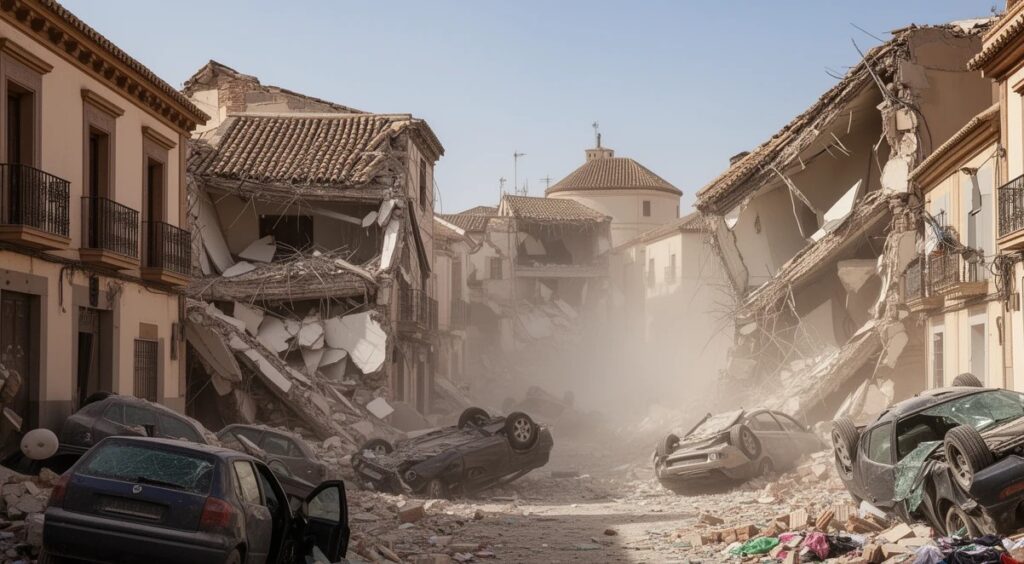
In addition, numerous cases of damage to buildings have been reported. The most common issues include fallen sections of façades, roof tiles and other structural elements. Vehicles were also damaged by falling debris. So far, the IGN has primarily reported non-structural damage and objects being dislodged or falling. The full extent of the damage is still being assessed.
Parts of the Alhambra evacuated as a precaution
One of Spain’s best-known landmarks was also affected by the tremors. Following the latest earthquake, parts of the Alhambra were evacuated as a precaution. The areas affected included the Nasrid Palaces and the Alcazaba.
The measure was taken as a precaution while officials assessed the impact of the tremors. The historic complex is one of Spain’s most important tourist attractions and welcomes large numbers of visitors every day.
Other public facilities were also temporarily closed or evacuated as a safety precaution.
Granada Metro reduces speed
The series of earthquakes also affected public transport. The Granada Metro reduced the speed of its trains as a precaution, in order to minimise risks amid the ongoing seismic activity.
Several buildings were also evacuated as a precaution. Streets were cordoned off in various parts of the city after sections of façades and other building materials fell. At the same time, the city authorities increased the presence of police officers and emergency services.
Granada has been experiencing an unusual series of earthquakes for days
The latest earthquake is not an isolated event. On 14 August, the IGN had already recorded a magnitude Mw 4.8 earthquake in the Alhendín area. Since then, the region has continued to experience further tremors.
Tuesday’s earthquake again reached Mw 4.8, making it the strongest event in the sequence so far alongside the quake on 14 August. Both tremors reached a maximum observed intensity of V–VI.
However, most of the earthquakes recorded since Friday have been significantly weaker. So far, a total of nine events with a magnitude of at least 3 have been recorded, while 45 earthquakes were felt by the public.
Why does the ground shake so frequently in Granada?
Granada is one of the most seismically active regions in Spain. The city lies within the Betic Cordillera, a geologically active mountain system in the south of the Iberian Peninsula. The current earthquake sequence is occurring in an area affected by several active faults.
The IGN places the current sequence, among others, between the Dílar, Granada and Belicena-Alhendín faults. According to the institute, the mechanisms observed in the stronger earthquakes are consistent with the region’s known tectonic structures. Earthquakes occurring repeatedly in this area are therefore not unusual.
One of Spain’s most seismically active regions
History shows that Granada can be affected by powerful earthquakes. The IGN points to significant historical events in 1431, 1806/1807, 1911 and 1918. One of the most severe was the 1884 earthquake near Arenas del Rey, which reached an intensity of IX to X and caused widespread destruction.
More recently, the region has also experienced prolonged earthquake sequences. For example, between December 2020 and August 2021, more than 3,000 shallow earthquakes were recorded around Santa Fe and Atarfe. The current activity is therefore notable, but it is occurring in a region that has experienced several periods of intense seismic activity in the past.
It is unclear how long the earthquake sequence will continue
One of the most important questions for people in Granada at the moment is: When will the earthquakes stop? There is currently no definitive answer to this question.
The IGN is continuously monitoring the situation. According to the agency, it is currently not possible to reliably predict how the sequence will develop. Further tremors may occur, but science cannot predict with certainty whether an even stronger earthquake will follow.
The current situation does not necessarily mean that a major earthquake is imminent. At the same time, further tremors cannot be ruled out.
IGN steps up monitoring of the region
In light of the unusually intense seismic activity, the region is being closely monitored. The IGN operates 52 permanent seismic sensors within a radius of around 50 kilometres of the epicentre. In addition, two mobile monitoring stations have been installed directly in the area affected by the current earthquake sequence. This will allow movements beneath the surface to be analysed in greater detail.
Since the beginning of the sequence, the IGN has also received more than 15,000 reports from members of the public via its website and mobile app. This information helps scientists determine how strongly the tremors were actually felt in different locations.
Authorities urge residents to remain calm
Authorities are closely monitoring the situation while urging people not to panic unnecessarily. Residents are being advised to follow official information and to observe established safety guidance in the event of further tremors.
Although Granada is currently experiencing an unusually active period of seismic activity, the large number of smaller earthquakes does not automatically mean that an even stronger earthquake is imminent.
One thing is certain: the ground beneath Granada remains active. Following two magnitude 4.8 earthquakes within just a few days and hundreds of further recorded tremors, attention is likely to remain focused on the Andalusian province in the days ahead.