Pedro Sánchez went before Spain’s parliament on Thursday hoping to draw a line under the growing controversy surrounding the Ceuta crisis. Instead, he emerged facing an increasingly uncomfortable question: why does the Spanish prime minister remain so reluctant to point the finger at Morocco when even some of his own political allies are openly doing so?
The opposition’s anger was predictable. What happened next was not. Parties whose votes Sánchez relies on – including voices within his own governing coalition – challenged his account, questioned the handling of intelligence before the crisis and, in unusually blunt terms, rejected his continued caution towards Rabat.
And the documents that might finally establish who knew what, and when? They are not yet public. Spaniards will have to wait several more days.
Spain Expat Press Editorial Team
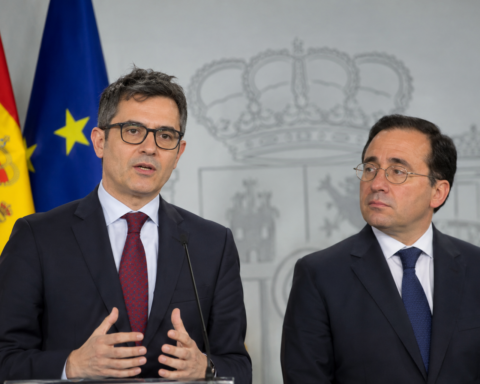
Pedro Sánchez appeared before Spain’s Congress of Deputies on Thursday, 3 September, to explain his government’s handling of the crisis in Ceuta and, crucially, what information the authorities had received before the mass arrivals of 30 July.
It was supposed to provide clarity after weeks of political recriminations.
Instead, it exposed just how isolated the prime minister has become on one of the most sensitive questions surrounding the crisis: Morocco.
Sánchez defended his government’s response and insisted that, while intelligence and police reports had pointed to an increased risk of attempted crossings, none had accurately anticipated either the likelihood or the extraordinary scale of what eventually unfolded.
That argument is now at the heart of the dispute.
Warnings existed. The question is whether they were sufficiently specific and serious to have prompted a different response from the government.
The reports are coming – but not yet
Sánchez announced that the relevant reports covering the period between 1 July and 1 August would be made public.
But they have not been released yet.
The government must first establish which documents can legally be published and whether classified intelligence material needs to be formally declassified.
Any documents requiring declassification would have to go through the Council of Ministers, meaning the process is expected to take several days.
That delay matters.
The documents could provide crucial evidence in determining whether Sánchez’s central defence – that his government had not received sufficiently accurate warnings of what was about to happen – stands up to scrutiny.
Until then, one of the central questions of the crisis remains unresolved: what exactly did the Spanish government know before 30 July?
The Morocco question Sánchez cannot escape
But it was Sánchez’s continued caution over Morocco that produced some of the most heated exchanges in parliament.
The prime minister again insisted that there was no solid evidence proving that the Moroccan government had planned or orchestrated the mass crossings.
He said Spain would act if such evidence emerged.
Sánchez acknowledged that Moroccan security forces had failed to prevent crossings during crucial hours, but stopped short of concluding that this amounted to deliberate action by Rabat.
That position is becoming increasingly difficult politically.
A Spanish police report that has emerged in recent days contains troubling indications about events on the Moroccan side of the border.
It describes an operation whose scale appeared to require a degree of planning beyond the capabilities normally associated with trafficking organisations. It also refers to the unusual passivity of Moroccan security forces and includes accounts from migrants who said Moroccan officers had given them directions concerning the crossing.
None of that, on the publicly available evidence, proves that Morocco’s government directly ordered the operation.
But it has intensified an obvious question: why is Sánchez still so reluctant to blame Rabat?
Questions for Spain’s own security apparatus
The controversy has become still more sensitive because Sánchez has simultaneously raised questions about Spain’s own intelligence and security structures.
He called for clarification over why certain information from the National Centre for Immigration and Borders, CENIF, had apparently not reached senior officials or the political leadership.
His argument is that the government cannot be accused of ignoring information it did not receive in a form that accurately predicted the crisis.
Critics see things very differently.
For them, an uncomfortable contrast has emerged: Spain’s own warning systems and information flows are being publicly scrutinised while Sánchez remains extraordinarily cautious about assigning responsibility to Morocco.
It was precisely this contrast that helped turn Thursday’s parliamentary session into something more serious than another confrontation between government and opposition.
Because this time the criticism came from Sánchez’s own side too.
Even Sumar challenges the prime minister
Perhaps the most politically damaging intervention came from Sumar, the leftwing alliance that is itself part of Sánchez’s coalition government.
Enrique Santiago, of Izquierda Unida, described what happened as an “attack by Morocco” in which vulnerable people had been used as instruments.
The handling of the crisis was sharply criticised, while Sánchez’s reluctance to attribute responsibility to Rabat was openly challenged.
That created an extraordinary political spectacle: while Spain’s prime minister continued to insist that there was insufficient evidence to accuse Morocco, politicians from within his own governing camp were publicly pointing the finger at Rabat.
Rufián issues a warning
Gabriel Rufián, of the Catalan Republican Left (ERC), also delivered one of the sharpest interventions of the day.
Governments, he warned Sánchez, do not fall because they make mistakes. They fall because they lie.
ERC has taken a considerably harder line towards Morocco and questioned whether the government’s explanation of the events is credible.
Miriam Nogueras, of Junts, presented Sánchez with an equally uncomfortable dilemma.
Either the prime minister knew about the warnings and was downplaying them in order to protect Morocco, she argued, or he genuinely did not know.
For Junts, both possibilities raise serious questions.
If the warnings reached the government, why were they not acted upon? If they did not, how could information concerning a potential threat of such magnitude fail to reach Spain’s political leadership?
Feijóo: ‘Incompetence or complicity’
Alberto Núñez Feijóo, leader of the conservative People’s party, was predictably more aggressive.
He accused Sánchez of minimising the warnings and argued that the government had been given enough information to understand that a serious threat was developing.
Feijóo framed the issue in stark terms: either Sánchez’s government had been incompetent or it had been complicit.
He again called for the prime minister to step down.
Vox leader Santiago Abascal went further, accusing Sánchez of failing to defend Spain’s interests and being excessively protective of Morocco.
The opposition attacks were hardly unexpected.
The reaction of Sánchez’s allies was.
A prime minister increasingly under pressure
Thursday’s debate therefore revealed something politically more significant than another fierce parliamentary row.
The disagreement over Ceuta now cuts through the parliamentary coalition on which Sánchez depends.
PP and Vox are demanding political responsibility. ERC and Junts are openly questioning the government’s account. And figures within Sumar – Sánchez’s coalition partner – are prepared to describe what happened as an attack by Morocco while the prime minister himself refuses to reach that conclusion.
Meanwhile, the documents that could settle at least part of the argument remain unavailable to the public.
Sánchez has promised transparency. Within days, the reports should begin to show whether his insistence that the warnings were insufficient or inaccurate is supported by the documentary record.
If they are, the prime minister may be able to rebut one of the most damaging accusations levelled against his government.
If they are not, Thursday’s bruising appearance in parliament may prove to have been merely the beginning of a much deeper political crisis.
But one question already refuses to go away.
Why is Sánchez prepared to question the failures and information flows of Spain’s own security apparatus while remaining so determined not to accuse Morocco?
After Thursday’s appearance, Spain is still waiting for a convincing answer.