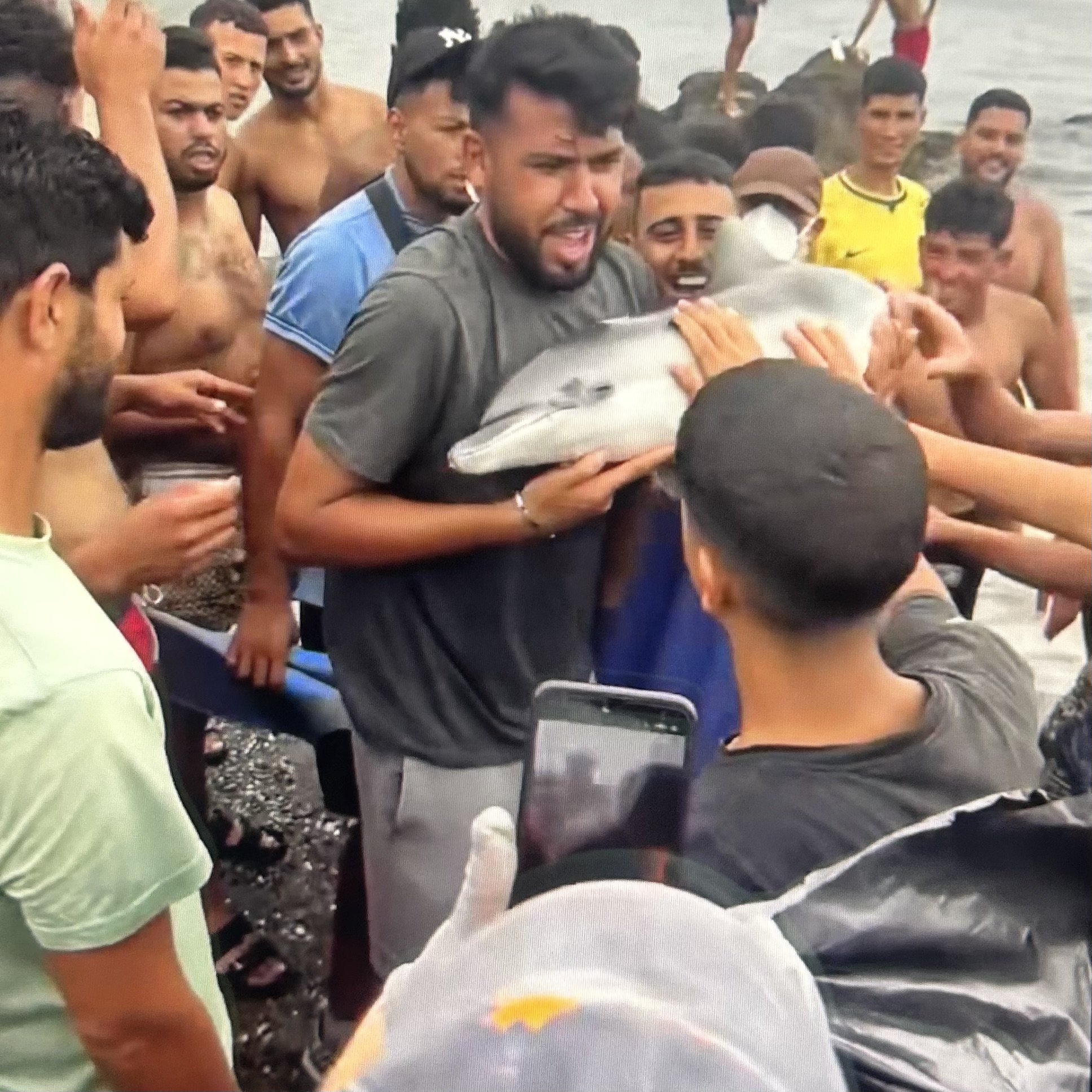
Footage showing several migrants carrying a young dolphin has triggered an angry reaction across social media. Yet one crucial fact remains unclear: nobody has established what happened to the animal before the camera started rolling. In a city already exhausted and deeply divided by the migration crisis, a few seconds of video have proved enough to reignite an increasingly volatile debate.
Spain Expat Press Editorial Team
A short video filmed on a beach in Ceuta has become the latest flashpoint in a city where tensions are already running dangerously high.
The footage, recorded at El Trampolín beach, shows several migrants carrying a young dolphin. Claims quickly spread across social media that the animal had been caught, mistreated or even killed by the men.
But that has not been established.
It remains unclear what happened to the dolphin before the recording began, or whether it was still alive when the men found it. It is entirely possible that the animal was already injured or dead.
That uncertainty, however, has done little to contain the anger online.
A confrontation caught on camera
The video itself captures some of the tension surrounding the incident.
A young Spanish man can be heard telling the migrants to leave the dolphin alone and pointing out that dolphins are a protected species. As the exchange becomes increasingly heated, insults can also be heard.
The migrants respond by saying that the dolphin was already dead.
That exchange is significant. It does not establish what happened to the animal, but it does challenge the assumption – widely repeated online – that the people shown carrying it were necessarily responsible for its death.
What happened before the recording began simply cannot be determined from the footage currently available.
Social media erupts
Within hours, the images had provoked a wave of furious reactions.
Many users called for the people in the video to be identified and punished if an investigation establishes that they deliberately harmed or killed the animal.
Others went further, demanding that foreign nationals convicted of such an offence should be expelled from Spain where the law allows it.
A petition has also been launched on Change.org calling for those involved to be identified and for the circumstances surrounding the dolphin to be investigated.
Yet other voices have urged caution, warning against reaching conclusions on the basis of a brief video whose wider context remains unknown.
Some have also raised the desperate circumstances in which many migrants in Ceuta are currently living, with speculation online that hunger may have played a role.
There is, however, no confirmed evidence that the dolphin was caught for food.
A city already on edge
The scale of the reaction is difficult to understand without considering the wider atmosphere in Ceuta.
The Spanish enclave has spent weeks at the centre of an extraordinary migration crisis. The arrival of tens of thousands of people from Morocco, pressure on accommodation and public services, street demonstrations and an increasingly bitter political battle over responsibility have left the city deeply unsettled.
Residents are tired. Many are angry. Others are frightened about what happens next.
At the same time, the circumstances of the thousands of migrants caught up in the crisis vary enormously, and the actions of individuals cannot reasonably be attributed to an entire group.
Social media, however, rarely leaves much room for such distinctions.
Against that background, the dolphin footage has become about considerably more than one animal.
MIGRANTES MARROQUÍES ATRAPAN UN DELFÍN BEBÉ
Entre risas y celebración, migrantes marroquíes que pernotan en Ceuta, atraparon un pequeño delfín y festejan el hecho.
Según las leyes españolas esta acción podría incurrir en una multa de hasta 200,000 euros.
Los habitantes de la… pic.twitter.com/nZ0jLmbsKh— News On Demand (@OnDemand_News) September 3, 2026
When an image becomes a symbol
For some, the video has become another symbol of what they believe to be a situation spiralling out of control.
For others, the reaction demonstrates something quite different: how quickly an ambiguous image can become accepted as proof of something that has not yet been established when public anger is already running high.
Another video circulating at around the same time, apparently showing a man carrying a bird with its legs tied, has further intensified the debate over wildlife and animal welfare.
Again, speculation about the circumstances surrounding those images has travelled considerably faster than verified information.
And therein lies the problem.
What do we actually know?
For all the anger generated by the dolphin footage, the central question remains unanswered.
There is currently no conclusive evidence that the migrants shown in the video killed the dolphin.
The animal may have been injured. It may already have been dead. The men themselves can be heard saying precisely that.
If an investigation establishes that the dolphin was deliberately harmed or killed, those responsible should face the consequences provided for under Spanish law.
But if it emerges that the animal was already dead, some of the most serious accusations now circulating online will have been based on an assumption rather than a fact.
That distinction matters, particularly in Ceuta today.
The most revealing aspect of the episode may therefore be not what the video proves, but the extraordinary speed and intensity with which people have reacted to it.
Ceuta was already on edge. The images of the dolphin, combined with weeks of frustration, anger and exhaustion, have done the rest.
A few seconds of footage have become another battleground in Spain’s increasingly heated debate over the crisis.
And until the full circumstances are established, the images may tell us more about the mood in Ceuta than they do about how the dolphin died.
The video at the centre of the controversy can be viewed in this article.