When September begins to soften into autumn across much of Europe, there is a corner of southern Spain where summer seems in no particular hurry to leave.
Spain Expat Press Editorial Team
Along the Atlantic coast of Cádiz, the intense heat of July and August gives way to warm days, balmy evenings and beaches that suddenly have room to breathe again. For those who can travel outside the high season, this may well be the loveliest time of year to discover one of Andalusia’s most captivating stretches of coastline.
Start with the white sands of Zahara de los Atunes, follow the Atlantic north towards Cape Trafalgar and Los Caños de Meca, then leave the coast behind for dinner among the whitewashed lanes of Vejer de la Frontera.
It makes for an almost perfect late-summer day.
And this is a very different Andalusia from the one found a couple of hours away on the Costa del Sol.
Here, there is little interest in velvet ropes, designer labels or being seen at the right beach club. Cádiz does summer differently: barefoot, windswept and gloriously relaxed, with a lingering hippie spirit that somehow survived the arrival of Instagram.
Zahara de los Atunes: white sand and Atlantic blue
Begin in Zahara de los Atunes, where pale sand runs seemingly endlessly alongside remarkably clear Atlantic water.
On a calm September morning, there are moments when the colours look almost Caribbean.
Zahara itself has changed considerably over the years, becoming one of the most desirable summer destinations on the Cádiz coast. Yet it has retained much of its easy-going character.
The village is synonymous with atún de almadraba — the prized bluefin tuna caught here using a centuries-old fishing tradition — and lunch is reason enough to linger.
But Zahara’s greatest late-summer luxury is something rather simpler: space.
Walk along the sand, swim in the Atlantic, stop for a long lunch and then take the coastal road north.
There is no need to rush.
Cape Trafalgar: a wild edge of Spain
Soon, the lighthouse of Cape Trafalgar appears above the dunes.
The name is one of the most famous in European history. It was off this coastline in 1805 that the British Royal Navy fought the combined fleets of Spain and France in the Battle of Trafalgar.
Today, however, the cape feels remarkably removed from all that drama.
The attraction is its simplicity: dunes, sea, sky and an enormous horizon.
Walk towards the lighthouse in the late afternoon, when the light begins to turn golden and the Atlantic wind picks up. There are few buildings and even fewer distractions.
This is not a manicured Mediterranean beach.
It is wilder, windier and more elemental — and all the better for it.
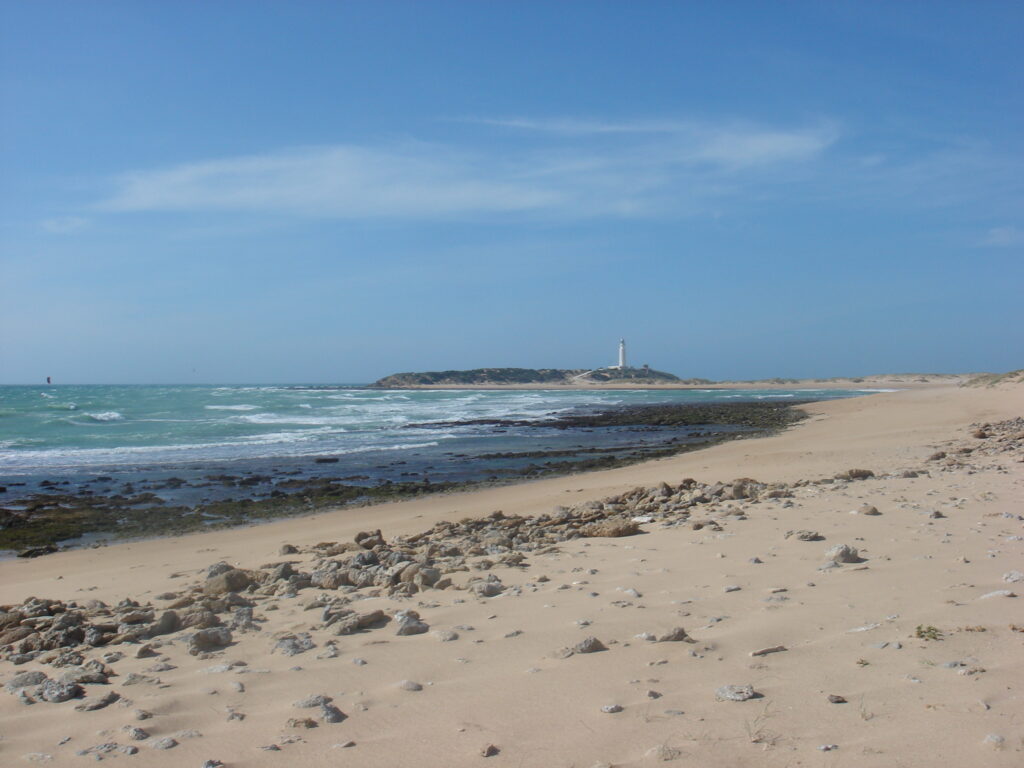
Credit Wikipedia
Los Caños de Meca: less beach, just as much soul
Continue along the coast and you reach Los Caños de Meca, a name that has been part of the mythology of alternative Andalusian summers for decades.
Those who knew Los Caños years ago will notice one obvious change.
Its beaches have lost some of their width over the years, but none of their charm.
The landscape may have evolved, yet the spirit of the place remains remarkably intact.
There are surfers carrying boards through the streets, camper vans, little bars, music drifting through the evening air and people wandering down to watch the sun disappear into the Atlantic.
Los Caños still carries a touch of the hippie Cádiz of another era.
And perhaps its greatest luxury is precisely what it does not have.
There is little of the carefully curated postureo — that peculiarly Spanish art of seeing and being seen — associated with some of the more glamorous stretches of the Costa del Sol.
Here, nobody particularly cares which label you are wearing.
Flip-flops will do nicely.
Come for the sea, stay for sunset and order another drink when you realise there is really nowhere else you need to be.

Then leave the coast behind
There is, however, one more stop.
As darkness begins to fall, turn inland and climb towards Vejer de la Frontera — one of the most beautiful white villages in Cádiz, and indeed in all of Andalusia.
Perched high above the surrounding countryside, Vejer provides the perfect contrast to the openness of the Atlantic.
Leave the car and walk.
Its old town is a maze of narrow cobbled lanes, brilliant white façades, flower-filled patios, arches and tiny squares. Every few minutes, another view appears between the houses or another terrace tempts you to stop.
There is something wonderfully cinematic about Vejer after dark.
Tables spill into little squares, warm light escapes from doorways and the smell of grilled fish and local cooking follows you through the streets.
Choose a restaurant, order tuna, fresh fish or a collection of tapas and allow dinner to take as long as it takes.
Then walk again.
Getting slightly lost in Vejer is not a problem. It is arguably the best way to see it.
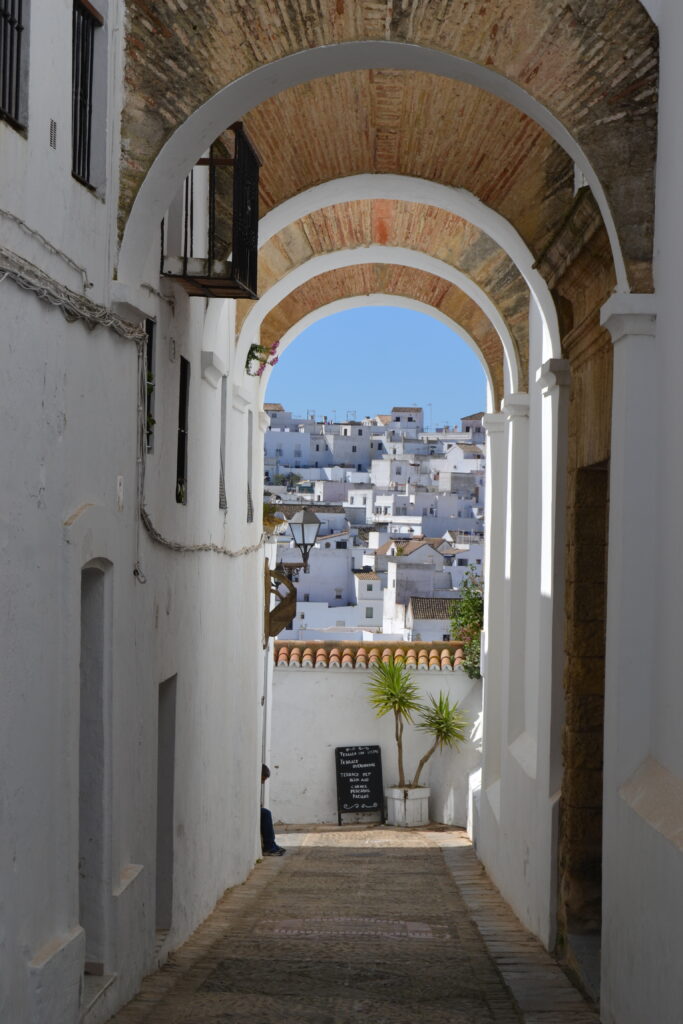
Credit Wikipedia
The Andalusian summer that refuses to end
There are flashier stretches of the Spanish coast. There are places with grander hotels, more famous restaurants and considerably more expensive beach clubs.
But that is not why you come here.
You come for the seemingly endless white sand of Zahara, the wild Atlantic at Trafalgar, the enduring hippie soul of Los Caños and the labyrinth of whitewashed streets waiting above you in Vejer.
September simply makes all of it better.
The crowds begin to disappear. The temperatures soften. The evenings remain warm. And the Atlantic coast slowly returns to itself.
No velvet ropes. No dress code. No need to be seen.
Just salt in your hair, sand between your toes and one last long Andalusian evening.
If you are searching for a corner of Spain where summer lingers just a little longer, head west. Cádiz is waiting.