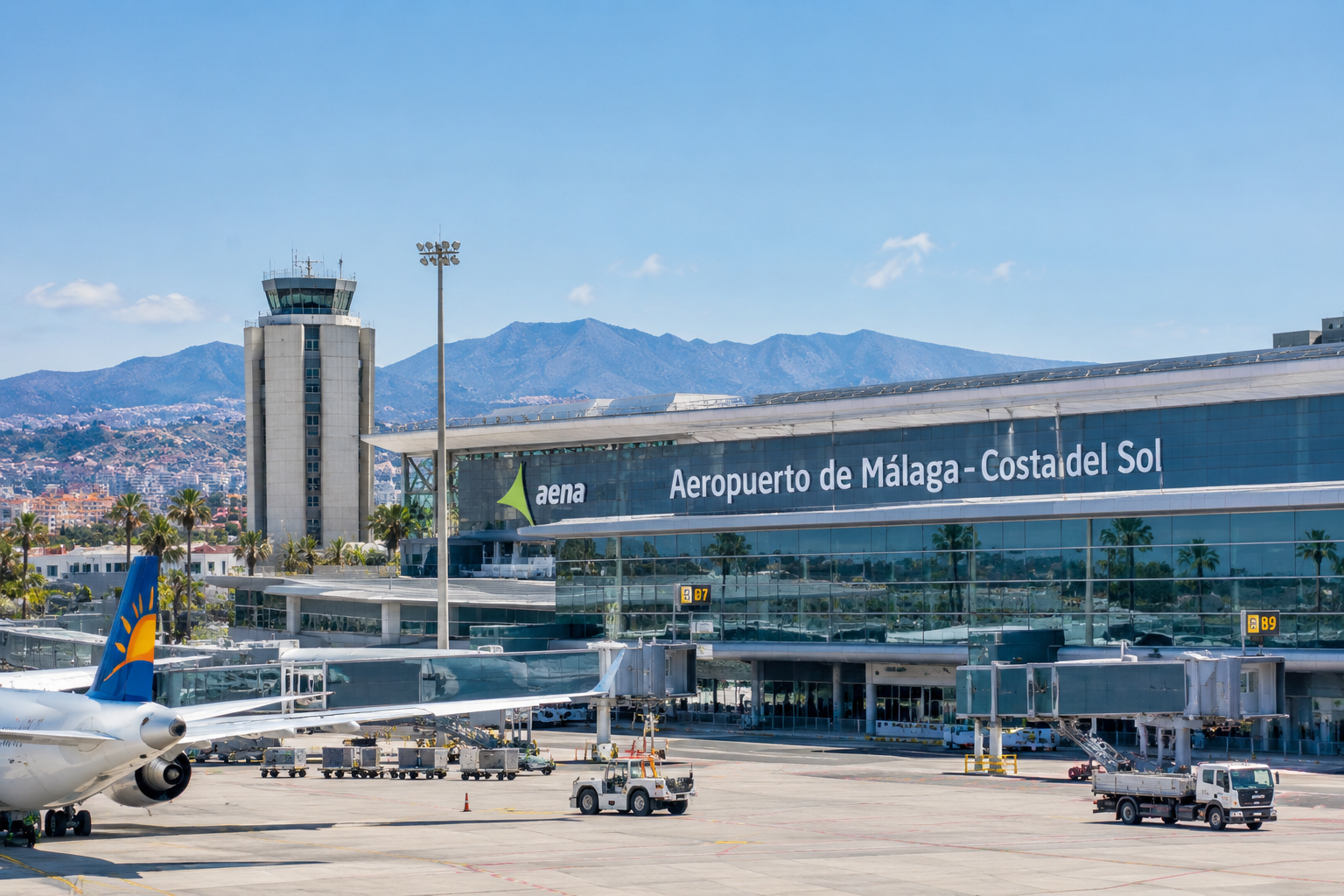
Málaga-Costa del Sol Airport is set to undergo extensive remodeling and expansion starting in 2029. The project, costing approximately 1.5 billion euros, aims to increase capacity to up to 36 million passengers per year. Construction work is expected to take seven years.
Spain Expat Press Editorial Team
by Marlon Gallego Bosbach
Málaga-Costa del Sol Airport is set to undergo its most significant modernization since the opening of Terminal 3 in 2010. According to the current schedule, construction work is due to begin in 2029 and last approximately seven years. This was announced by the new airport director, Sergio Millanes. However, the planning phase must first be completed, and the construction contracts put out to tender and awarded.
The project is expected to cost a total of around 1.5 billion euros. Of this amount, more than 850 million euros is already earmarked in Aena’s investment program for the 2027–2031 period. Around 570 million euros from this initial package is allocated for actual airport operations. The remaining funds are to be made available during a subsequent investment period.
Airport to be prepared for 36 million passengers
The redevelopment aims to prepare Málaga for a continued rise in passenger numbers in the long term. The planned capacity is around 36 million travelers per year. The airport currently has a capacity of approximately 30 million passengers.
The aim is not solely to create new space; rather, the goal is to reorganize existing processes and eliminate bottlenecks within the airport. According to Millanes, this affects virtually all passenger flows – from security and passport control to the arrival and departure areas. Certain areas are slated for significant expansion.
Six times more space for passport control
One of the major changes concerns passport control. The area allocated for this purpose is set to become six times larger than it is currently. Security screening facilities are also to be significantly expanded; plans call for the number of security checkpoints to be doubled. At the same time, the space for arriving passengers is to triple in size.
The aim is to relieve pressure primarily on those areas where bottlenecks can occur during periods of high passenger volume. Aena assesses the airport’s capacity not only based on the total annual number of passengers but also on the hourly performance of individual systems.
At passport control, this theoretical capacity limit currently stands at around 9,800 passengers per hour. The expansion is intended to eliminate precisely these kinds of individual bottlenecks.
Terminal area set to expand significantly
The terminal itself is also undergoing significant expansion. The current terminal area of approximately 80,000 square meters is set to increase to around 140,000 square meters. This would bring the available space much closer to the long-term expansion target. According to current plans, the commercial areas within the terminal could also grow by around 41 percent.
At the same time, the airport director emphasizes that the additional capacity is not intended to be achieved solely through new floor space. More efficient use of existing infrastructure and better management of passenger flows also play an important role.
Taxiways are also being modified
The project focuses not only on the terminals; changes are also planned for the apron and the area between the runways.
A taxiway between the two runways, currently single-lane, is to be expanded to two lanes. This would allow aircraft to taxi simultaneously in both directions and cross paths at this location in the future. The move is intended to speed up operations on the airport grounds and improve the airport’s overall capacity.
Málaga continues to grow
The expansion comes at a time when the airport is already handling significantly more passengers. In the first eight months of 2026, 19.32 million passengers were recorded in Málaga. This represents a 6.6 percent increase compared to the same period the previous year. More than 3.05 million people used the airport in August alone.
In addition, more than 100,000 passengers were recorded on individual days during the summer. The peak figure to date was around 107,000 travelers in a single day. Despite this heavy volume, the airport has operated without major issues so far, Millanes explained.
Growth is driven primarily by international traffic. In August, international routes accounted for around 2.57 million commercial passengers – an increase of 7.9 percent compared to August 2025. Key markets included the UK, Germany, Italy, France, and the Netherlands.
Focus on new international connections
The international route network is expanding alongside the airport’s physical expansion. According to Millanes, the airport sees new or expanded connections practically every week. The Middle East market, in particular, is showing interesting development.
According to the airport director, the connection between Málaga and New York is also developing positively. The route, operated by United Airlines, could be expanded in the future if demand warrants it. However, the decision regarding additional frequencies or a longer season rests with the airline.
A direct connection to China, however, remains an open question for the time being. Currently, Chinese airlines are focusing primarily on Madrid and Barcelona for their connections to Spain.
Airport remains open during construction work
The seven-year construction phase will pose a particular challenge. The airport is to remain operational throughout the entire project. Aena therefore plans to implement the work in stages. Wherever possible, new infrastructure will be built first, before existing areas are modified or replaced, in order to minimize disruption to ongoing flight operations.
Aena had already pointed out during the tender process for the technical planning that the work would need to be coordinated while operations continued. Consequently, the actual implementation will take place in several construction phases.
Málaga is preparing for the coming decades
The expansion is intended to do more than just accommodate current passenger numbers; the infrastructure is to be planned in such a way that it can also handle the continued growth of the Costa del Sol in the coming decades.
The current schedule therefore initially allocates several years for planning, tendering, and contract awarding. Actual construction is slated to begin in 2029. Work is then expected to continue until around 2036.
For travelers, this means greater long-term processing capacity, larger arrivals and security areas, and modernized procedures. For Málaga and the Costa del Sol, the project also represents one of the most significant infrastructure initiatives of the coming years. It aims to prepare the airport for a volume of traffic that – given sustained growth – is already rapidly approaching.