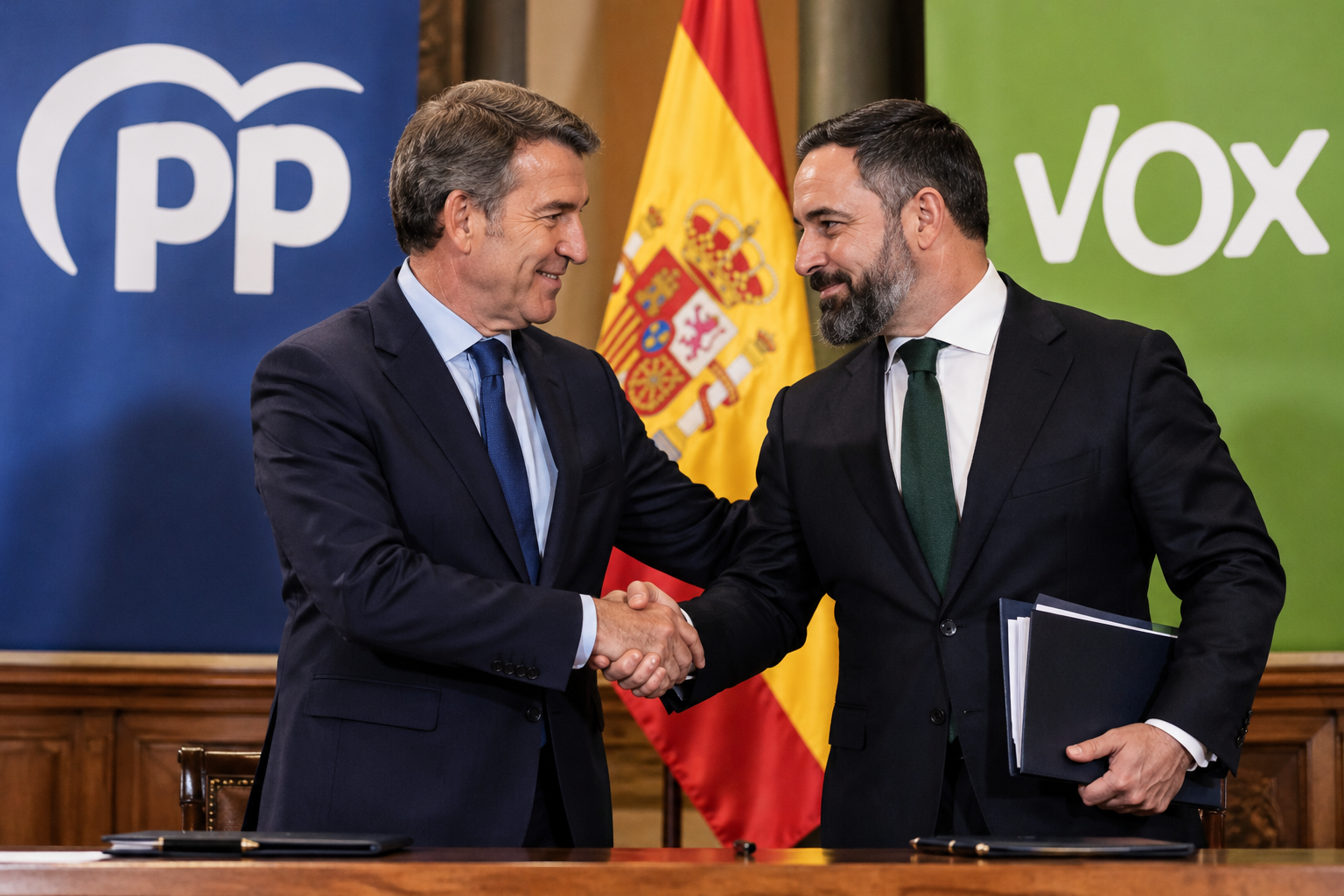
Spain’s two main right-wing parties, the conservative Popular Party (PP) and the hard-right Vox, have struck an unprecedented electoral pact ahead of the general election on 29 November. But anyone expecting a joint ticket to unseat Pedro Sánchez will be disappointed: the deal covers only the Senate, the upper house, and leaves the two parties competing head-to-head for the Congress, where the government is decided.
Spain Expat Press
The agreement was announced on Monday 26 October, just hours before the deadline for registering candidate lists, by the PP’s campaign chief, Miguel Tellado. Within hours, Sánchez had denounced it as proof that the two parties are one and the same.
Why only the Senate?
Spain has a two-chamber parliament. The Congress of Deputies, with 350 seats elected by proportional representation, chooses the prime minister and passes laws. The Senate has far less power: it can amend or delay legislation, but the Congress can override it. That is why the PP and Vox still prefer to fight each other for every congressional seat.
The Senate matters, however, in one key respect. Some of the state’s most important appointments, including four of the twelve judges on the Constitutional Court, require a three-fifths majority there. Whoever controls that majority can unblock, or block, those nominations.
The voting system also explains the pact. In each mainland province, four senators are elected, but each voter may tick at most three names. In practice, the party that comes first usually takes three seats and the runner-up one. Splitting the right-wing vote between two lists can hand a seat to the left; uniting it can secure three. This time 209 senators are elected directly; the rest are appointed by regional parliaments.
What the deal says
The pact is a swap of withdrawals. Vox will not stand in six provinces: Las Palmas, Santa Cruz de Tenerife, Cádiz, Valencia, Castellón and the Balearic Islands. There, the PP will include on its ballot an “independent” candidate proposed by Vox. In return, the PP will step aside in three provinces where it has little chance: Gipuzkoa in the Basque Country, where it has not won a Senate seat for 26 years, and Girona and Tarragona in Catalonia, where it never has. In a further 14 provinces, the PP will field three candidates and Vox just one.
The PP estimates the joint operation could deliver between 125 and 140 of the 209 elected seats, enough for the coveted three-fifths majority. Tellado insisted that “the agreement is what it is”, ruling out any hidden extras such as lending Vox senators so it can form its own parliamentary group, which requires ten.
The pact is also a direct response to the left. The Socialists (PSOE) and the left-wing Frente Amplio have already agreed to run joint Senate lists under the banner Senado de progreso (“Senate of progress”).
Sánchez sees blue and green
The prime minister responded with a video on social media. He opened by citing research on how the human brain struggles to tell certain shades of blue from green, a nod to the colours of the PP and Vox. Some people, he said, have spent years trying to convince voters those colours are very different. On pensions, women’s rights and the welfare state, he argued, the two parties say the same things, vote the same way and govern together; now they even share Senate lists. He called them “two colours and one project of regression” and urged voters to choose between Spain moving forward or the past moving forward.
The PP leader, Alberto Núñez Feijóo, dismissed the attack as a “furious” reaction and said it only proved his party was on the right track.
Sánchez’s sudden horror at electoral alliances is, it must be said, a little puzzling. This is the same politician who returned to power in November 2023 thanks to the votes of Junts, the party of Carles Puigdemont, who fled Spain after the 2017 Catalan independence referendum, in exchange for an amnesty law. The same prime minister counted on EH Bildu, the Basque pro-independence coalition whose ranks include former members of ETA, for his investiture and for key votes ever since. And the same Socialist party that is now scandalised by joint Senate lists has, as it happens, just signed up to joint Senate lists of its own with the Frente Amplio.
Pacts with the Catalan separatists and the heirs of the Basque independence left are, apparently, progressive coalition-building; a seat swap between two Spanish parties of the right is a threat to the nation. Voters on 29 November will be able to decide for themselves which colour they find harder to tell apart.