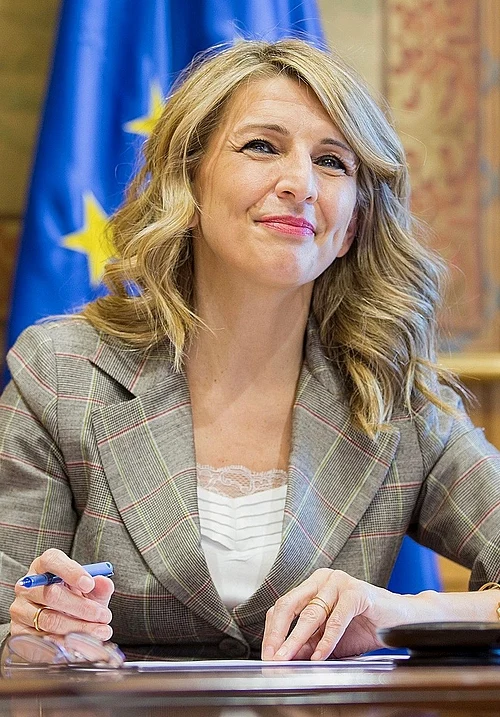
The Spanish government is proposing a 5.3% increase in the national minimum wage next year, giving the lowest-paid workers an extra €65 a month. But the proposal has failed to satisfy either trade unions or employers.
Spain Expat Press Editorial Team
Spain’s national minimum wage could rise from its current €1,221 to €1,286 gross per month in 2027, under plans published by the Ministry of Labour, headed by Yolanda Díaz. The proposed increase would bring the annual minimum salary to €18,004, an additional €910 compared with this year.
For many workers, the rise would make a noticeable difference. The minimum wage is particularly important in sectors such as hospitality, retail and agriculture, where salaries tend to be lower and increases in the cost of living have placed considerable pressure on household budgets.
The increase has not yet been formally approved. The draft decree is open for public consultation until 16 November, after which the Council of Ministers can give it the go-ahead.
Government goes further than experts recommended
The proposed 5.3% rise exceeds the 4.9% increase recommended by the government’s own panel of experts, which had taken October’s inflation figures into account.
The Ministry of Labour argues that the higher minimum wage is necessary to protect purchasing power and ensure that people on low incomes can afford a reasonable standard of living.
Spain has also committed to bringing its statutory minimum wage into line with 60% of the country’s average wage, in accordance with the principles of the European Social Charter.
However, the proposal has met with an unexpectedly cool response from the country’s two main trade unions.
UGT and CCOO had called for a 7% increase and are particularly unhappy that employers will still be allowed to offset minimum wage rises against certain existing salary supplements.
In practice, this means that some workers may see a smaller increase in their take-home pay than the headline figure suggests, or no increase at all if their overall earnings already meet the new legal threshold.
Employers are equally unconvinced, although for different reasons. The business organisations CEOE and Cepyme have criticised the pace of the negotiations and accused the government of using the minimum wage debate for political purposes ahead of the parliamentary elections scheduled for 29 November.
What does €1,286 a month actually mean?
For foreign residents working in Spain, the figures can be confusing because Spanish salaries are traditionally calculated over 14 payments a year rather than 12.
Employees generally receive twelve regular monthly payments plus two additional payments, often made in summer and at Christmas.
Under the government’s proposal, the minimum wage of €1,286 across 14 payments would amount to €18,004 gross annually.
Where the two extra payments are spread across the year, the equivalent monthly salary would be approximately €1,500.33 gross over twelve months.
This distinction is particularly relevant for international employees comparing Spanish salaries with those in countries such as the United Kingdom, where annual salaries are normally divided into twelve monthly payments.
Not everyone would automatically receive a pay rise, however. Employees whose total annual earnings already exceed €18,004 would not generally be entitled to an increase solely because the statutory minimum wage has changed.
For businesses employing staff on the minimum wage, the proposal would mean higher employment costs. In addition to the extra €910 in annual gross pay, employers could face an increase in their social security contributions.
The draft decree also sets a minimum daily rate of €60.88 for certain temporary employees working no more than 120 days for the same employer.
A decision still to be made
The government hopes to approve the increase in the coming weeks, although the political calendar could complicate matters.
Unlike ordinary legislation, changes to Spain’s statutory minimum wage do not require a parliamentary vote. Following consultation with employers and trade unions, the government can approve the increase by royal decree.
This means the measure could still be adopted after the 29 November elections, even if the government is operating in a caretaker capacity.
For now, the €1,286 figure remains a proposal rather than an approved minimum wage. Workers and employers will have to wait for the final decree to know exactly what will apply in 2027.