Days before Spain’s general election on Sunday, the tiny Canary Island of El Hierro is facing the largest influx of migrants in its history. This month alone, almost as many people have arrived by boat as live on the island. The opposition blames the migration policies of Prime Minister Pedro Sánchez, while some suspect that people smugglers are pushing departures ahead of a possible change of government.
Spain Expat Press Editorial Team
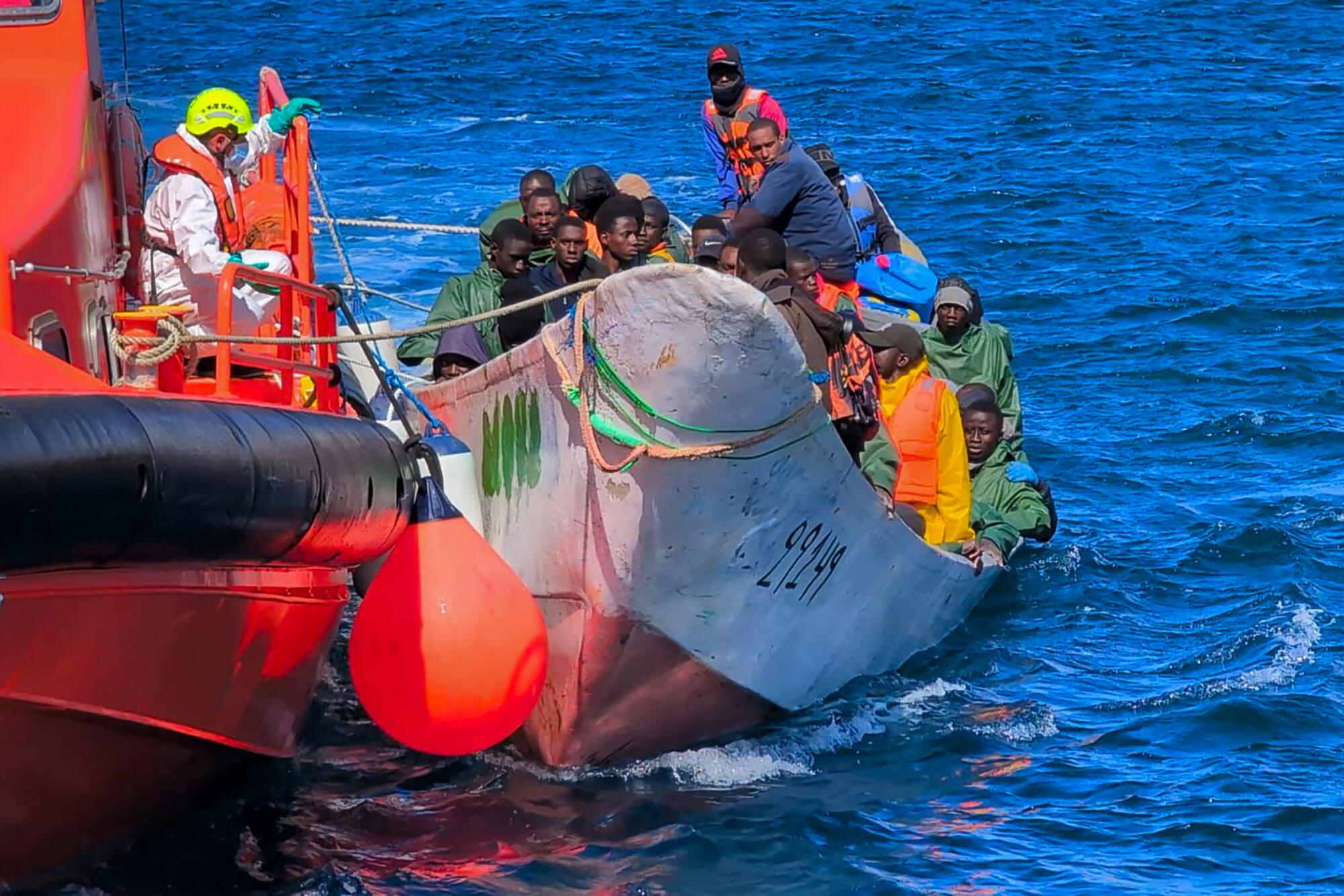
In La Restinga, a fishing village on the southern tip of the westernmost Canary Island, rescue vessels arrive almost daily escorting cayucos, the traditional wooden boats of West Africa. Most set out from Senegal and the Gambia, on crossings that can last up to two weeks. In mid-November the authorities recorded the busiest single day since records began on the Atlantic route.
According to Spain’s Interior Ministry, around 11,000 people have landed on El Hierro since the start of November, on an island of roughly 11,400 residents. Between 1 and 16 November, 96 boats reached the island, compared with 66 in the previous ten months. On 14 November, 1,580 people reached the Canaries in a single day, 1,235 of them on El Hierro; on 24 November, 1,560 people arrived on El Hierro alone, aboard ten boats. Across the archipelago, the ministry counted 11,037 irregular arrivals in the first half of November and 24,364 since January, up 65.9 per cent on last year. Nationwide, arrivals are up 39.4 per cent. The number of unaccompanied minors in the care of the Canary Islands rose from 2,300 to more than 3,000 in just two weeks.
State of social emergency
El Hierro’s island council, the Cabildo, declared a state of social emergency in early November and appealed to the central government in Madrid for help. Three days later, the government declared a migration emergency in the Canaries and released extra funding for reception places and transfers.
The island has a single hospital and a temporary reception centre with only a handful of medical beds. A field hospital has since been set up, public buses have been diverted to ferry new arrivals, and medical staff have been drafted in from other islands. According to the regional government, La Restinga’s fishermen can barely work, and several diving schools have closed. The Canary Islands’ president, Fernando Clavijo, described the situation as “absolutely unsustainable”.
Few people stay on the island. After initial care, new arrivals are taken by ferry to Tenerife and, in most cases, on to mainland Spain. Many later move on to France or other European countries.
Row over a ‘pull factor’
The conservative Popular Party (PP) and the hard-right Vox accuse the government of creating an “efecto llamada”, or pull factor. At the centre of the criticism is the extraordinary regularisation of undocumented migrants approved by the cabinet in January, which drew more than a million applications. According to Spanish media reports, senior officers in the immigration police also warned the Interior Ministry of such an effect.
The government rejects the claim. It says the regularisation applies only to people already living in Spain, and points out that arrivals in the Canaries fell sharply in the months after it was announced. Studies of the last large regularisation, in 2005, found no pull factor. Ministers attribute the current surge to a resumption of departures from Senegal, favourable sea conditions and weaker coastal patrols in countries of origin. Mr Clavijo has also suggested that the Youth Olympic Games in Senegal, which drew thousands of police officers away from the coast, may have played a part.
‘Now or never’ before the vote?
On the island and on social media, another explanation is doing the rounds: smugglers are said to be telling would-be migrants that a new government after the 29 November election could tighten migration policy. Polls put the PP ahead. Its leader, Alberto Núñez Feijóo, promised during a visit to El Hierro to create a single command for migration and to crack down on trafficking networks. Some Spanish media report that smugglers are exploiting the electoral calendar, noting a similar rise before the 2023 general election. The link has not been officially confirmed.
Demands on Madrid and Brussels
The Canary Islands parliament has unanimously approved a list of demands. These include deploying the EU border agency Frontex in Canary waters, bringing the islands into the solidarity mechanism of the European migration pact, greater diplomatic pressure on Senegal, and legal changes to allow smugglers to be prosecuted for offences committed on the high seas. For La Restinga, the regional government is calling for an economic support package.
Whoever wins on Sunday will have to tackle the crisis immediately. The PP and Vox favour control and deterrence; the Socialists and their partners favour reception, redistribution and legal routes for labour migration.