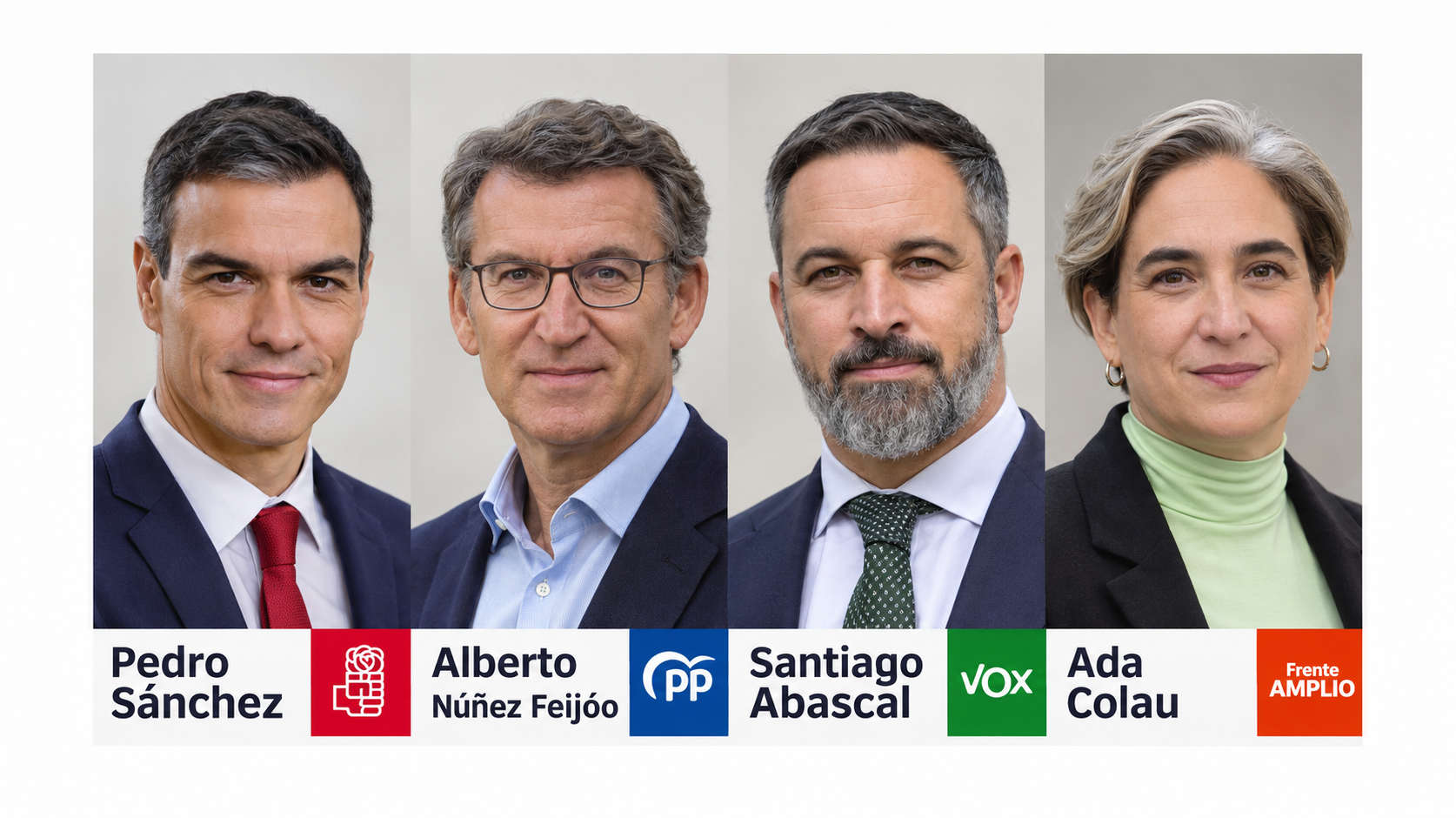
Sánchez, Feijóo, Abascal and Colau share a stage for the first and only time in the campaign tonight. With opinion polls now under a legal blackout, it is the last big chance to win over undecided voters.
Spain Expat Press Editorial Team
Against the clock
Spain goes to the polls on Sunday 29 November, and tonight brings the campaign’s last big television showdown. At 10pm local time, in Studio A at Madrid Content City in Tres Cantos, on the northern edge of the capital, the Socialist Prime Minister, Pedro Sánchez (PSOE), will face the conservative opposition leader, Alberto Núñez Feijóo (Popular Party, PP), the hard-right Vox leader, Santiago Abascal, and Ada Colau of the left-wing Frente Amplio alliance. The debate is organised by Spain’s Television Academy and moderated by its president, María Casado.
The Academy will not broadcast the debate itself. Instead it provides a feed that any channel can carry, the same arrangement used for last week’s head-to-head. It was the compromise the two main parties reached after weeks of wrangling: the Socialists wanted one debate on the public broadcaster RTVE and the other on a private network, and the PP refused.
Five familiar themes
The agenda mirrors that of the Sánchez–Feijóo duel on 19 November:
- Housing.
- The economy and taxation.
- Social policy and public services.
- Tackling corruption and democratic renewal.
- Migration and foreign policy.
Repeating the running order has an obvious effect. Sánchez and Feijóo arrive with lines already road-tested before millions of viewers, while Abascal and Colau know exactly where the two front-runners attacked and defended last week.
What the head-to-head left behind
The prevailing verdict on the 19 November duel was a win for Feijóo, and not only in the conservative press. A snap poll by Ateneo del Dato for the left-leaning news site elDiario.es put the PP leader 13 points ahead of Sánchez, with 45 per cent naming him the winner, and almost one in five Socialist voters thought the conservative candidate had the better night. El Plural, another left-leaning outlet, reviewed seven reader polls from different media: all of them had Feijóo ahead, by margins of between 4 and 67 points.
The tactics were clear. Feijóo went on the attack and interrupted often; Sánchez held back, avoided confrontation, admitted mistakes and at times even conceded the point. The caveat came from the elDiario.es poll itself: Feijóo may have won the debate, but voting intention barely moved.
On Monday 23 November it was the spokespeople’s turn, as RTVE brought together representatives of eight parties at its Prado del Rey studios, with Xabier Fortes in the chair. Tonight the leaders themselves take the stage.
The state of play
Spanish electoral law has banned the publication of polls since Tuesday 24 November, so the last picture published in Spain dates from last week. An average of 19 pollsters compiled by the news site Demócrata on 19 November put the PP on 31.0 per cent, the PSOE on 27.7 per cent, Vox on 19.0 per cent and Frente Amplio on 6.2 per cent.
Three features stood out:
- The PP ahead, and the gap not closing. Feijóo led most polls by three to four points. The Socialists gained ground in some trackers, but largely at the expense of their allies rather than the PP, leaving the gap between the two big parties little changed. Only the odd daily tracker, such as SW Demoscopia’s, had the PSOE in front.
- The Vox surge. Abascal’s party stood at around 19 per cent, almost seven points up on the general election of July 2023.
- The blocs on the brink of a majority. Together, the PP and Vox were polling about half the vote and, in most surveys, close to or above the 176 seats needed for an absolute majority in the 350-seat Congress.
Nor does the tracker being published abroad during the blackout point to a Socialist comeback. The Australian website The Adelaide Review, which is running daily GESOP surveys while the ban is in force, this week put the PP 3.7 points ahead of the PSOE (down from 3.9 in the previous instalment) and gave the PP and Vox between 187 and 195 seats combined. According to the same series, both big parties are gaining at the expense of Vox and Frente Amplio, so the gap between the blocs is holding steady. The one crumb of comfort for the left is that most undecided voters sit on its side of the spectrum.
With margins like these, a debate may not change who comes first. It could, however, decide whether either bloc reaches a majority or falls just short.
What is at stake for each leader
Pedro Sánchez (PSOE). The Prime Minister needs something the polls are not giving him: a real dent in the PP’s lead. To get it, he must mobilise undecided left-wing voters, the biggest pool still up for grabs. Expect him to frame Sunday as a choice between his government and a PP–Vox coalition, and to face renewed pressure over housing and corruption, the two areas where he took the most punishment in the head-to-head.
Alberto Núñez Feijóo (PP). The front-runner’s main task is to avoid slipping up. Unlike last week, he will share the stage with Abascal, competing with him for right-wing votes while fielding questions about a possible governing deal with Vox.
Santiago Abascal (Vox). With his party’s best result within reach, Abascal wants to cement third place and make himself indispensable to any right-wing majority. The final block, on migration, is likely to be where he tries hardest to set himself apart from the PP.
Ada Colau (Frente Amplio). The former mayor of Barcelona makes her big national debut as leader of the alliance, which includes Sumar. She has to stand out alongside the two main contenders and persuade voters to the left of the PSOE that Frente Amplio is the vote that counts on that side, on a night when Podemos is absent.
Podemos left out
Irene Montero will not be in the studio. Podemos has no parliamentary group of its own, as its five MPs sit in the Mixed Group, and the Central Electoral Board rejected its appeals, ruling that not every list with seats in parliament has a right to take part in these debates and that the format is for broadcasters to decide. The board had already backed the party’s exclusion from Monday’s RTVE debate. Montero has accused the PSOE and Frente Amplio of shutting her party out, warning that without Podemos the evening will simply be a rerun of the Sánchez–Feijóo duel.
What to watch for tonight
- The triangle on the right. Whether Feijóo and Abascal turn on each other or close ranks against Sánchez will say a lot about the post-election landscape.
- Colau’s role. Whether she carves out space of her own or is overshadowed by the two front-runners.
- The interruptions. With four voices rather than two, María Casado’s job as moderator will be harder, and matter more, than a week ago.
- The closing statement. The final minute is what gets replayed most on social media and the news bulletins on Friday, the last day of campaigning before Saturday’s “day of reflection”, when campaigning is banned.