Spain’s prime minister will appear before Congress at 9am today to account for his government’s handling of the Ceuta crisis. He does so just hours after thousands took to the streets across Spain and amid fresh questions over Morocco following a police report describing the mass crossings of 30 and 31 July as planned rather than spontaneous.
All eyes in Spain will be on Pedro Sánchez this morning.
Spain Expat Press Editorial Team
At 9am on Thursday, 3 September, the Spanish prime minister is due to appear before the plenary session of the Congress of Deputies in Madrid to explain his government’s handling of the crisis in Ceuta since the extraordinary events of 30 July.
The appearance had already been scheduled. Sánchez is attending both at his own request and following a request from the conservative People’s Party.
But the political circumstances surrounding today’s appearance have changed dramatically.
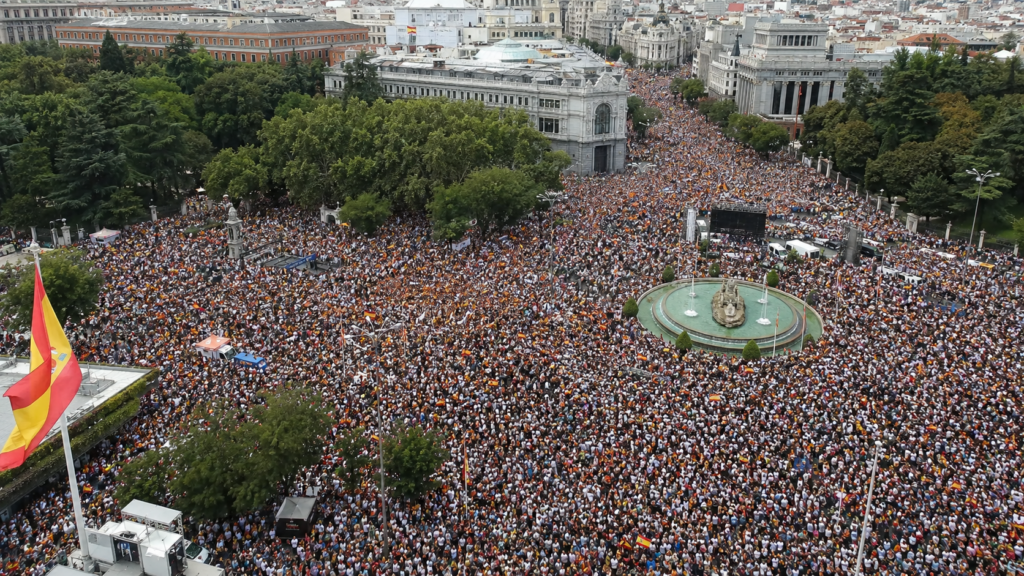
Sánchez will enter parliament less than 24 hours after thousands of people took to the streets across Spain in support of Ceuta, in demonstrations that in many places also became an expression of anger towards the Government.
Calls of “Pedro Sánchez, dimisión” – “Pedro Sánchez, resign” were heard among protesters at several gatherings.
And now there is another issue likely to dominate today’s debate: Morocco.
A police report changes the political landscape
A report by Spain’s National Centre for Immigration and Borders, the CENIF, submitted to the Audiencia Nacional, has described the events of 30 and 31 July as a mass entry that was “planned” rather than “spontaneous”.
According to information emerging from the police document, people linked to Morocco’s security forces are placed among those involved in organising and carrying out the operation.
Investigators reportedly consider the level of planning required to be far beyond what would normally be expected of criminal people-smuggling networks.
The overwhelming majority of messages sent in the days before 30 July also originated from Moroccan telephone numbers, according to the police findings.
That is potentially highly significant.
But there is an equally important distinction.
The report does not establish that the Moroccan Government itself ordered or masterminded the operation.
That distinction will be crucial today.
The question confronting Sánchez is therefore more complicated than simply whether Morocco was responsible.
It is whether Spanish authorities now have a sufficiently clear picture of what happened on the other side of the border – and whether the Government’s previous public position was too categorical.
What did Madrid know before 30 July?
For Sánchez, perhaps the most politically dangerous questions today will concern not Rabat, but Madrid.
What did the Spanish Government know before 30 July?
When did it know it?
How seriously were the warnings taken?
And could anything have been done differently?
There have been apparently conflicting accounts within the Government over the intelligence available before the crossings began.
Defence Minister Margarita Robles has referred to warnings concerning messages circulating on social media encouraging people to attempt to enter Ceuta.
Interior Minister Fernando Grande-Marlaska, meanwhile, has maintained that there was no intelligence report warning of an event on the scale that ultimately unfolded.
Sánchez will now have an opportunity to clarify those positions.
What information reached the Government?
Who received it?
What level of threat was attributed to it?
And what measures were taken as a result?
After tens of thousands of people attempted to enter Spanish territory in an extraordinarily short period, these are no longer minor questions.
Morocco, Spain’s indispensable – and increasingly uncomfortable – neighbour
The diplomatic problem facing Sánchez is obvious.
Morocco is not simply another neighbouring country for Spain.
Cooperation with Rabat is fundamental to migration control, counter-terrorism and security along one of the European Union’s most sensitive external borders.
Madrid therefore has little interest in turning the Ceuta crisis into an open confrontation with the Moroccan Government.
But avoiding confrontation carries its own political cost if Spaniards begin to believe their Government is reluctant to challenge Rabat.
Until now, Sánchez has rejected suggestions that there was evidence establishing the involvement of the Moroccan authorities in orchestrating the crisis.
The CENIF report does not prove otherwise at government level.
It does, however, make it considerably harder to dismiss questions about the conduct of people linked to Moroccan security forces on the ground.
That is the narrow but politically explosive territory Sánchez will have to navigate this morning.
Sánchez appears hours after Spain took to the streets
Today’s appearance also comes immediately after one of the most politically significant days since the Ceuta crisis began.
Yesterday, Wednesday 2 September, thousands of people gathered in towns and cities across Spain to show their solidarity with Ceuta.
Some of the most striking scenes came from Madrid, but demonstrations and gatherings were also held across Andalusia, the Canary Islands, the Balearics, Navarra, Castilla-La Mancha and numerous other parts of the country.
The official purpose of the demonstrations was to support Ceuta.
It would therefore be misleading to suggest that everyone who attended was protesting against Pedro Sánchez.
But it would be equally misleading to ignore the political anger that was visible at many of the gatherings.
Calls for the prime minister to resign were heard among sections of the crowds.
What began as a national expression of solidarity with Ceuta consequently became, in some places, something broader: a public expression of frustration with the Government’s handling of the crisis.
Sánchez will walk into Congress this morning with the images of those demonstrations still fresh.
Ceuta wants its life back
Beyond the political confrontation in Madrid lies a city that has now spent more than a month living with the consequences of the crisis.
The Spanish Government has deployed additional resources and announced an extensive package of economic, security and humanitarian measures intended to help Ceuta return to normality.
Thousands of those who crossed have since returned to Morocco, either voluntarily or through official procedures.
But the sheer scale and speed of the original influx placed extraordinary pressure on a Spanish city of little more than 80,000 inhabitants.
For Ceuta’s residents, the argument over who knew what and when is not simply another political dispute in Madrid.
It is about whether the Spanish state was prepared to protect and manage one of its most vulnerable borders.
And, crucially, whether it would be able to prevent the same thing happening again.
Numbers alone will not be enough
Pedro Sánchez will undoubtedly use today’s appearance to defend his Government’s response.
He can point to additional police deployments, humanitarian assistance, returns, accommodation places and hundreds of millions of euros committed to Ceuta.
Those measures matter.
But today’s parliamentary appearance is unlikely to be judged on figures alone.
Sánchez needs to explain what his Government believes actually happened on 30 and 31 July.
He needs to reconcile the apparently different accounts of the warnings received before the crisis.
He needs to explain how the Government interprets the findings contained in the police report.
And, perhaps most delicately of all, he needs to define Spain’s position towards Morocco without making accusations unsupported by the available evidence – while at the same time demonstrating that Madrid is prepared to ask difficult questions about the actions of Moroccan security personnel.
The opposition will inevitably attempt to turn today’s session into a reckoning over Sánchez’s leadership.
But beneath the partisan confrontation lies a much more fundamental issue.
One of the European Union’s external borders was overwhelmed on an extraordinary scale.
More than a month later, Spain is still debating precisely how it happened, who organised it and how much its Government knew beforehand.
Yesterday, thousands of Spaniards took those questions onto the streets.
At 9am today, Pedro Sánchez will have the floor.
This time, simply explaining what his Government has done may not be enough. Spain is waiting to hear what went wrong – and why.