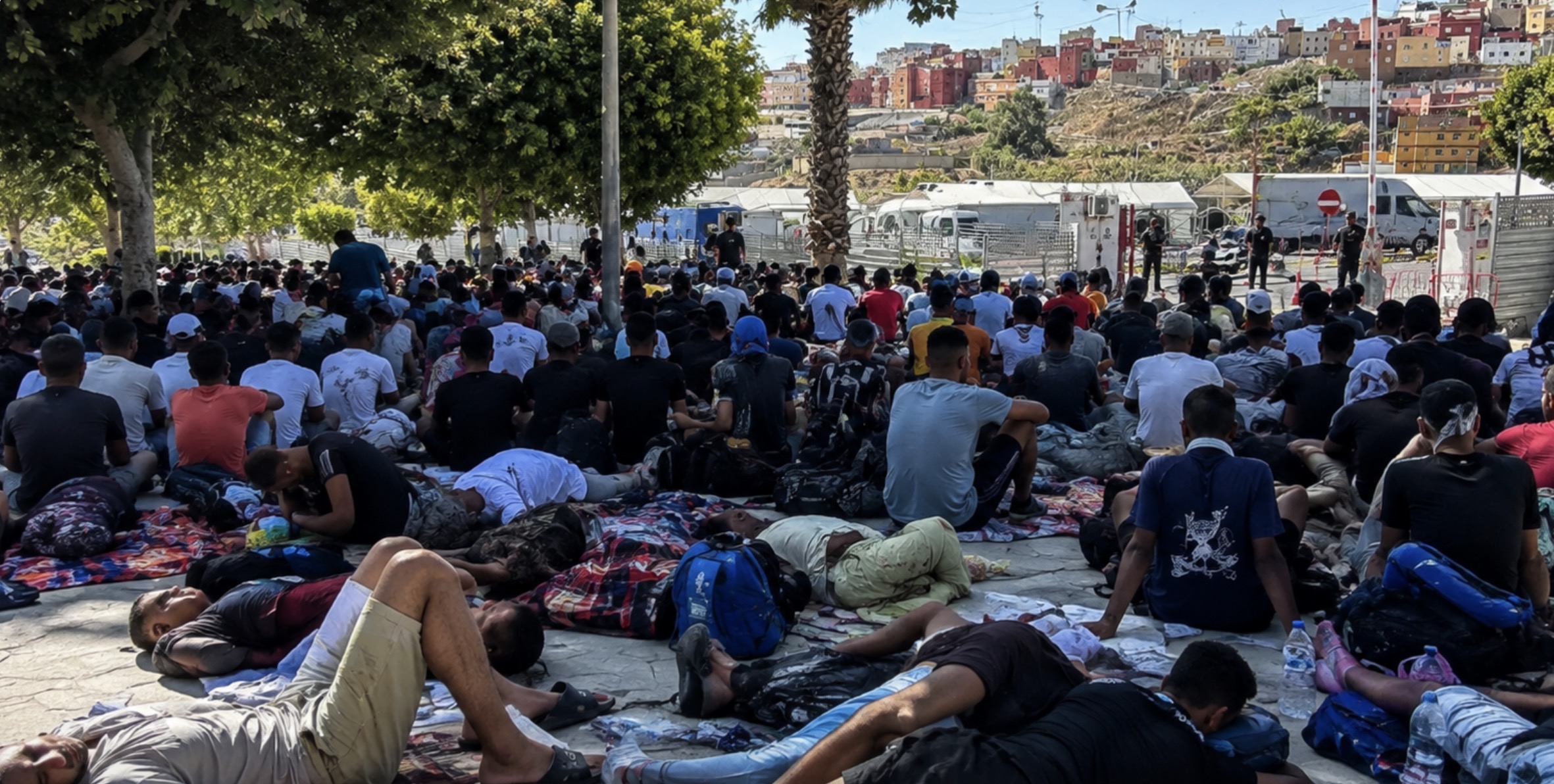
Spain’s North African enclave is under increasing strain. According to police unions and Guardia Civil associations, between 8,000 and 10,000 migrants are currently living outside designated accommodation, while security services warn of mounting operational pressure and worsening sanitary conditions.
Spain Expat Press Editorial Team
The situation in Ceuta is becoming increasingly difficult, with thousands of migrants already in the Spanish enclave continuing to live outside official accommodation. According to estimates from police unions and Guardia Civil organisations, between 8,000 and 10,000 people are currently sleeping rough or spending much of their time in public spaces across the city.
For Ceuta, a compact territory with a population of roughly 80,000, the scale of the situation represents a considerable challenge. Many of those affected are staying outside official reception facilities and are dispersed across different parts of the city and its surroundings.
The police union JUPOL has criticised what it describes as insufficient resources provided by Spain’s Interior Ministry to manage the situation. Officers are calling for additional personnel and logistical support as the number of incidents requiring police intervention increases.
Sanitary conditions have also become a growing concern. According to the Asociación Unificada de Guardias Civiles (AUGC), the showers and temporary sanitation facilities currently available are inadequate for the number of people who need them.
The association says that many migrants are relieving themselves in public areas, including streets and beaches, as well as in the sea. Police representatives warn that this is creating an increasingly serious problem for public hygiene.
At the same time, security services say they are facing a heavier operational burden. Police sources report a marked increase in calls to the 091 emergency number, which unions regard as further evidence of the pressure being placed on Ceuta’s already stretched security services.
Ceuta’s geography makes the challenge particularly acute. With a population of around 80,000 and a very limited territory, the Spanish enclave has only restricted capacity to accommodate and provide services for such a large number of additional people.
Police organisations are therefore urging the Spanish government to act swiftly to ease the pressure. They are calling for additional accommodation, as well as more personnel and resources for the police and emergency services.
Meanwhile, thousands of migrants remain on the streets of Ceuta as the authorities seek ways of addressing the situation.
For one of Spain’s smallest territories, the result is an increasingly difficult combination of humanitarian need, logistical strain and security concerns — intensified by Ceuta’s limited size and its unique position on Europe’s southern frontier.