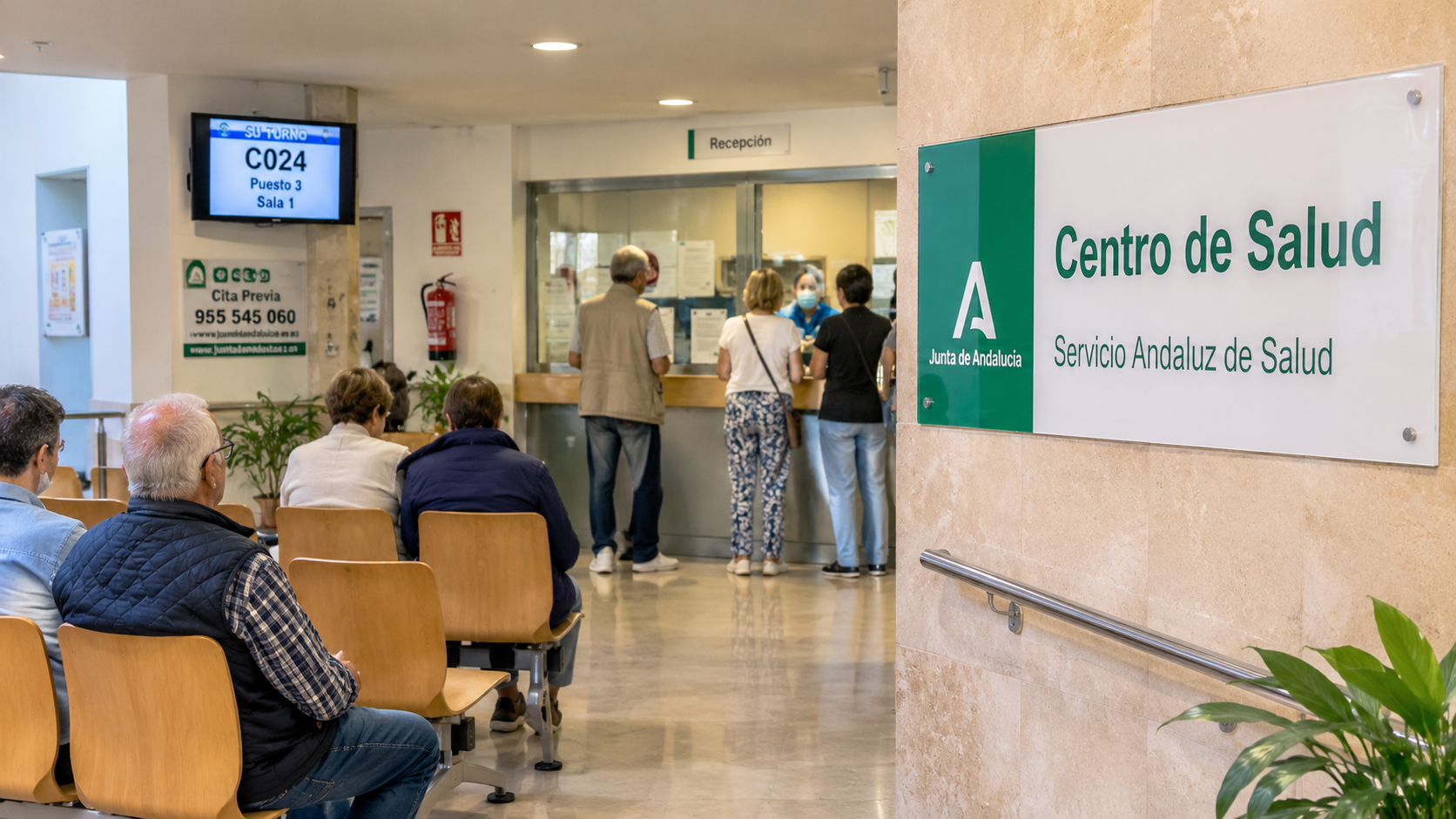
In the province of Málaga, those seeking an appointment with a primary care physician increasingly face long wait times – or, in some cases, are unable to secure an appointment at all. According to a recent study by the group “Jubilados y Jubiladas del SAS”, 31.34 percent of in-person requests for appointments failed to result in a scheduled date. For requests made by phone, that figure was even higher, at 33.64 percent.
Spain Expat Press Editorial Team
by Marlon Gallego Bosbach
According to the study’s findings, approximately one in three attempts to secure an appointment with a general practitioner ends in failure. The survey was conducted at the end of October and, according to the organizers, marks the fourth such investigation to be carried out in the province of Málaga.
871 appointment requests examined
The study took place on October 28, 29, and 30, 2026. A total of 871 appointment requests at health centers across the province were examined. According to the group, all health centers were included. This resulted in an estimated coverage of 92.08 percent of the population aged 14 and older, corresponding to approximately 1.45 million people.
The testers did not actually book any appointments. Instead, they used the official appointment-scheduling systems of the Andalusian Health Service (SAS) to check for the earliest possible available date. According to the group’s assessment, the result is significantly worse than in previous studies.
In the city of Málaga, appointments are unavailable for more than a third of requests
In the Málaga health district, no available appointment was shown for 34.84 percent of in-person requests. Those who did manage to secure an appointment faced an average wait time of 10.86 days.
Across the entire province, the average waiting time was 9.8 days. On the Costa del Sol, patients had to wait an average of 10.75 days for an appointment. In that area, 29.77 percent of requests did not result in an appointment at all. These figures highlight two distinct problems: on one hand, patients may fail to secure an appointment when they request one; on the other, the appointments that are offered are sometimes scheduled far into the future.
Particularly critical situation in the Guadalhorce area
According to the study, the situation is most acute in the Guadalhorce health district. There, no available date could be found for 68.63 percent of requests for in-person appointments – meaning that, initially, it was not possible to secure an appointment in more than two out of every three attempts.
Certain individual health centers also stand out. At the El Palo center, 70 percent of in-person requests could not be accommodated with an appointment. Meanwhile, at the Las Delicias health center, half of the appointments that were actually secured involved a wait time of more than 20 days.
The situation has worsened since March
According to the group, the trend over the course of the year is also a cause for concern. In March, no appointments were available for 21.29 percent of in-person inquiries; by October, this figure had risen to 31.34 percent. Consequently, the proportion of cases where no appointment could be secured increased by approximately ten percentage points within just a few months. The group therefore describes the situation regarding access to public primary care as an alarming development.
Previous studies had already identified significant wait times. According to an earlier survey, the average wait time in the province in March was approximately 8.7 days; at the same time, about 21 percent of in-person inquiries were made without an appointment.
Those who ask early evidently have better chances
The study also concludes that the time at which an appointment is requested plays a role. Those who request an appointment before 9 a.m. have a significantly better chance of securing one. Furthermore, wait times are shorter at that time of day.
According to the group, access to primary care therefore appears to depend, in part, on how early patients attempt to secure an appointment.
Long-serving SAS employees call for better accessibility
The group “Jubilados y Jubiladas del SAS” views these results as indicative of a structural problem within outpatient care. They point out, as a particular concern, that looking solely at the average waiting time fails to adequately reflect the actual situation; for instance, an average waiting time of 9.8 days does not account for those patients who are unable to secure an appointment at all when they make a request.
According to the group, the current figures are significantly higher than the 24-to-48-hour service standard they cite – a target established by the Forum of Physicians for Primary Care.
Health authority does not officially designate it as an investigation
However, these results do not come from official statistics provided by the Junta de Andalucía; rather, they originate from an investigation conducted by a group of retired SAS employees. This is significant because, in previous inquiries by the same group, the Junta had questioned the validity of the figures presented. In June, for instance, the health authority stated that it did not know the source of the figures cited at the time and asserted that, in its view, they did not reflect reality.
The current figures should therefore be presented as the results of an independent survey by the “Jubilados del SAS,” rather than as official statistics from the Andalusian Health Service.
For patients, this means a difficult situation
The study thus paints a picture of primary care in which the length of the wait time is not the only issue. For many patients, a more fundamental question is whether an appointment is offered at all.
In the province of Málaga, nearly a third of the in-person appointment requests examined did not result in an appointment. In the Guadalhorce area, the figure was as high as nearly 69 percent. Those who did secure an appointment within the Málaga health district faced an average wait of nearly eleven days.
This once again places public primary care in Málaga at the center of the debate regarding waiting times, staffing, and accessibility within the Andalusian healthcare system. Current figures indicate a deterioration compared to the spring. It remains to be seen whether – and through what measures – the Andalusian health authorities will respond to this situation.