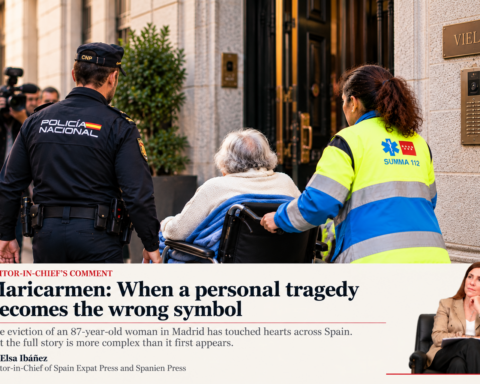
What is driving thousands of Spanish homeowners out of the rental market today is not fear, but the practical impossibility of enforcing an eviction. Owners faced with illegal occupation or persistent non-payment often find themselves trapped in lengthy legal proceedings with no clear end in sight. As a result, an increasing number are choosing to sell their properties — exhausted by litigation, financially strained, and frequently well below market value — simply to bring an unresolved conflict to an end.
Spain Press Editorial Team
According to figures published by the property portal Idealista, more than 24,000 occupied homes were listed for sale between October and December 2025, representing a 4.6% increase compared with the previous quarter. In most cases, these listings reflect failed or indefinitely delayed eviction attempts.
Eviction proceedings with no realistic outcome
Whether involving outright illegal occupation or so-called inquiokupación — tenants who stop paying rent while remaining protected — the experience for homeowners is broadly the same. Court proceedings frequently drag on for years, hearings are postponed, enforcement suspended and rulings delayed.
Even when landlords obtain favourable judgments, actual evictions are often blocked, particularly when occupants are classified as vulnerable households. During this time, owners continue to face mortgage payments, community fees, maintenance costs and mounting legal expenses, while being deprived of the use of their own property.
Selling becomes the last resort
Faced with this deadlock, many homeowners opt for what they see as the only viable escape: selling the property despite ongoing occupation. Such homes are typically marketed well below their true market value, attracting mainly specialist investors willing to assume legal and financial risk.
In these cases, the sale is not a strategic investment decision, but a means of exiting an unsustainable situation.
Catalonia at the centre of the trend
The phenomenon is particularly pronounced in Catalonia, which accounted for around 40% of all occupied homes listed for sale in Spain during the final quarter of 2025. In the province of Barcelona, 8.3% of all properties offered for sale were occupied.
Market analysts point to a clear correlation: the more complex and prolonged eviction procedures become, the faster private landlords withdraw from the rental market.
No longer confined to major cities
Once associated mainly with large urban centres, the issue has now spread across much of the country. Significant increases in the sale of occupied homes have been recorded in smaller and mid-sized provinces such as Teruel, Ávila, Burgos, Murcia and Ourense.
Soria remains one of the few notable exceptions, with very limited cases reported.
A rental market in gradual retreat
The structural consequences are increasingly evident:
a shrinking supply of rental homes, rising prices, and a growing reluctance among private owners to let their properties. At the same time, the government has extended the state anti-eviction decree until at least the end of 2026, reinforcing perceptions among landlords that enforced eviction may be effectively postponed indefinitely in certain cases.
An alarming signal
The growing practice of selling occupied homes below market value is not a normal market adjustment, but a clear symptom of systemic dysfunction. As long as eviction procedures are perceived as endless, costly and emotionally draining, many owners will reach the same conclusion:
selling ends the problem — renting prolongs it.
And with each such decision, Spain’s rental market continues to shrink further.