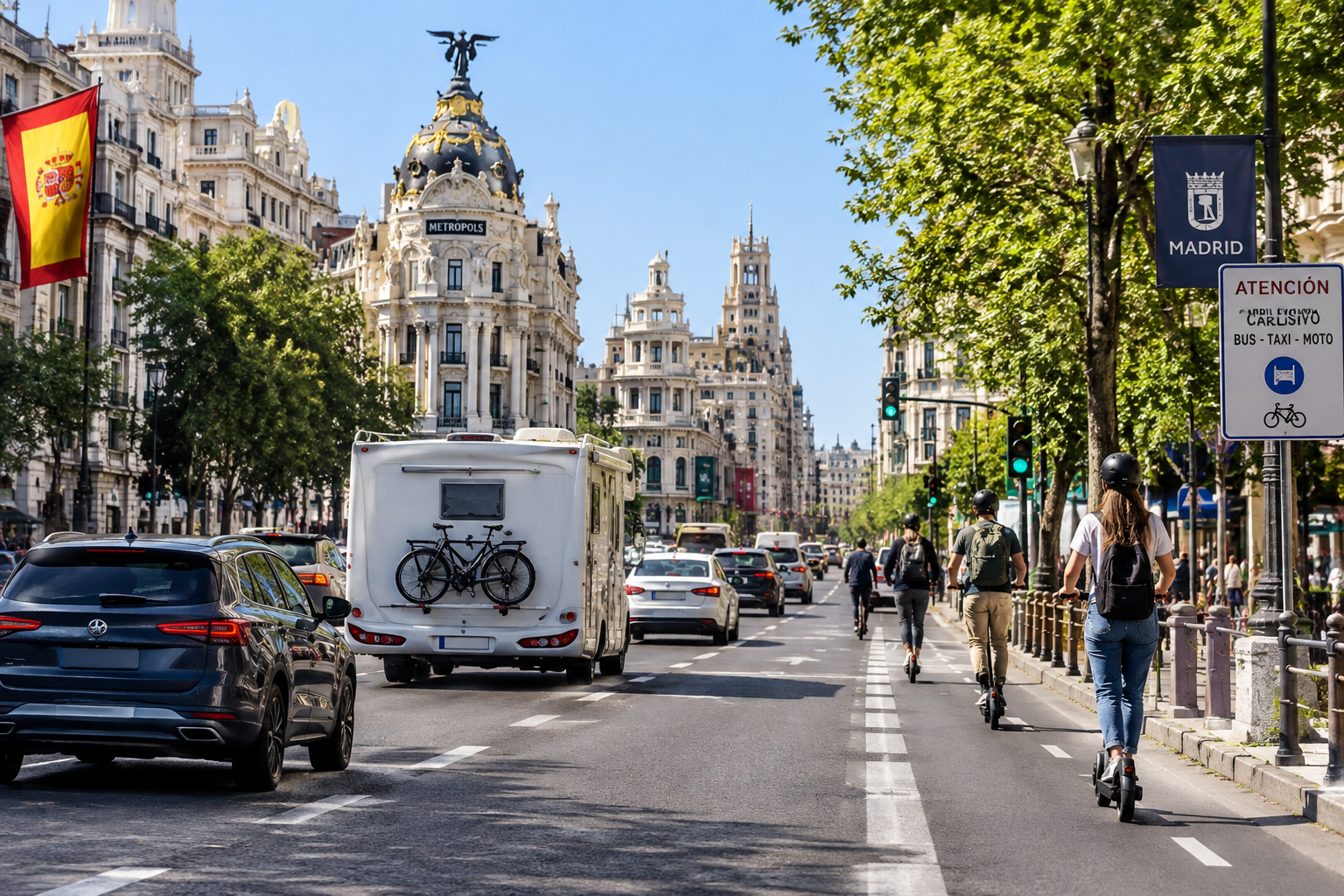
Numerous new traffic regulations have been in effect in Spain since October 1, 2026. The reform primarily focuses on the protection of cyclists, pedestrians, and e-scooter users, but also introduces new rules for motorcycles, car drivers, and urban traffic.
Spain Expat Press Editorial Team
by Marlon Gallego Bosbach
Anyone traveling in Spain by car, motorcycle, bicycle, or e-scooter must adapt to new rules as of October 1st. Comprehensive amendments to the Spanish General Traffic Regulations (Reglamento General de Circulación) come into effect today. These changes are based on Royal Decree 518/2026, which was published in the Spanish Official State Gazette (BOE) at the end of June.
A significant part of the reform focuses on so-called particularly vulnerable road users. These include, among others, pedestrians, cyclists, motorcyclists, and users of small electric vehicles.
New rules for e-scooters
A particularly large number of changes affect so-called VMPs – that is, small electric vehicles such as electric scooters. The minimum age for use will be 15. In addition, wearing a helmet is mandatory. In darkness or conditions of poor visibility, the vehicles – or their riders – must be equipped with appropriate lighting or reflective elements.
As a general rule, e-scooters must not be ridden on sidewalks. Restrictions also apply outside built-up areas. Motorways, expressways, and other roads where these vehicles are prohibited may not be used.
An important transitional rule concerns lighting: under the official regulations, the requirement to keep lights on during the day does not apply until October 1, 2027.
Stricter rules for cyclists
Cyclists must also adapt to new rules. As a general rule, wearing a helmet is mandatory outside built-up areas. For those under the age of 16, helmet use is mandatory on all roads.
The rules for overtaking bicycles are being tightened significantly. Outside built-up areas, drivers must continue to maintain a lateral clearance of at least 1.5 meters when overtaking. At the same time, the speed during the overtaking maneuver must not be more than 20 km/h below the speed limit applicable to the road in question.
If the road has multiple lanes in the same direction, a driver must move completely into the other lane when overtaking a bicycle. There is also a new rule for built-up areas: if a bicycle is traveling ahead of a motorized vehicle in the same lane, a minimum distance of five meters must be maintained.
New regulations for motorcyclists
Additional safety regulations also apply to motorcyclists and moped riders. On roads outside built-up areas, riders and passengers will henceforth be required to wear protective gloves. Furthermore, closed footwear covering the entire foot is mandatory on all roads; open-toed shoes such as sandals or flip-flops are therefore not permitted while riding.
Motorcycles must also carry a high-visibility warning vest. It must be used, in particular, when the rider leaves the motorcycle outside built-up areas and is on the roadway or hard shoulder due to a breakdown or other incident.
Another change concerns traffic jams: under certain conditions, motorcycles are permitted to use the right-hand shoulder in the event of significant traffic congestion. A maximum speed of 30 km/h applies in such cases. Actual usage may depend on specific traffic conditions and signage.
New rules for traffic jams and breakdowns
There are also changes for drivers that become particularly relevant in unusual traffic situations. In the event of traffic jams, sufficient space must be created for emergency and rescue vehicles. Drivers should position their vehicles accordingly to ensure a clear passage for the police, fire department, ambulance services, and other emergency personnel.
The handling of broken-down vehicles is also being newly or more precisely regulated by the reform. The aim is to enhance safety for individuals who have to leave their vehicles due to a breakdown or an accident.
New regulations for snowy conditions
The reform also includes regulations for traffic during snow and wintry conditions.
On motorways and expressways, the aim is in particular to ensure that snowplows as well as rescue and emergency vehicles have sufficient space. To this end, the use of certain lanes may be restricted.
More protection for pedestrians
Another pillar of the reform is the protection of pedestrians. Particular consideration is given to people with reduced mobility, people with disabilities, children, and the elderly.
Consequently, traffic within urban areas is also being more strictly regulated. A new section of the traffic regulations specifically addresses the unique conditions found in cities and municipalities. This includes, among other things, rules regarding sidewalks, parking areas, loading and delivery zones, and access restrictions.
Safe routes to school are to be expanded
Also new is the explicit legal basis for so-called safe routes to school. Municipalities can establish such routes for children, incorporating measures such as speed limits, special traffic signs, or access restrictions.
The regulations are intended to help make traffic around schools safer.
Motorhomes also affected
The reform also includes new or more precise requirements for motorhomes and other camping vehicles.
In doing so, a clearer distinction is being made between merely parking a motorhome and actual camping. The regulations aim to provide greater clarity, although municipalities can still establish additional provisions through their own traffic ordinances.
For holidaymakers traveling through Spain in a motorhome, it therefore remains worthwhile to pay attention to local signage and the respective municipal regulations.
Overview of the key changes
As of October 1, 2026, the following new or amended requirements apply, among others:
- E-scooters: minimum age of 15 and mandatory helmet use; riding on sidewalks is prohibited; lighting or reflective elements required after dark
- Cyclists: stricter helmet requirements
- Overtaking bicycles: minimum clearance of 1.5 meters and additional speed requirements; within built-up areas, a distance of five meters from bicycles traveling ahead in the same lane.
- Motorcycles: Protective gloves required outside built-up areas; closed footwear required on all roads; high-visibility vest must be carried; use of the hard shoulder permitted in specific traffic jam situations at a maximum speed of 30 km/h
- Traffic jams: Emergency corridors for emergency vehicles
- Snow: additional regulations on keeping traffic lanes clear
- Cities: new guidelines for pedestrians, parking, and traffic organization
- School routes: legal basis for safe routes to school
- Motorhomes: more precise rules for distinguishing between parking and camping
The reform is thus far more extensive than a mere modification of individual traffic rules. It affects various road users and is intended, in particular, to enhance the protection of people who are especially vulnerable in traffic.