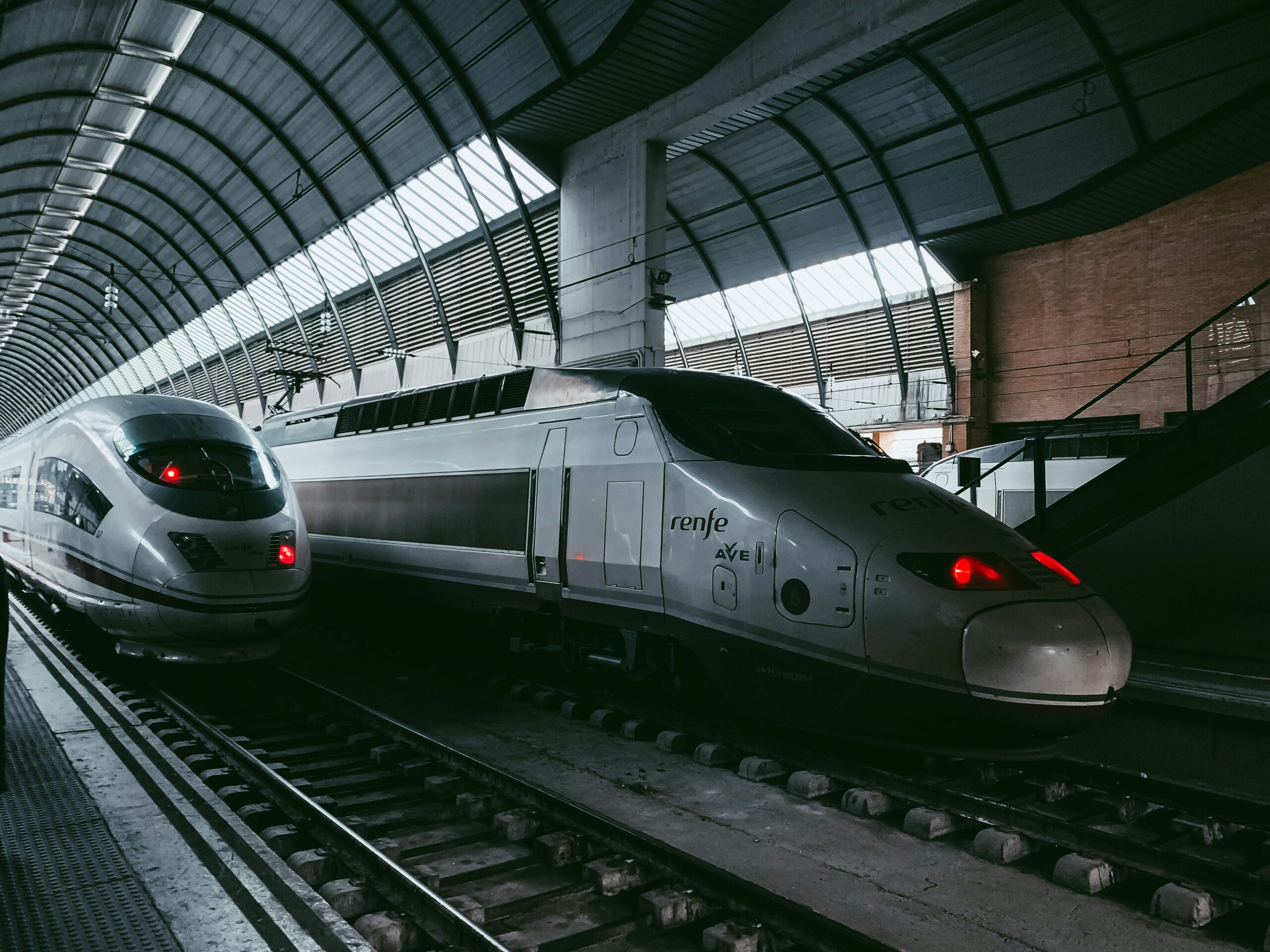
The work stoppage by railway traffic controllers at Adif, originally planned for tomorrow, Thursday, has been called off following an agreement reached with the company and the Ministry of Transport. However, the conflict within the Spanish rail sector is not yet over: the train drivers’ union, Semaf, is sticking to its planned strike at Renfe on November 23 and has signaled the possibility of further strike days.
Spain Expat Press Editorial Team
by Marlon Gallego Bosbach
There is some welcome relief for rail travelers in Spain, though the overall situation remains tense: the strike by traffic controllers at the infrastructure company Adif, which had been scheduled for this Thursday, will not take place. The trade union Sindicato de Circulación Ferroviario (SCF) stated that Adif has accepted its demands and provided concrete commitments regarding staffing, working hours, breaks, and the workload of control personnel.
Meanwhile, the strike by Renfe train drivers scheduled for next Monday (November 23) is still set to go ahead. The trade union Semaf considers the proposals put forward so far by the Ministry of Transport to be insufficient and is already weighing up further strike days.
Agreement ends Adif strike on Thursday
The SCF had announced a separate strike for tomorrow, Thursday. Following discussions with Adif and the Ministry of Transport, this strike has now been called off. The agreement focuses primarily on the working conditions of the staff responsible for controlling and managing train traffic. Among other things, the union had demanded better staffing levels, limits on workloads, and guaranteed breaks.
Adif now intends, among other measures, to request an extraordinary public recruitment process to secure additional staff for train traffic control operations. This process is slated to take place ahead of the regular recruitment drive scheduled for 2027. Furthermore, an assessment will be conducted to determine the actual staffing requirements for each individual control center. With this move, the infrastructure company is also responding to criticism regarding the excessive workload placed on existing personnel.
Two hours of traffic control, followed by a break of at least 30 minutes
One particularly specific aspect of the agreement concerns continuous traffic management. In the future, such tasks are not to be performed for more than two hours without a break. Following this, a rest period of at least 30 minutes must be provided. Initially, this policy is to be implemented primarily in locations where control centers are under heavy strain and staff are subject to a high workload.
In addition, new regulations are to be introduced to limit the number of tasks that can be assigned simultaneously to an individual responsible for rail traffic operations. Pending the full implementation of a corresponding technical regulation, Adif intends to produce a document – within a maximum of 30 days – that restricts the number of tasks to be managed concurrently on high-speed lines.
More staff and better training
Another component of the agreement involves increasing staffing levels at the control centers. Adif also intends to expand ongoing staff training, which includes practical exercises and sessions using modernized simulators. Furthermore, the actual observance of break periods is to be facilitated through the creation of additional positions at the affected control centers.
Furthermore, existing work instructions are to be reviewed and, in some cases, replaced. According to the SCF, this concerns, among other things, regulations that had previously placed an additional burden on those responsible for traffic control.
Why train drivers are striking anyway
While the SCF, UGT, and CCOO have accepted the agreement with the Ministry of Transport, the train drivers’ union Semaf has not followed suit. The union is sticking to its planned strike for next Monday (November 23). It criticizes the fact that some of the measures proposed by the Ministry have not yet been definitively adopted or implemented.
Semaf states that it is demanding concrete results rather than new promises. The union explains that it has lost confidence that announced measures will actually be implemented. Furthermore, the substance of the proposals fails to convince the train drivers. Semaf criticizes the fact that, from its perspective, the remaining unresolved issues do not adequately address the actual problems facing railway operations.
Security issues are at the heart of the matter
The conflict is particularly sensitive against the backdrop of the serious train accidents in Urda and Adamuz. For months, the trade unions have been demanding improvements to safety procedures, technical systems, and working conditions for staff.
The current agreement with Adif therefore also includes measures for reviewing operational and safety protocols. These include, among other things, changes to procedures for situations in which regular safety systems are not fully available.
For train drivers, the issue of safety is of particular importance. Among other things, Semaf is calling for definitive solutions for situations in which technical systems – such as LZB or ERTMS – fail. In the union’s view, the responsibility for ensuring safe continued travel in such scenarios should not be placed too heavily on the train drivers.
Dispute over the implementation of the agreements
It is precisely on this point that one of the major differences between the trade unions emerges. The government and Adif point to concrete commitments and measures already set in motion; Semaf, by contrast, argues that many of these points have been framed merely as intentions or ongoing processes.
The union stated that the document includes some measures that have already been decided upon or implemented, while other points are still being processed. For Semaf, this is not enough to call off the strike. Consequently, the core conflict remains: while the Ministry of Transport points to an agreement reached with several other unions, Semaf demands binding measures that have already been put into effect.
What does this mean for rail passengers?
For travelers, the difference between Thursday and Monday is particularly significant. The planned strike by Adif traffic controllers, scheduled for this Thursday, has been called off. This removes an additional strain on Spain’s rail network for tomorrow.
On the other hand, rail passengers should continue to expect disruptions this coming Monday (November 23). The strike by Renfe train drivers is still set to go ahead. The actual number of train cancellations will depend, among other factors, on the mandatory minimum service requirements and the final timetables.
In principle, various Renfe services can be affected, including long-distance trains, regional connections, as well as Cercanías and Rodalies (commuter rail) services. During previous strike days, commuter services were particularly heavily impacted.
Further strike days possible
The cancellation of the Adif strike does not mean the conflict is over. Semaf has explicitly stated that November 23 remains the next scheduled round of mobilization, while the possibility of further strike days is also being considered.
This leaves the Ministry of Transport under continued pressure to reach a solution with the train drivers before Monday. While the agreement reached with SCF, UGT, and CCOO provides a basis for further discussions, Semaf is demanding additional and more binding commitments.
Agreement brings temporary relief, but no lasting solution
The current situation is therefore twofold: the Adif strike scheduled for tomorrow, Thursday, has been called off, while the Renfe strike set for next Monday remains in place. The agreement reached with the traffic controllers includes concrete measures regarding staffing, working hours, breaks, and training. At the same time, it demonstrates that the Ministry of Transport is capable of reaching agreements with certain segments of the trade unions.
For the train drivers, however, this is not enough. Semaf is demanding further concrete improvements and has already signaled the possibility of additional strike days. The rail dispute in Spain therefore continues, despite the initial agreement – and could once again have a significant impact on travelers and commuters in the coming days.