Spain’s Prime Minister is using the visit of Argentine President Javier Milei to launch attacks on the conservative opposition. In the context of the election campaign, he contrasts the policies of the right with the social-policy agenda of his own government.
Spain Expat Press Editorial Team
by Marlon Gallego Bosbach
Spanish Prime Minister Pedro Sánchez used Argentine President Javier Milei’s visit to Madrid as an opportunity to launch a sharp attack on the conservative People’s Party (PP) and the right-wing populist party Vox. At a PSOE campaign event in Burgos, he warned of the political consequences of a potential change in government, accusing both opposition parties of representing not merely a standard political transition, but a step backward.
In doing so, Sánchez drew a parallel between Milei’s economic policy agenda and the ideas held by the Spanish right. While the Argentine president advocates for sweeping state spending cuts and a radical overhaul of the public administration, the Spanish head of government defended his own administration’s social policy measures. This confrontation comes at a time when the PSOE is seeking to mobilize its supporters ahead of upcoming regional elections.
Sánchez presents Milei as a warning for Spain
In his speech in Burgos, Sánchez attacked both PP leader Alberto Núñez Feijóo and Vox chairman Santiago Abascal. He accused them of being politically aligned with Milei – specifically regarding the demand to scale back state services – thereby attempting to hold both opposition parties jointly responsible for a potential shift in economic and social policy.
Sánchez emphasized that a change of government is, in principle, both legitimate and necessary in a democracy. However, a shift in power does not automatically equate to progress. In his view, a potential government formed by the PP and Vox would, in fact, jeopardize existing social achievements. He described the course he fears they might take as a political “involution” – that is, a regression.
The warning is part of the PSOE’s strategy to frame the upcoming elections as a choice about the country’s future direction. In doing so, the Socialists aim to appeal, in particular, to those voters who view state social benefits, labor rights, and public services as key achievements.
Minimum wage and employment as a counterargument
To support his position, Sánchez pointed to Spain’s economic performance and contrasted it with the situation in Argentina. In doing so, he highlighted the increases to the Spanish minimum wage since he took office; according to his figures, it has risen by a total of 66 percent since 2018.
Furthermore, the Prime Minister pointed to the number of employees in Spain who are subject to mandatory social security contributions. He contrasted the approximately 22.6 million such contributors with the scale of informal employment in Argentina – a figure he estimated at around eleven million people.
With these figures, Sánchez sought to demonstrate that his government could combine economic growth with social improvements. In contrast, he presented Milei’s policies as an example of an approach in which austerity measures and state spending cuts come at the expense of the population.
However, these comparisons are part of the political debate. The economic conditions in the two countries differ significantly, which is why the figures cannot be directly compared.
Pension policy also played a role in Sánchez’s line of argument. The head of government defended the Spanish pension system and highlighted the safeguarding of social benefits as a key distinction between his administration’s approach and the vision put forward by the opposition.
“Left-wing pride”: The PSOE counters Milei with a campaign of its own
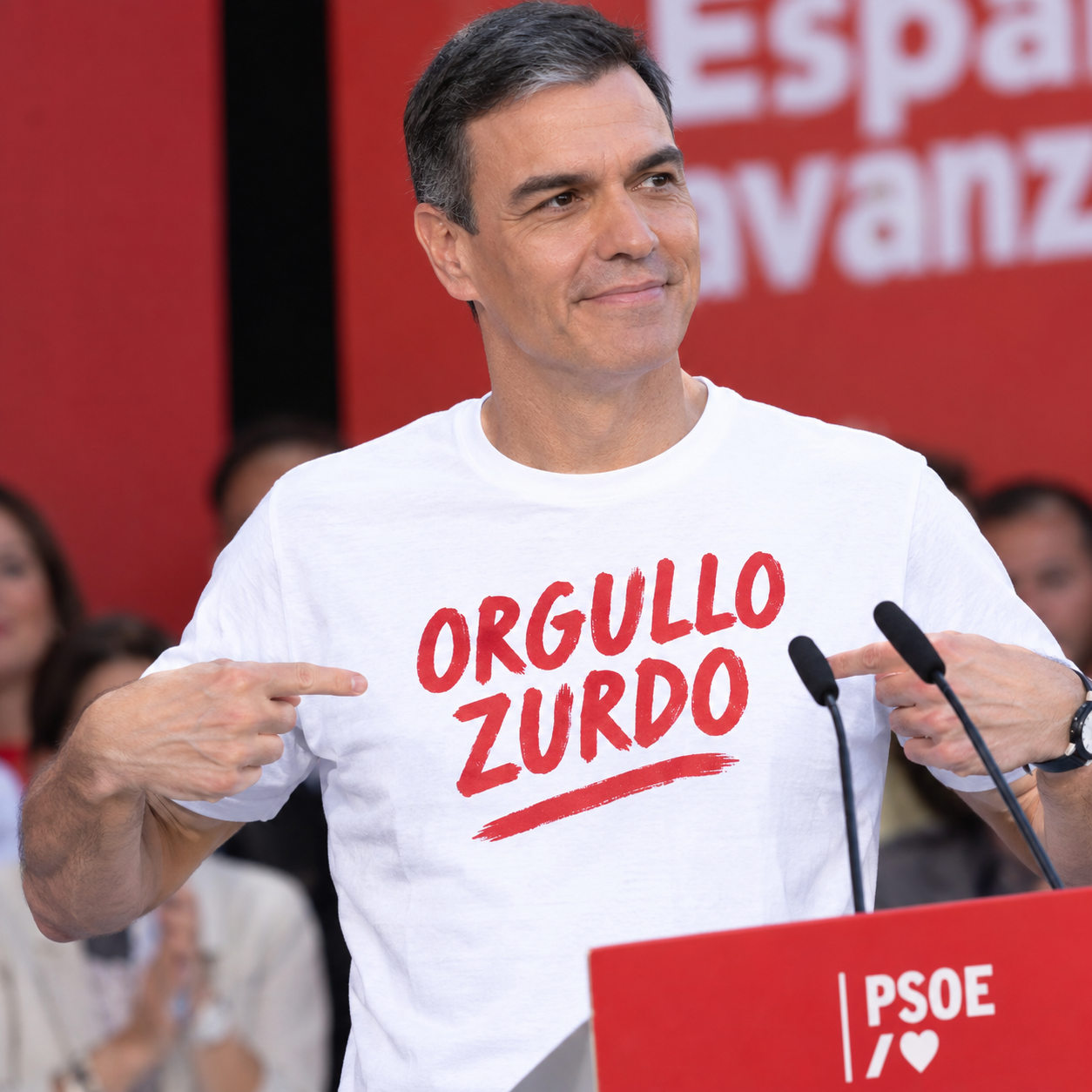
The visit by the Argentine president became a political symbol that extended beyond the campaign event itself. The PSOE responded with a campaign titled “Orgullo zurdo,” which can be loosely translated as “Pride in the Left.”
A banner was hung at the party headquarters on Madrid’s Calle Ferraz, offering an ironic welcome to Milei while simultaneously highlighting the self-conception of the Spanish left. During an appearance in Burgos, Sánchez echoed this message by wearing a T-shirt emblazoned with the words “Orgullo zurdo.”
In a video, he highlighted political achievements such as higher pensions, an increased minimum wage, better opportunities for parents to spend time with their children, and the right to abortion. With this, the PSOE aimed to convey a positive message about its own policies while simultaneously rebuffing criticism from the political right.
The campaign has a clear objective: the PSOE aims to leverage the public attention surrounding Milei’s visit to strengthen its own political identity and to present itself as an alternative to the economic and social policy visions of the right.
Dispute over abortion rights
During his appearance in Burgos, Sánchez also took the opportunity to reiterate another policy announcement. He once again raised the prospect of enshrining the right to abortion in the Spanish Constitution. According to him, the initiative is set to be revisited during the next legislative term. However, such a constitutional amendment would be politically challenging and would require the necessary parliamentary majorities – support from the conservative opposition is by no means guaranteed.
This announcement aligns with the PSOE’s strategy of placing socio-political issues – alongside economic concerns – at the heart of their election campaign. The protection of women’s rights and the defense of existing social rights are among the key arguments the Socialists intend to use to mobilize their voters.
Milei’s visit intensifies the political divide
The dispute between Sánchez and Milei extends beyond Spanish domestic politics. The Argentine president advocates for an economically liberal—or even libertarian—approach, calling for a sweeping reduction in state intervention. Sánchez, by contrast, favors a stronger welfare state, higher wages, and the protection of public services.
The Spanish head of government is attempting to leverage these contrasts for his own election campaign. By linking Milei’s positions to the political views of the PP and Vox, he aims to warn of the potential consequences of a shift to the right.
Whether this strategy will resonate with voters remains an open question. What is certain, however, is that the Argentine president’s visit offers the PSOE an additional opportunity to highlight its key policy priorities and put pressure on the opposition. For Sánchez, this is not just about the confrontation with Milei, but also about the broader question of which economic and social path Spain should pursue in the future.