Demonstrations are being held across Spain at 8pm today, with a number of Socialist-run councils joining the mobilisation despite the position taken by the PSOE leadership. Meanwhile, questions are mounting over what the Spanish government knew before the crisis erupted.
Spain Expat Press Editorial Team
Spain’s attention turns to Ceuta today as demonstrations are held across the country in solidarity with the Spanish enclave, which has been struggling with the consequences of the migration crisis since the end of July.
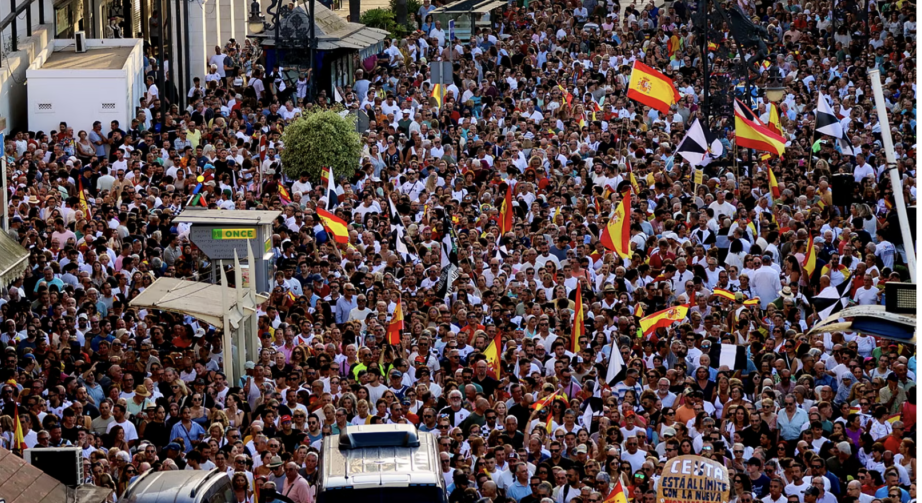
The main demonstrations, called through the Spanish Federation of Municipalities and Provinces (FEMP), are due to take place outside town and city halls at 8pm on Wednesday, 2 September.
The message is straightforward: Ceuta is not alone.
Yet what was intended primarily as an expression of solidarity has also become another source of political tension in Spain.
The national PSOE leadership has distanced itself from the demonstrations, arguing that the initiative is being politically exploited by the conservative Partido Popular.
Not every Socialist mayor, however, is following the party line.
Socialist councils break ranks
A number of Socialist mayors and PSOE-run councils have decided either to participate in the demonstrations or organise their own events in solidarity with Ceuta.
The divisions are particularly significant because they demonstrate the difficulty of maintaining party discipline over an issue that many local politicians regard as extending beyond the usual battle between Spain’s political parties.
In Andalusia, too, Socialist-run municipalities have chosen to show their support for Ceuta despite reservations expressed by the party leadership.
The crisis has therefore become more than a question of migration and border control. It is increasingly developing into a test for Spanish domestic politics.
What did the government know?
An even more uncomfortable question is now being asked in Madrid: what did the Spanish government know before the mass border crossings at the end of July?
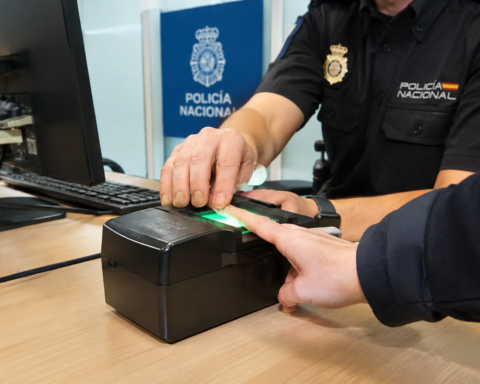
Reports concerning internal information held by the Policía Nacional have intensified the controversy.
A police report is said to contain indications that Moroccan security personnel may have played a role in the events. Spanish media have reported allegations that Moroccan officers in plain clothes may even have guided migrants or contributed to the pressure at the border.
These are serious claims and they have not yet been conclusively established.
Interior Minister Fernando Grande-Marlaska has demanded explanations from the director-general of the National Police over the report.
The controversy raises an obvious question: if Spanish security services possessed potentially significant information before or during the crisis, when did that information reach the government – and what action was taken?
Prime Minister Pedro Sánchez has acknowledged that Spanish authorities had received information about the developing situation, while maintaining that it did not allow them to foresee an influx on the scale that subsequently occurred.
Exactly what was known, and when, is therefore likely to remain at the centre of the political debate.
Sánchez rejects Moroccan responsibility
The Spanish prime minister has so far rejected attempts to place direct responsibility for the crisis on Morocco, emphasising instead the role played by international disinformation networks.
Sánchez has pointed to networks linked to Russia and Israel, as well as international far-right groups, accusing them of helping to spread or amplify misleading information on social media.
Both Russia and Israel have rejected the accusations.
There is little dispute that false information concerning Spain’s border circulated extensively online. What remains disputed is who originally generated that information, who subsequently amplified it and how decisive a role it played in bringing thousands of people to the border.
Those questions will require further investigation.
For Ceuta, the argument over blame is no longer enough
For residents of Ceuta, however, the debate over whether responsibility ultimately lies with Morocco, foreign disinformation networks or failures within Spain itself is increasingly overshadowed by a much more urgent question:
What happens now?
Ceuta has been living under extraordinary pressure for weeks.
Migrants must be accommodated, registered and their individual circumstances assessed. Security forces and public services are under considerable strain, while local businesses are also feeling the effects of prolonged uncertainty.
The Spanish government has announced emergency financial assistance and additional resources, but the challenge facing the enclave cannot be solved by funding alone.
Residents want security and a return to normality.
Above all, they want to know how long a city of fewer than 100,000 inhabitants can reasonably be expected to cope with such an exceptional situation.
Ceuta cannot become a political football
The circumstances surrounding the crisis must be investigated.
If Spanish authorities possessed significant information before the events of 30 and 31 July, it must be established how that intelligence was handled.
If allegations concerning the involvement of Moroccan officials are substantiated, the diplomatic implications would be considerable.
And if foreign actors deliberately exploited the crisis through disinformation, that too needs to be examined.
But while Madrid debates who was responsible, Ceuta continues to live with the consequences.
The priority must therefore be not only to establish how the crisis happened, but to find a credible and lasting solution.
The situation remains tense, and there are growing concerns that frustration within the enclave could eventually spill over.
Today at 8pm: Spain stands with Ceuta
People will gather outside town and city halls across Spain this Wednesday to demonstrate their solidarity.
Not every event will take place at precisely the same time, and some Socialist-run councils have chosen to organise separate gatherings. The main FEMP mobilisation, however, is scheduled for 8pm.
For one evening, the intention is to put party politics to one side.
Because regardless of who is ultimately held responsible for the crisis, one fact remains:
Ceuta needs a solution – and it needs one urgently.
Wednesday, 2 September, 8pm: Spain stands with Ceuta.