The eviction of an 87-year-old woman after 71 years in the same Madrid flat has shaken Spain and piled pressure on the government. Yet behind one highly emotional case lies a much bigger problem: Spain does not have enough homes, and the gap between supply and demand continues to widen.
Spain Expat Press Editorial Team
The case of Maricarmen has, within a matter of days, triggered one of Spain’s most intense housing debates in recent years.
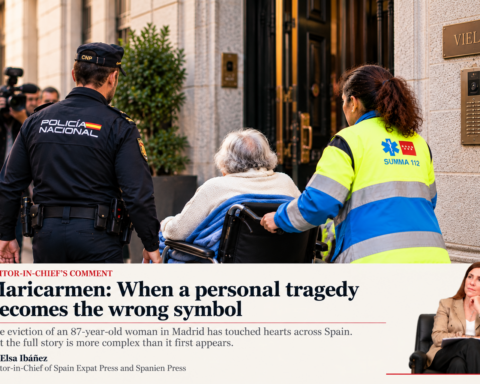
Images of the 87-year-old woman leaving her home in Madrid’s Retiro district spread rapidly across the media and social networks. Hundreds of people gathered outside the property in an attempt to stop the eviction, politicians intervened and fresh tensions emerged within Spain’s PSOE-Sumar coalition government.
Maricarmen has now become a symbol of Spain’s housing crisis.
But understanding her case requires looking beyond the images. She was not evicted for failing to pay her rent, nor was hers an ordinary modern tenancy agreement.
At the heart of the dispute lies an almost historical relic of Spanish rental law: the so-called “renta antigua”, or old protected tenancy.
Así ha salido Maricarmen de su casa. La imagen de la barbarie. pic.twitter.com/2nqXBWN9Wp
— Eva Baroja 🗞 (@eva_baroja) September 22, 2026
A tenancy agreement from another era
Maricarmen had lived in the flat since the 1950s. The original tenancy agreement was signed by her father.
After his death, the tenancy passed to her mother. When her mother died in 2005, Maricarmen continued living in the property under the succession rules applying to these historic contracts.
Spain once had an exceptionally protective system for long-standing tenants. Rents could remain far below later market prices for decades, while tenancy rights could, under certain circumstances, pass from one member of a family to another.
The system generally associated today with renta antigua was consolidated by Spain’s 1964 Urban Tenancy Act during the Franco dictatorship.
One of its defining features was the “prórroga forzosa”, or compulsory extension of a tenancy, which severely restricted an owner’s ability to terminate such contracts.
But Spanish rental law subsequently changed dramatically.
Under the transitional rules governing old contracts, a second succession to a child could generally continue for only two years, unless certain exceptions applied. One of those concerned tenants with a recognised disability of at least 65 per cent.
Maricarmen has a recognised disability of 50 per cent.
The crucial date: 2007
This brings us to an important part of the story that can easily become lost in the emotional debate.
According to the legal interpretation that ultimately prevailed, Maricarmen’s right to continue the inherited historic tenancy expired in 2007, two years after her mother’s death.
That does not mean that she simply stopped paying rent.
She remained in the flat and continued making rental payments, which were accepted for years.
The dispute emerged later after ownership of the property changed and the new owners argued that the historic tenancy had legally expired.
The matter eventually reached the courts, which upheld the argument that Maricarmen no longer had the right to continue the inherited protected tenancy.
Her eviction was therefore not the result of unpaid rent. It followed a legal dispute over whether she still had the right to remain in the property under her parents’ historic tenancy.
That distinction is important.
A historical irony: Franco and the Socialists
There is also a striking historical dimension to the current political debate.
The highly protective tenancy system associated with renta antigua was strengthened during the Franco era, particularly through the 1964 legislation.
Years later, it was a Socialist government that began dismantling one of its central features for new contracts.
Under Prime Minister Felipe González, the PSOE government introduced the 1985 “Boyer Decree”, ending compulsory indefinite extensions for new rental agreements.
The aim was, among other things, to make the rental market more flexible and encourage owners to put homes on the market.
Historic contracts did not disappear overnight. Later legislation, particularly the 1994 Urban Tenancy Act, established transitional rules governing how long old tenancies and succession rights could continue.
Maricarmen’s case is therefore also the product of a decades-long transition between two very different Spanish rental systems.
Sumar introduces a new word into the debate: expropriation
The political confrontation has now gone a significant step further.
Sumar, the junior and more left-wing partner in Pedro Sánchez’s coalition government, has called for Maricarmen’s former flat to be expropriated.
Second Deputy Prime Minister Yolanda Díaz has demanded that the Council of Ministers approve both the expropriation and a wider housing package. Sumar is also seeking measures including rent freezes and extensions, tighter regulation of tourist and seasonal rentals and stronger protection for tenants facing investment funds.
The Socialist side of the government has not committed itself to the proposed expropriation, although negotiations over a new housing decree have accelerated since the eviction.
The word expropriation has therefore suddenly entered the centre of Spain’s housing debate.
Supporters argue that compulsory purchase with compensation can be a legitimate instrument in exceptional circumstances where the public interest and the protection of vulnerable people are at stake.
Critics, meanwhile, argue that increasingly aggressive intervention in property rights risks undermining legal certainty and could discourage private owners from offering their properties on the long-term rental market.
This goes to the heart of one of Spain’s housing dilemmas: how far can the state regulate the rental market without further restricting an already insufficient supply of homes?
The left points to the right – but Sánchez has governed since 2018
The Maricarmen case has also intensified the political argument over who bears responsibility for Spain’s housing crisis.
The PSOE and Sumar regularly point to conservative regional governments, the housing policies of the Partido Popular (PP), major property owners and investment funds.
There is an important factual basis for part of that argument.
Spain is a highly decentralised country. Its autonomous regions and municipalities have substantial powers over planning, development land and social housing. Responsibility for housing policy therefore does not rest solely with the national government.
But another fact is equally relevant: Pedro Sánchez has been Prime Minister since June 2018.
Spain’s central government has therefore been led by a Socialist prime minister for more than eight years. Since early 2020, the PSOE has also governed in coalition with parties to its left — first Unidas Podemos and now Sumar.
The present housing crisis can therefore hardly be attributed exclusively to previous conservative governments or to regions currently governed by the PP.
During those years, access to affordable housing has become increasingly difficult in many parts of Spain.
Behind the political battles over rent controls, investment funds, holiday lets and now expropriation lies a less dramatic but fundamental problem:
Spain has not built enough homes.
The problem is not that Spain builds nothing – it builds too little
Precision matters here.
New homes are, of course, being built in Spain. The problem is that housing supply has failed to keep pace with the creation of new households, particularly in areas experiencing rapid population and employment growth.
This produces an increasingly severe imbalance between supply and demand.
Even if every argument about rent controls, investment funds and tourist accommodation were set aside, the basic arithmetic would remain.
If substantially more households are being created than homes are being completed, more people are forced to compete for a limited housing stock.
And scarcity puts upward pressure on prices.
Housing has become Spain’s number one concern
That helps explain why the Maricarmen case has had such political impact.
Housing has moved to the centre of public concern in Spain.
High purchase prices, rapidly rising rents and limited supply are no longer problems affecting only the poorest households.
The pressure is particularly acute in economically dynamic cities and regions experiencing strong population growth or tourism, including Madrid, Barcelona, Valencia, Málaga, Alicante and the Balearic Islands.
For many young Spaniards, leaving the parental home has become increasingly difficult. Families compete for rental properties, while even households on average incomes can struggle to find affordable accommodation in the most sought-after areas.
Maricarmen did not create this problem.
Her case simply gave it a human face.
Evictions have not disappeared
The political debate also raises an uncomfortable question for the government.
Housing campaigners and parties on the left have spent years promising stronger protection for people at risk of losing their homes.
Yet evictions continue.
According to figures cited by RTVE from Spain’s General Council of the Judiciary, 4,005 judicial evictions were carried out in the first quarter of 2026 alone — an average of 44 a day. The statistics cover different types of judicial proceedings and should not be interpreted as 4,005 vulnerable families being removed from their primary homes, but they nevertheless demonstrate that eviction remains a significant issue.
The government itself has now described the Maricarmen case as a “turning point” and is working to secure parliamentary support for a decree that would include an anti-eviction moratorium for vulnerable people who cannot be offered alternative accommodation.
Adding fuel to the fire, old campaign videos of Pedro Sánchez promising “zero evictions” are now circulating widely on social media.
-“Y ese va a ser mi compromiso. Ni un solo deshaucio cuando gobierne!
¡Y vaya si cumplió!
272.000 desde que gobierna. 90 diarios
Los compromisos de Sanchez siempre se cumplenhttps://t.co/R0OclrKDGm pic.twitter.com/3ayXUgg9P7
— Miguel Fuentes 🇪🇸 (@miguefuente) September 24, 2026
And what does Maricarmen herself say?
There is another politically significant element to the story.
Maricarmen herself has criticised politicians across the political spectrum.
In an interview shortly before her eviction, she directed criticism at the institutions she believed had failed to protect her. Her frustration was not limited to Madrid’s conservative authorities: she also singled out Prime Minister Pedro Sánchez.
That makes her position particularly noteworthy in a debate in which the central government has blamed the PP and Vox for blocking previous measures intended to prevent evictions, while the Madrid authorities have faced criticism from the left and from tenant organisations.
Maricarmen’s own message does not fit neatly into either political camp.
Periodista: ¿A quien responsabilizas tú de todo lo que te está pasando?
Maricarmen: A Pedro Sánchez pic.twitter.com/QuKgeP1ofI
— Luis Daoiz (@LuisDaoiz1808) September 24, 2026
Spain’s housing shortage is the bigger story
Ultimately, however, the debate goes far beyond one eviction.
If housing construction does not accelerate significantly while the number of households continues to increase, the gap between the homes Spain needs and those available will continue to widen.
That is a problem no tenancy law can solve on its own.
Spain can extend rental contracts.
It can regulate rents.
It can tighten the rules governing holiday accommodation.
It can strengthen protections for vulnerable tenants.
And it can debate whether expropriation should ever be used in exceptional circumstances.
But none of those measures automatically creates an additional home.