Onstage kisses, a campaign chief dancing in the front row and a minister declaring his party “the party of love”. Five weeks before Spain’s general election, Pedro Sánchez’s Socialists have left the country scratching its head.
Spain Expat Press Editorial Team
Spanish election campaigns are rarely genteel affairs. They tend to be loud, bad-tempered and occasionally crude. What they are not, as a rule, is sentimental. That is why the opening stretch of the Socialist party’s (PSOE) campaign for the 29 November election has caught so many people off guard, supporters included.
For foreign residents wondering whether this is how Spanish politics normally looks, the short answer is no. Here is what happened, and why so many observers suspect there is little romance behind all the love.
A kiss and a dance in Fuenlabrada
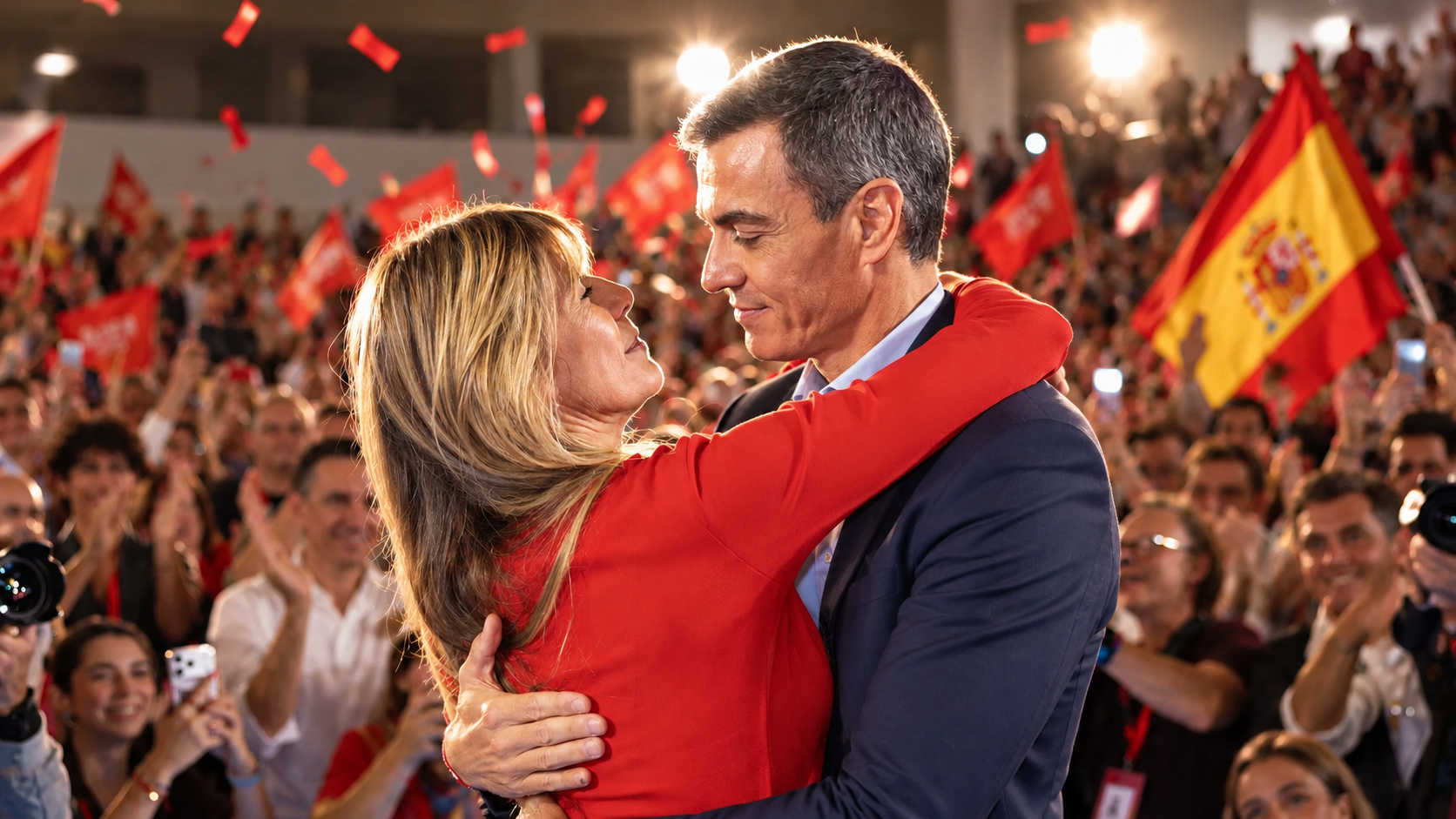
It began on Saturday 17 October in Fuenlabrada, a working-class suburb south of Madrid. The PSOE had convened its federal committee to approve its candidate lists, but the gathering soon resembled a party rather than a party meeting: cheering, music, dancing and a lingering kiss from Pedro Sánchez to his wife, Begoña Gómez, in full view of the faithful.
Ojo a la cobra y la posterior cara de asco de Sánchez.
Le ha faltado sacudirse la camisa.
No es su mujer, es Begoña Gómez. Esa señora que vive en Moncloa. https://t.co/HiKgi3adOD
— Tania de Ois (@taniadeois) October 17, 2026
The image that travelled furthest, however, was another one. María Jesús Montero, the Socialists’ candidate in May’s Andalusian regional election and now director of the general election campaign, broke into an energetic seated dance to a track by the Spanish singer Rusowsky, alongside the prime minister and his wife. Within hours the clip had gone viral. Far from playing it down, the transport minister, Óscar Puente, posted his own video of the group swaying to the music.
🔴👏 Así se ha visto el comentado baile de María Jesús Montero en el mitin del PSOE en Fuenlabrada
📲 Más en EL ESPAÑOL https://t.co/8CFVdnVr2w
— EL ESPAÑOL (@elespanolcom) October 17, 2026
To many viewers, the scene was simply odd. To critics, it was something more calculated: a party atmosphere staged to paper over a very bad week.
“Long live the party of love!”
Two days later, on Monday 19 October, the show moved to Valladolid, where some 2,800 supporters packed a rally. Mr Puente, a former mayor of the city, recalled the scenes in Fuenlabrada with relish and promoted the prime ministerial kiss to something close to a manifesto pledge.
Love, the minister told the crowd, is the most powerful force there is. It lay behind the defence of pensions and the lowest wages, he said, and behind the government’s stance on Gaza. Everything the PSOE does, he argued, is ultimately a constant act of love. He signed off with a rallying cry: “Long live the PSOE and long live love!”
Óscar Puente reivindica al PSOE como el partido del amor: «El amor es el poder más poderoso que existe».
El ministro asegura que las políticas socialistas están guiadas por el amor hacia los más débiles.
¿Discurso sincero o estrategia electoral?
#ÓscarPuente #PSOE #Política https://t.co/IoYqMxZ7i8
— Onda Capital (@ondacapitalfm) October 20, 2026
The equality minister, Ana Redondo, added a metaphor of her own. Voters, she said, must choose between the Socialists’ “white ball” and the “black ball” of hatred, which she pinned on the conservative Partido Popular and the hard-right Vox. Mr Sánchez himself picked up the theme, presenting himself as leader of the party of love, as a woman in the audience shouted that everyone loved Begoña.
Online, the reaction swung between laughter and disbelief. Many struggled to tell whether they were watching a political rally, a concert or the final episode of a soap opera.
Why all the love, and why now?
To make sense of the charm offensive, it helps to look at what happened immediately beforehand.
On Friday 16 October, the day before Fuenlabrada, the PSOE’s spokeswoman, Montse Mínguez, resigned. Reports had revealed that her partner runs a property group with at least 30 rental flats and had evicted tenants. The blow was all the more damaging because housing is the issue on which the Socialists hope to win this election, and Ms Mínguez had been one of the party’s fiercest critics of property speculators. Mr Sánchez had publicly stood by her the day before; within 24 hours she was gone. According to the Madrid broadcaster Telemadrid, her departure went unmentioned at the festive rally in Fuenlabrada.
The second issue is Begoña Gómez herself. The prime minister’s wife is under judicial investigation for alleged influence peddling and misappropriation of public funds, and is awaiting a trial date. Critics believe the party has chosen to turn a legal problem into an emotional asset: casting her as the victim of persecution and rallying the base around her. Crowds chanting her name at rallies have only reinforced that reading.
Then there is the mood inside the party. The PSOE is still smarting from its worst ever result in Andalusia in May, and some Socialists are uneasy that the candidate who led that campaign, Ms Montero, is now running the national one.
Against that backdrop, many commentators see the “party of love” as a change of subject: fewer flats, fewer courtrooms, more kisses and more dancing.
The Socialists’ answer
At party headquarters on Madrid’s Calle Ferraz, they see things differently. The campaign’s message, summed up in the slogan “The strength of the people”, rests on a simple idea: the government has endured years of insults and personal attacks, and the right response is joy and unity rather than resentment. The party’s first pre-campaign video struck the same note, setting jibes from rivals and commentators against a list of social achievements.
Mr Sánchez blamed Ms Mínguez’s resignation on the harshness, aggression and hatred that politicians and their families now face. As for the dancing, supporters insist it is nothing more than a cheerful, uninhibited membership. It would not be the first time a Spanish Socialist had danced his way into the headlines: in 2015 the Catalan leader Miquel Iceta surprised everyone with a dance at a campaign rally, and the move went on to become something of a trademark.
Love, or an anaesthetic?
Spanish politics has seen plenty over the years. But a cabinet minister shouting “long live love” while his party absorbs the resignation of its spokeswoman, and the prime minister’s wife awaits trial, is something new. To loyal voters it may feel like a welcome burst of optimism. To many others it is proof that when the answers run out, there is always the music.
The official campaign has not even begun. If the warm-up is anything to go by, Spain should brace itself: there are still five weeks of love to come.