While politicians continue to argue over responsibility for what happened in Ceuta, one video has given the crisis a human face. The footage of a 12-year-old boy crying and repeatedly pleading not to be sent back to Morocco has gone viral, becoming one of the most poignant images to emerge from the events at Spain’s border with North Africa.
CEUTA – “No, Morocco, no.”
Spain Expat Press Editorial Team
They are just a few words, spoken through tears by a frightened 12-year-old boy. Yet they have become one of the most powerful images of the latest migration crisis in Ceuta.
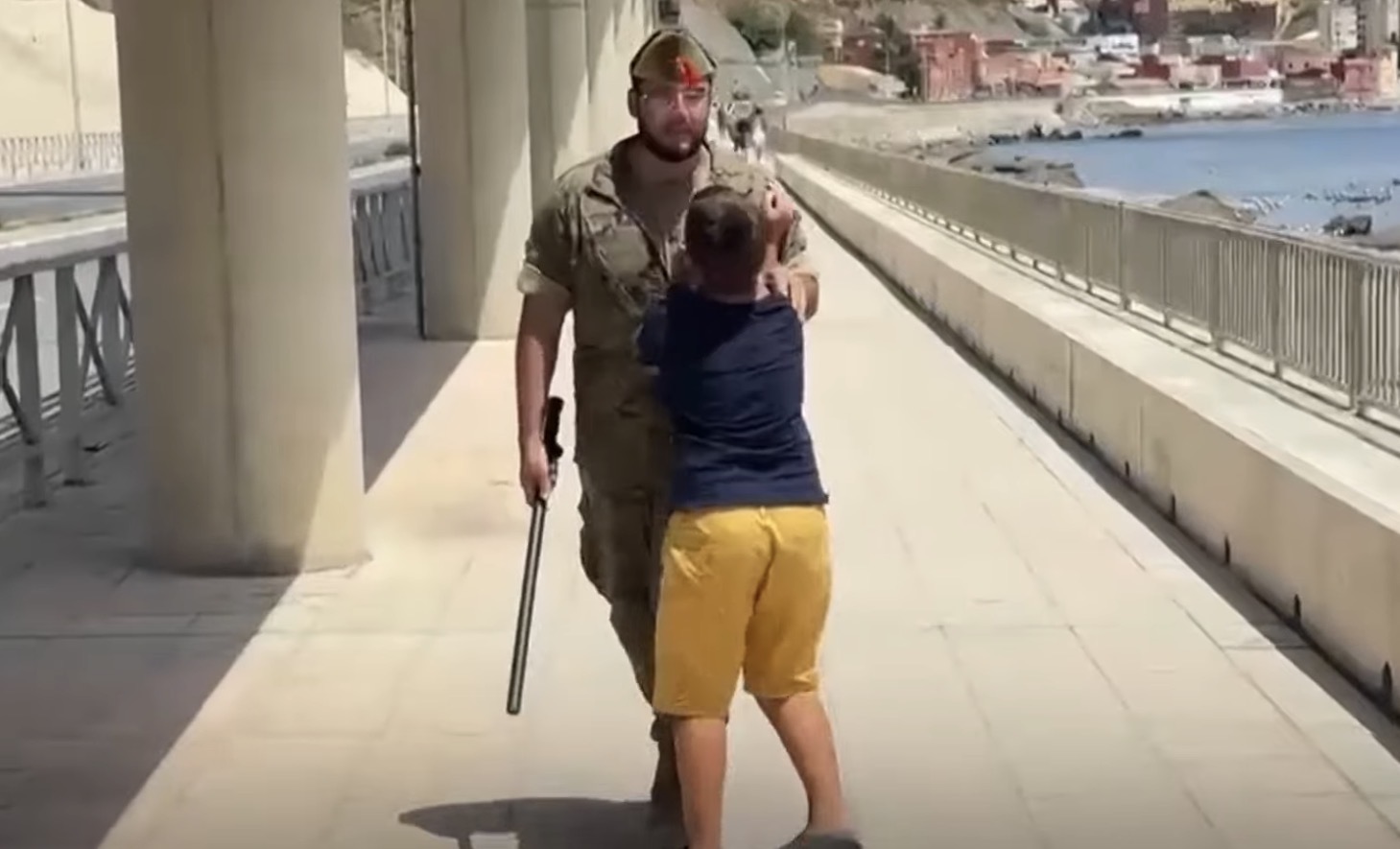
Footage of the child crying as he was being taken towards the border with Morocco has spread rapidly across social media, attracting widespread attention in Spain and beyond.
Behind the short video lies a much more complicated story.
Nobody Initially Realised He Was Alone
The incident took place close to the border separating the Spanish city of Ceuta from Morocco.
According to Spanish radio station Cadena SER, the 12-year-old was being accompanied by a Spanish soldier towards the border area.
The boy was visibly distressed.
As he walked, he cried and repeatedly said:
“No, Morocco, no.”
At first, however, those dealing with the situation apparently did not realise one crucial fact: the child was not accompanied by his parents or any other adult responsible for him.
Several women nearby helped translate what the boy was trying to explain.
It then became clear that he was alone.
No mother. No father. No adult relative.
That discovery fundamentally changed the situation.
“No, Marruecos, no”: las lágrimas de un niño de 12 años que suplicaba a los soldados españoles no ser expulsado de Ceuta https://t.co/lNd3oEqGJ2 pic.twitter.com/DMeUmdCc5y
— 20minutos.es (@20m) August 4, 2026
Spanish Officer Stops the Return
According to reports, the lieutenant colonel commanding the unit deployed in the area eventually intervened.
Once it was established that the 12-year-old was an unaccompanied minor, the transfer towards the border was stopped.
Under Spanish law and child-protection procedures, unaccompanied foreign minors are subject to specific safeguards and cannot simply be treated in the same way as adult migrants at the border.
The boy was subsequently placed in the care of the Guardia Civil and received assistance from the Red Cross.
The Video Goes Viral
The scene did not remain confined to Ceuta.
The footage and images of the crying boy have spread across social media, while Spanish media outlets have extensively reported his story.
His repeated words — “No, Morocco, no” — have become inseparable from the images.
And perhaps that explains why the footage has resonated so strongly.
Migration crises are normally described through numbers.
Numbers of arrivals. Numbers of police officers. Numbers of minors. Numbers of people returned across the border.
This video shows something statistics cannot.
Fear.
A child crying.
And the desperation of someone too young to understand the political battle unfolding around him, but old enough to know that he desperately does not want to go back.
Ceuta Is Caring for Hundreds of Minors
The incident comes against the backdrop of extraordinary pressure on Ceuta, a Spanish city of around 85,000 inhabitants situated on the North African coast.
According to figures released by the city, 862 minors were being accommodated in official centres and emergency facilities at the beginning of the week.
Authorities believe the true number of children who entered during the latest wave may be higher, as some have yet to approach the authorities or are believed to be staying elsewhere in the city.
Emergency accommodation has been opened as Ceuta attempts to deal with the consequences of the sudden influx.
For a city of its size, the challenge is enormous.
When Social Media Becomes Part of the Crisis
Social networks have played a striking role throughout the events surrounding Ceuta.
Messages circulated online suggesting that the border was open and that people could cross into Spanish territory without documentation.
Such information can spread extraordinarily quickly, particularly among young people.
Now the same social networks are carrying images showing the consequences.
The video of the 12-year-old boy has become one of the clearest examples of how a geopolitical and migration crisis can suddenly be reduced to a single human story.
Children Change the Legal Equation
The distinction between an adult migrant and an unaccompanied child is crucial.
When Spanish authorities establish that a foreign minor has arrived without a parent or legal guardian, specific child-protection procedures apply.
That is why discovering that the boy was travelling alone proved decisive.
The case also illustrates the immense pressure facing soldiers, police officers, the Guardia Civil, humanitarian organisations and Ceuta’s authorities.
In chaotic circumstances involving large numbers of people, officials may have only a short time to establish someone’s identity, age and family situation.
When that person is 12 years old, the consequences of getting that decision wrong can be profound.
Behind the Political Battle, a Human Tragedy
The political arguments surrounding Ceuta will continue.
Questions remain over how the mass crossings were possible, what role Morocco played, whether Spanish authorities had sufficient warning and how Madrid and the European Union should respond.
Those questions matter.
Responsibility matters.
Border security matters.
But the images of this child are a reminder that another reality exists behind the political confrontation.
There are human beings caught in the middle.
And among them are children.
Whatever one’s position on immigration, the image of a frightened 12-year-old standing at Europe’s southern border is difficult to ignore.
For many, this video has become the image that captures the true human tragedy of what happened in Ceuta.
A child.
Alone.
Crying.
And repeating the same desperate words:
“No, Morocco, no.”