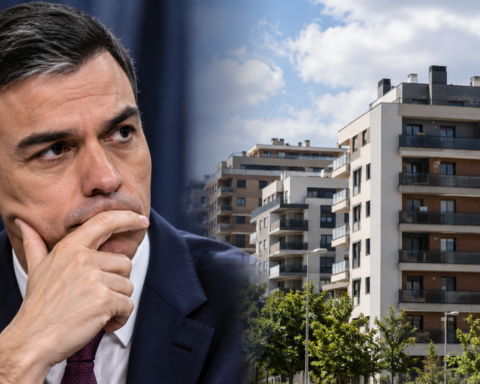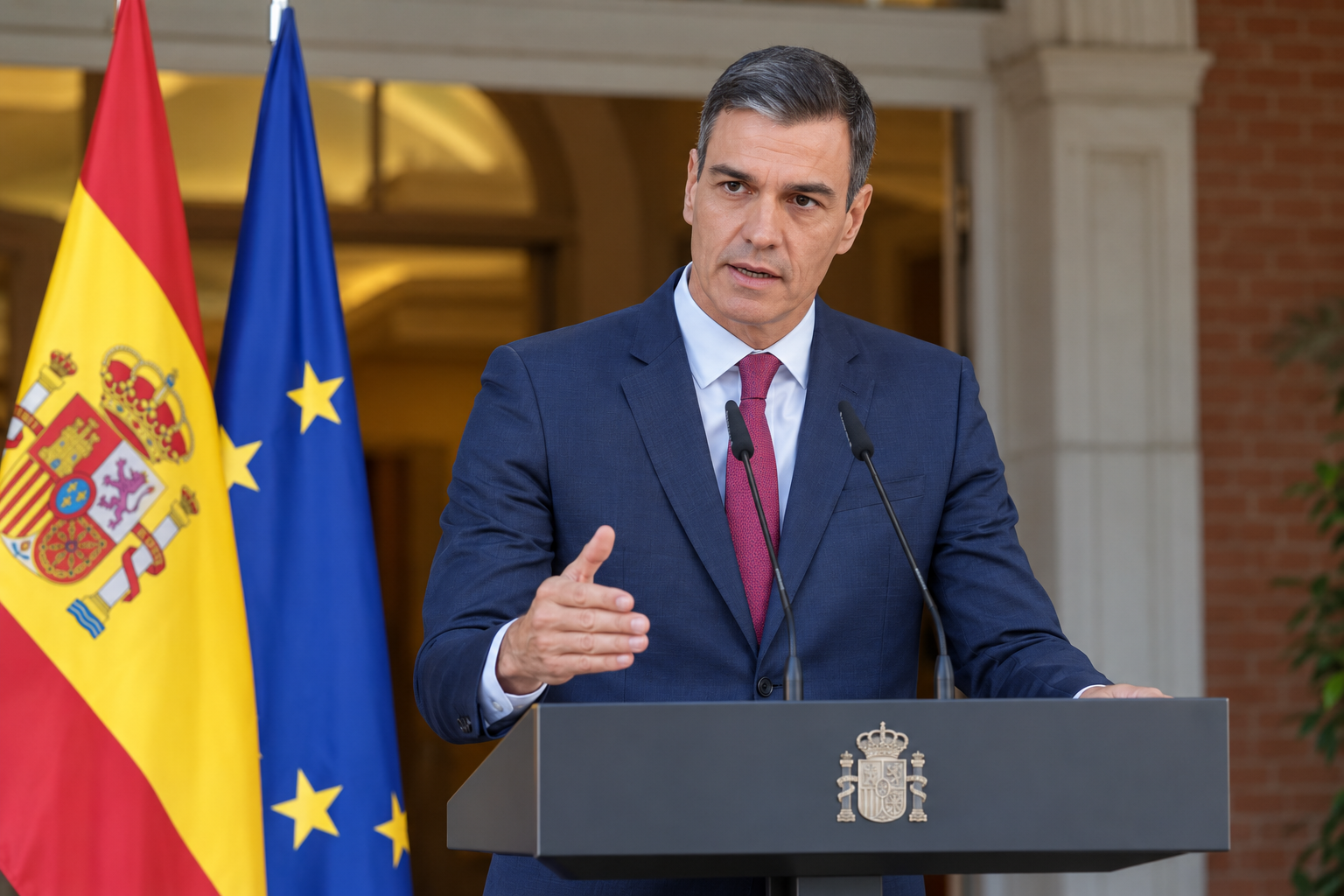
Pedro Sánchez has called a snap general election for Sunday 29 November, bringing months of political uncertainty to an abrupt end and making an audacious attempt to turn his government’s parliamentary weakness into an electoral offensive. Days after suffering a damaging defeat over two housing decrees, the Spanish prime minister is placing the housing crisis at the centre of his campaign while warning voters of the consequences of a PP government dependent on Vox. Noticeably less prominent in his intervention were the corruption scandals and investigations that have weighed heavily on his party and political entourage.
Spain Expat Press Editorial Team
The timing is striking.
Only days ago, Sánchez’s minority government suffered a significant defeat in the Congreso de los Diputados when both of its housing decrees were rejected.
The measures were opposed not only by the conservative People’s Party (PP) and the far-right Vox, but also by Junts, the Catalan party whose votes have repeatedly proved crucial to Sánchez’s ability to govern.
The defeat exposed, once again, the increasingly fragile parliamentary foundations of his administration.
Rather than spend the coming months negotiating unpredictable majorities and risking further defeats, Sánchez has chosen to change the political terrain altogether.
Spain is going back to the polls.
Turning defeat into an opportunity
What looked like a serious setback for the government is now being transformed into the starting point of Sánchez’s election campaign.
Housing has become one of Spain’s most pressing social problems. Rents have risen sharply in many parts of the country, property prices remain beyond the reach of many younger Spaniards, and the shortage of affordable homes has fuelled growing anger.
Recent protests and high-profile eviction cases have pushed the issue further up the political agenda.
Sánchez is now seeking to harness that anger.
The Socialist argument is straightforward: the government attempted to introduce new protections and measures on housing, but other parties prevented it from doing so.
A parliamentary defeat can therefore be reframed as an electoral message: we tried to act; they stopped us.
But there is an obvious vulnerability in that argument.
Sánchez has been Spain’s prime minister since 2018.
His opponents will inevitably ask why the housing emergency has become so severe after more than eight years under his leadership – and why it is only now, on the eve of an election, being presented as the defining political battle.
The PP offers precisely the opposite diagnosis. Conservatives argue that the government’s intervention in the rental market and what they describe as increasing legal uncertainty for landlords have discouraged supply and contributed to the problem.
Housing will therefore not simply be an issue on which Sánchez can attack the opposition. It will also be a test of his own record in office.
‘Democracy or the far right’
The second pillar of Sánchez’s strategy is even more confrontational.
The prime minister is warning voters about the consequences of a change of government, particularly the prospect of the PP relying on Vox to secure power.
His message amounts to a stark choice: democracy or the far right.
Sánchez is therefore seeking to make 29 November about considerably more than taxation, housing or economic policy. He is framing the election as a fundamental decision over Spain’s political and social direction.
He has warned that a PP administration reliant on Vox could, in his view, roll back social advances, reduce rights and usher in cuts.
It is familiar territory for Sánchez.
Faced with disillusionment among parts of the Spanish left, the prospect of a rightwing government involving or dependent on Vox offers the Socialists a powerful argument with which to mobilise progressive voters who might otherwise stay at home.
But it is also a highly polarising strategy.
An election between democratic parties is inevitably more complicated than a binary choice between “democracy” and “the far right”. The PP is Spain’s mainstream conservative party; Vox sits considerably further to its right and is routinely described by Sánchez and the PSOE as far right.
By increasingly presenting the two as part of the same political alternative, Sánchez is drawing a clear moral dividing line.
On one side, his government: democracy, social protection and progressive rights.
On the other, he argues: cuts, regression and the growing influence of the far right.
The ‘right side of history’
The approach fits a broader theme that has long characterised Sánchez’s political rhetoric: the idea of being on the “right side of history”.
That division is once again evident.
The prime minister presents his political project as the defender of democratic values and social advances, while warning that his opponents could reverse them.
It may prove an effective way of mobilising his political base, but it also opens Sánchez to an obvious criticism: that he is seeking to turn an election about his own record in government into an argument about the dangers of the government that might replace him.
The PP and Vox reject his portrayal and accuse the prime minister of using fear of the right to avoid scrutiny of his own record.
And that brings the campaign to one of the subjects that received considerably less attention in Sánchez’s narrative.
And what about the corruption scandals?
As striking as what Sánchez chose to discuss was what received far less prominence.
The corruption investigations and scandals that have damaged the PSOE and figures in the prime minister’s wider political orbit have weighed heavily on the government during this parliament.
Yet they sit awkwardly with the story Sánchez now wants to tell.
His emphasis is firmly on the future: what would happen if the PP came to power? What influence would Vox have? Which social protections might be changed? What cuts could follow?
Politically, the logic is understandable.
Sánchez would rather the election were not simply a referendum on more than eight years of his premiership, but a choice about what Spain might look like after him.
The opposition will try to do precisely the reverse.
It will seek to drag the campaign back towards the government’s record: corruption controversies, parliamentary instability, Sánchez’s dependence on Junts, repeated difficulties in securing majorities and the question of why problems such as housing remain unresolved after so many years in office.
A gamble born of weakness
The decision to call an election now is unlikely to be accidental.
Senior figures within the Socialist camp had increasingly argued that waiting carried its own considerable risks. More months in office could mean further parliamentary defeats, more confrontations with Junts and the gradual erosion of the government’s authority.
Calling an election allows Sánchez to seize back the initiative.
Paradoxically, the defeat of his housing decrees has provided him with the social issue around which to build his campaign. He can portray himself as the politician attempting to protect tenants while blaming rival parties for blocking his proposals.
At the same time, the prospect of a PP government reliant on Vox gives him the second half of his electoral argument: a warning to the fragmented and increasingly disillusioned left about what could happen if it fails to mobilise.
It is nevertheless an enormous gamble.
The housing crisis can just as easily be turned against the prime minister. After more than eight years in power, Sánchez will have to explain why the situation has become so acute on his watch.
He will also face questions about why the controversies surrounding his own administration feature so little in his account of what is at stake, while the possible dangers of a future rightwing government feature so prominently.
The battle lines are therefore already becoming clear.
Sánchez wants the election to be about housing, social rights, democracy and the threat of a shift to the right.
His opponents will want it to be about corruption, political instability and the record of eight years of Sánchez government.
The prime minister is attempting to turn parliamentary weakness into an electoral offensive – and to make this election less a verdict on his past than a decision about Spain’s future.
It is a high-risk political escape forward, and one of the biggest gambles of Sánchez’s premiership.
On 29 November, Spanish voters will decide.