In the aftermath of the unprecedented migration crisis in Ceuta, Morocco’s long-standing claim over Spain’s two North African cities has returned to the spotlight. Barely two weeks after the unprecedented migration crisis in Ceuta, tensions between Spain and Morocco are once again being fuelled by one of the most sensitive issues in relations between the two countries: sovereignty over Ceuta and Melilla.
Spain Expat Press Editorial Team
While the two countries are working together to prevent further mass crossings, sections of the Moroccan media are adopting increasingly assertive language over the two Spanish autonomous cities in North Africa.
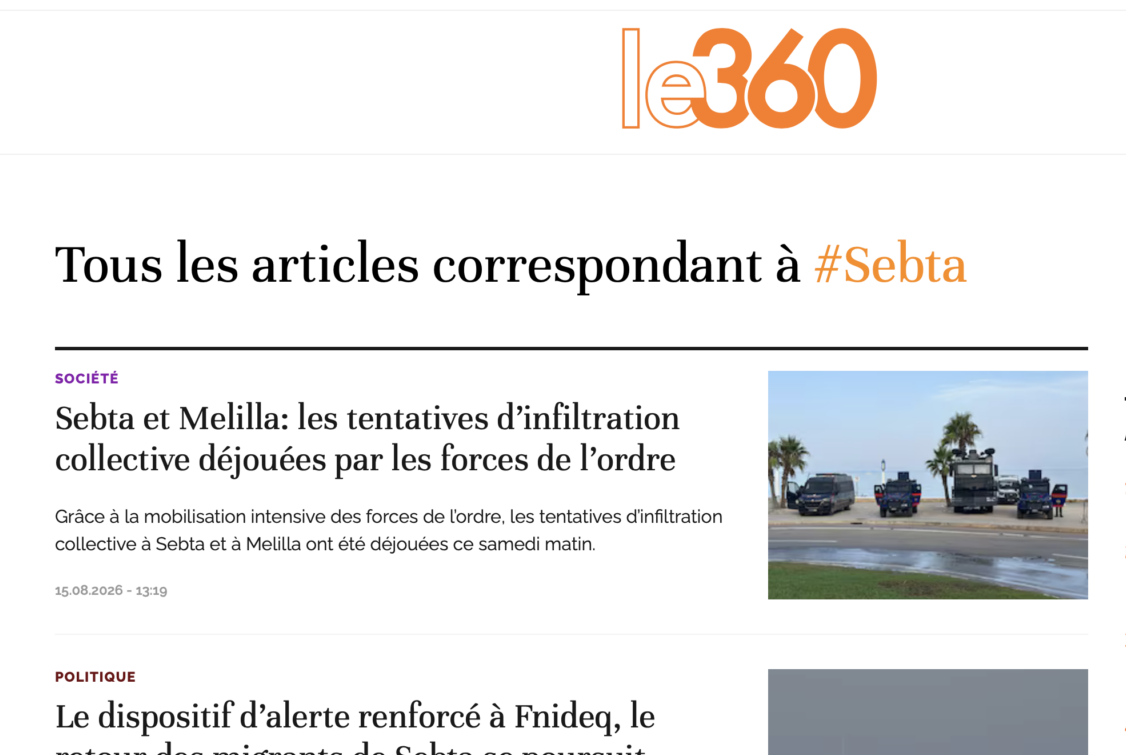
One of the clearest examples is the Moroccan news outlet Le360, which regularly refers to Ceuta – known as Sebta in Morocco – and Melilla as “occupied cities” or “occupied territories”.
In recent coverage, the publication has gone further, describing their status as a “geopolitical anomaly” and raising the prospect of their eventual “reintegration” into Morocco.
Spain firmly rejects that interpretation.
Migration crisis reignites an old dispute
The renewed rhetoric comes in the wake of the extraordinary events at the end of July, when tens of thousands of people crossed from Morocco into Ceuta during an unprecedented mass movement at the border.
The influx placed enormous pressure on the small Spanish city and prompted Madrid to reinforce security around the frontier.
Morocco has also increased controls in its northern regions following further calls on social media for people to attempt new crossings.
Against this highly sensitive backdrop, the territorial question has once again entered the debate.
For Le360, the migration crisis is not presented simply as a border-control problem. The outlet has linked it to the very existence of Spanish territory on the North African coast, questioning how many further “human tragedies” will occur before Ceuta and Melilla are eventually integrated into Morocco.
That is a significant political framing – and one that goes far beyond reporting the immediate migration crisis.
Morocco has never abandoned its claim
The dispute itself is anything but new.
Ceuta and Melilla are Spanish autonomous cities, and Madrid regards them as an integral part of Spain. Morocco, however, has claimed sovereignty over both since gaining independence in 1956.
The historical circumstances of the two cities are different. Melilla has been under Spanish rule since the late 15th century, while Ceuta became part of the Spanish Crown in the 17th century.
For decades, the disagreement has existed alongside extensive economic and political cooperation between the two neighbours.
What has changed is the prominence the issue has suddenly regained.
Morocco’s Justice Minister joins the debate
The rhetoric is not limited to the media.
Moroccan Justice Minister Abdellatif Ouahbi recently reiterated Rabat’s position, saying that the question of sovereignty over Ceuta and Melilla remains on the table and is raised in contacts with Spain.
Madrid responded immediately.
Foreign Minister José Manuel Albares said Spain’s territorial integrity “has not been and will never be discussed with anyone”, while Defence Minister Margarita Robles declared that Ceuta and Melilla are Spanish and “untouchable”.
The exchange illustrates how sensitive the issue remains despite the much closer relationship Spain and Morocco have developed in recent years.
A complicated relationship across the Strait
The timing is particularly delicate because Spain and Morocco depend heavily on one another.
Spain needs Moroccan cooperation to control irregular migration towards its southern borders. Moroccan security forces are currently reinforcing areas around northern cities such as Fnideq as authorities try to prevent another mass movement towards Ceuta.
At the same time, Spain is one of Morocco’s most important European partners. The two countries cooperate on trade, investment, counter-terrorism, drug trafficking, organised crime and migration.
This produces an unusual situation: Morocco challenges Spanish sovereignty over Ceuta and Melilla while simultaneously cooperating with Spain to control access to their borders.
Another dispute over extraditions
Migration and sovereignty are not the only sources of tension.
Ouahbi has also raised the possibility of suspending the bilateral extradition agreement with Spain amid disagreements over the handling of certain extraditions and repatriations.
Such a step could have consequences well beyond diplomatic relations.
Spanish and Moroccan authorities work closely against drug trafficking, terrorism and organised criminal networks operating across the Strait. Any serious disruption to judicial cooperation would therefore affect interests on both sides.
How significant is Le360’s language?
There is an important distinction to make.
The terminology used by Le360 should not automatically be presented as the wording of the Moroccan government itself.
Nevertheless, its repeated description of Ceuta and Melilla as “occupied” is significant because it presents Spanish sovereignty not simply as disputed, but as an occupation of territory considered Moroccan.
The outlet has used this terminology on numerous occasions and not only in opinion pieces.
Official Moroccan statements can be considerably more restrained in their choice of words, even though Rabat continues to maintain its territorial claim.
An old dispute in a newly volatile moment
The recent migration crisis did not create the disagreement over Ceuta and Melilla. It has, however, returned it to the centre of public attention at a particularly difficult moment.
Spain and Morocco are simultaneously partners and neighbours with a major unresolved territorial disagreement.
Their security forces are cooperating to prevent another migration crisis, trade between the two countries remains substantial and their governments maintain close diplomatic relations.
Yet across parts of the Moroccan media, Ceuta and Melilla continue to be portrayed not as Spanish cities, but as Moroccan territory awaiting a different future.
For Madrid, there is no such debate.
Spain’s position remains that the sovereignty of Ceuta and Melilla is not negotiable.