Anyone who has lived in Spain for long enough may have come across the word ‘dominguero’ – or ‘dominguera’. It comes from domingo, the Spanish word for Sunday, but it describes far more than simply someone who goes out on a Sunday.
Spain Expat Press Editorial Team
The classic dominguero is part of a Spanish tradition that shaped the summers of generations of families: people from inland towns and cities who did not own a house or flat by the sea, but were certainly not going to miss out on a day at the beach.
So Sunday began early. The car was packed to bursting point and the family set off for the coast.
Up early – and off to find the perfect spot
A traditional Spanish Sunday at the beach did not begin at midday.
It began early in the morning.
The aim was to secure a good spot, preferably close to the water and with enough room for the friends, cousins, aunts, uncles and grandparents who might be joining later.
From Seville, families would head towards the beaches of Cádiz or Huelva. Elsewhere in Spain, the principle was much the same: people from inland towns and villages made for their nearest stretch of coast.
Sunday was beach day.
And if you did not have a holiday home by the sea, you simply brought everything you might possibly need with you.
The car? Packed to the roof
A proper dominguero did not arrive carrying a single beach bag.
It often looked as though half the contents of the family home had been squeezed into the car.
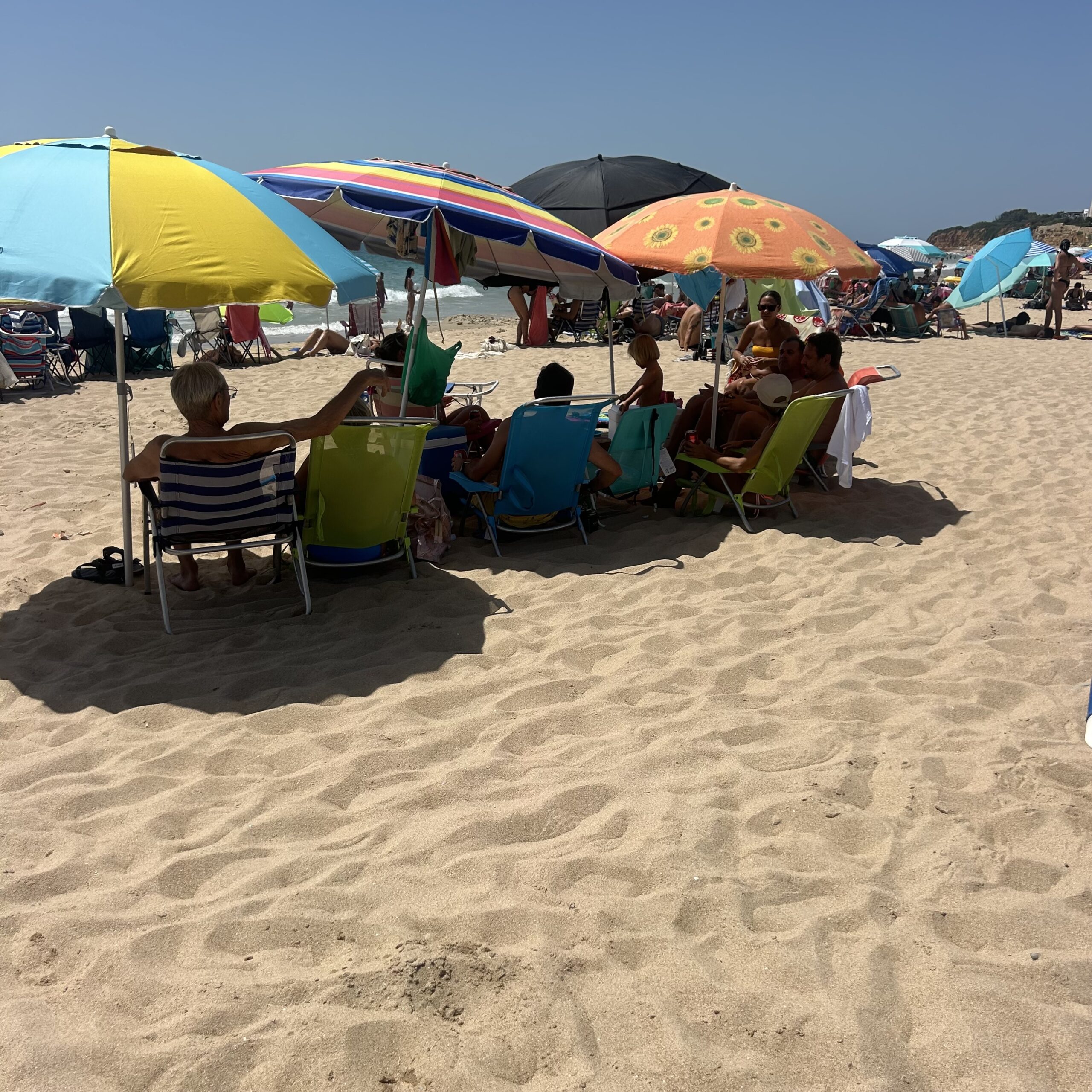
There were parasols, folding beach chairs – the ubiquitous Spanish silletas – cool boxes, towels, changes of clothes, awnings or toldos, balls, inflatables, buckets, spades and enough toys to keep the children occupied for hours.
The adults brought books, newspapers and magazines.
Today, of course, phones, chargers and power banks would probably be added to the list. In earlier days, a newspaper was sufficient – and frequently ended up covering the face of somebody having a post-lunch nap beneath the parasol.
And then there was the food
This was serious business.
Anyone planning to ‘echar el día en la playa’ – essentially, to spend the entire day at the beach – needed to be properly prepared.
Breakfast? Packed.
Lunch? Obviously.
Something for the afternoon? Of course.
And there was usually enough left over for an early evening meal if nobody felt like going home yet.
At the heart of the cool box was often the undisputed queen of the Spanish picnic: tortilla de patatas.
Alongside it came gazpacho, sandwiches and the legendary bocadillos de filetes empanados – crusty bread filled with breaded meat.
Fruit, biscuits, crisps, drinks and various snacks completed the mobile feast.
A Spanish family setting off for a single Sunday at the beach could sometimes look as though it was preparing for a three-week expedition.
The beach became the family living room
Within minutes of arriving, a temporary home was established on the sand.
Parasols went up. Chairs unfolded. Towels appeared. Cool boxes were strategically positioned in the shade and the children disappeared towards the sea.
The particularly well prepared even brought a large toldo to create their own patch of shade.
And then the real purpose of the day began: doing very little at all.
Swimming. Talking. Eating. Reading. Sleeping. Swimming again.
And, inevitably, eating again.
The most important thing could not be packed into a cool box
For all the preparation, however, the essential ingredient of the traditional domingo de playa was neither the tortilla nor the parasol.
It was family and friends.
Several families would arrange to meet at the same spot, placing their parasols alongside one another until a simple trip to the beach became a full-scale social gathering.
Children played together while the adults talked for hours. Food was shared without ceremony.
One family’s tortilla made its way beneath another family’s parasol. Someone had brought too much gazpacho. Somewhere, almost inevitably, there were a few spare filetes empanados.
Perhaps that was the real luxury of being a dominguero: not owning a house beside the sea, but having an entire summer’s day to spend with the people who mattered.
Where does the word ‘dominguero’ come from?
The word comes directly from domingo – Sunday.
The Royal Spanish Academy uses dominguero for, among other meanings, someone who habitually carries out a particular activity on Sundays.
Depending on the context, it can have a mildly teasing or even dismissive tone, rather like referring to someone as a typical Sunday driver or weekend day-tripper.
Over time, however, it also became associated with a very recognisable figure in Spanish popular culture: the Sunday excursionist.
And in summer, that excursion often meant the beach.
Once mocked, now remembered with nostalgia
Being called a dominguero was not necessarily a compliment.
Families arriving with cars packed with enormous parasols, cool boxes, folding chairs and enough supplies to establish a small settlement could be gently mocked by those fortunate enough to own a flat or house on the coast.
Today, however, the word also carries considerable nostalgia.
These Sundays belong to a Spain in which spending weeks at the seaside or owning a second home was far from an option for every family.
You did not need a beach house or a reservation at a fashionable restaurant.
You needed a car, a parasol, a tortilla and enough people with whom you wanted to spend the day.
‘Echar el día’ – an expression that says it all
Few Spanish expressions capture the tradition better than ‘echar el día en la playa’.
It does not mean popping down to the beach for a quick swim.
It means spending the day there. The whole day.
From early morning until evening, there was swimming, eating, talking, playing and sleeping beneath the parasol.
Only when the sun began to disappear did the great packing-up operation begin.
When the sun goes down, the roads fill up
And that helps explain a familiar sight on summer Sundays in Spain even today.
As the sun begins to set, roads and motorways leading away from the coast start filling with cars.
Tired families head back to their towns and cities. In the boot are folded silletas, parasols, cool boxes, damp towels, toys and perhaps the final piece of tortilla. On the back seat, children often sleep after an entire day beside the sea.
Long queues can form on Sunday evenings around Spain’s most popular coastal resorts as thousands of families begin the journey home at roughly the same time.
In a way, the Sunday-evening traffic jam became almost as much a part of the traditional dominguero experience as the tortilla, gazpacho, parasol and folding chair.
Monday morning meant a return to normal life.
But the following Sunday?
If the weather was good, they would pack the car and do it all over again.