The Camino de Santiago is on course for yet another record. More than 363,000 pilgrims have already reached Santiago de Compostela in 2026 – and with the next Holy Year approaching, 2027 could bring crowds on a scale the ancient pilgrimage has never seen before.
Spain Expat Press Editorial Team
The Camino de Santiago shows little sign of losing its appeal.
More than 363,000 people have completed one of the pilgrimage routes to Santiago de Compostela so far this year and collected their Compostela, the certificate awarded to those who fulfil the requirements of the pilgrimage.
That figure is around 6 per cent higher than at the same point in 2025, when a record 530,724 pilgrims were registered – the first time the annual total had passed half a million.
At the current pace, that record may not survive 2026.
Yet attention is already turning to 2027, when Santiago will celebrate one of the most important dates in its religious and cultural calendar: a Holy Year.
Why 2027 matters
For visitors from outside Spain, the term Xacobeo – or Año Santo Jacobeo – may require some explanation.
A Holy Year in Santiago de Compostela is celebrated whenever 25 July, the feast day of St James the Apostle, falls on a Sunday. The next one will be in 2027.
The tradition stretches back centuries. During a Holy Year, the Holy Door of Santiago Cathedral is opened and Catholic pilgrims who meet the Church’s religious requirements may receive a plenary indulgence.
The significance of the Xacobeo, however, now extends far beyond religion. Galicia stages cultural events, concerts and special programmes throughout the year, while towns and villages along the Camino prepare for a substantial increase in visitors.
The previous Holy Year began in 2021 but was heavily disrupted by the pandemic and was exceptionally extended into 2022. The 2027 Xacobeo will therefore be the first Holy Year to take place under normal conditions since 2010.
Expectations are correspondingly high.
A pilgrimage increasingly shaped by the world beyond Spain
The modern Camino is becoming steadily more international.
Only around 39 per cent of registered pilgrims are now Spanish, meaning that roughly six in ten arrive from abroad.
Americans make up the largest foreign contingent in 2026, accounting for 8.5 per cent of all pilgrims, followed by Italians at 7.7 per cent, Portuguese at 4.6 per cent and Germans at 4.3 per cent.
British pilgrims are also an increasingly visible presence. Around 9,000 people from the United Kingdom have already completed the pilgrimage in 2026. In 2025, 14,643 British pilgrims received the Compostela, an increase of 8.3 per cent on the previous year.
The figures underline how far the Camino has travelled from being primarily a Spanish and European religious tradition. It is now a genuinely international phenomenon, attracting walkers from across Europe, North America and beyond.
The routes themselves are changing too.
The celebrated Camino Francés remains the most popular, accounting for 42.8 per cent of pilgrims. But its dominance has diminished considerably: in 2016, roughly two-thirds of all pilgrims chose the French Way.
The Portuguese routes have been the great beneficiaries. The traditional Camino Portugués and its increasingly popular coastal alternative together now account for about 39.1 per cent of pilgrims.
When success becomes a challenge
For Galicia, the Camino is an economic lifeline as well as a cultural institution. Hotels, hostels, restaurants, cafés, shops and transport businesses benefit from the steady stream of walkers, while small communities along the routes have found new opportunities in an international pilgrimage economy.
But Santiago itself is increasingly confronting the consequences of that success.
The historic centre can become intensely crowded during the summer months, with large groups filling the streets around the cathedral and long queues forming at its entrances.
The city has begun introducing measures aimed at managing the pressure, including a tourist tax on overnight stays and restrictions governing certain commercial activities in the old town.
The scale of the phenomenon is clear from the monthly figures. August 2022 remains the busiest month on record, when 85,755 Compostelas were issued. September 2025 brought 81,535 pilgrims, while May 2026 had already reached 80,037.
All roads lead to Santiago – but some continue further
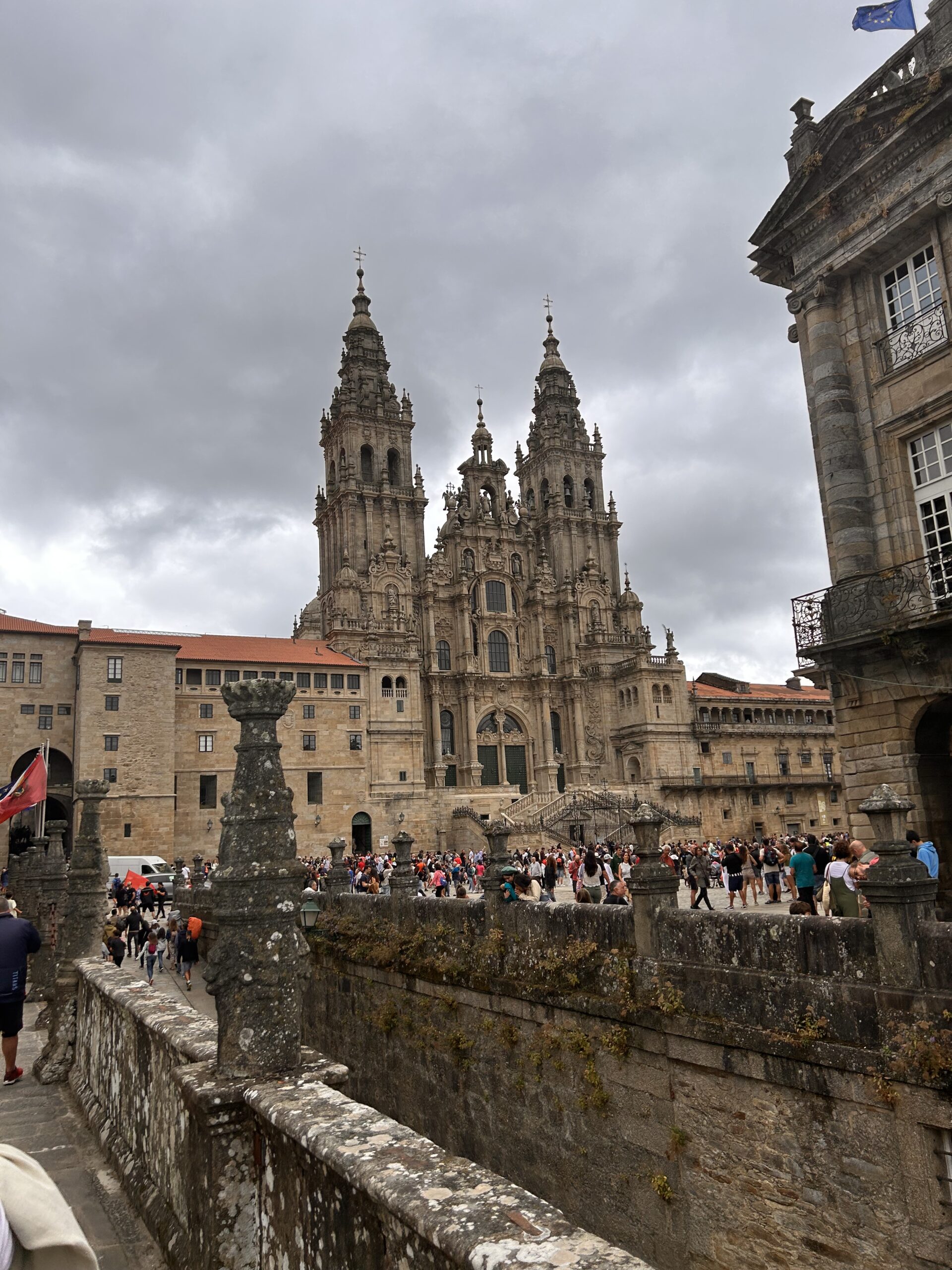
Santiago de Compostela Cathedral is the traditional final destination of the Camino, because, according to Christian tradition, it houses the tomb of St James the Apostle.
For generations of pilgrims, arrival in the Praza do Obradoiro, beneath the cathedral’s imposing Baroque façade, has marked the end of a journey that may have begun hundreds of miles away.
Some choose to keep walking westwards towards Fisterra or Muxía, on Galicia’s Atlantic coast. But Santiago remains the historic and spiritual destination around which the Camino has developed for more than a thousand years.
2027 could eclipse everything that came before
If the 2025 record of 530,724 registered pilgrims is surpassed this year, it will provide yet another measure of how dramatically the Camino has changed.
But 2027 is likely to be different again.
A Holy Year will coincide with the Camino’s growing international popularity and the rapid rise of alternative routes at a moment when Santiago is already wrestling with the pressures created by its success.
For anyone considering walking the Camino in 2027, particularly during spring and summer, planning ahead – and booking accommodation early – may prove more important than ever.
More than a millennium after pilgrims first began travelling towards the supposed resting place of St James, the Camino remains one of Europe’s most remarkable journeys.
People now walk it for faith, solitude, adventure, physical challenge or simply curiosity. Their reasons may have changed, and so has the scale of the phenomenon.
The destination, however, remains the same: Santiago de Compostela.