From live-in domestic workers to nannies who accompany families to the coast, paid household help remains far more visible in Spain than in much of northern Europe – and not only among the very rich.
Spain Expat Press
There is a phrase heard casually in Spanish homes that can sound rather more remarkable to northern European ears: “La chica viene mañana” – “the girl is coming tomorrow”.
Everyone knows who is meant. The woman who cleans, irons, does the laundry, perhaps cooks, collects the children from school or looks after them in the afternoon. In some households she comes a couple of times a week; in others, every day. And in some she lives with the family as an empleada de hogar interna – a live-in domestic worker.
To British, German, Dutch or Scandinavian eyes, such arrangements can suggest considerable wealth. In Spain, however, paid domestic help extends further down the income scale. It is by no means universal – millions of Spanish households could not afford it – but among the comfortable middle and upper-middle classes it remains strikingly commonplace.
A family that in Germany might employ a cleaner for a few hours once a week may, in Spain, have someone coming every weekday. Better-off households may employ a live-in worker.
The difference is partly economic. But it also reveals something about how Spanish families organise their money, their time and, crucially, their relatives.
Buying time rather than doing everything yourself
For households in which both parents work, the calculation can be straightforward.
Children have to be collected from school, meals prepared, clothes washed and ironed and homes cleaned. Rather than attempting to squeeze all of this around two working lives, families who can afford to do so are more inclined than their northern European counterparts to pay someone else to shoulder part of the burden.
Domestic help becomes part of the household budget.
The economics help explain why. Labour costs remain considerably lower in Spain than in northern Europe. Since 2026, a full-time domestic worker must receive at least the equivalent of Spain’s statutory minimum wage: €17,094 a year, or €1,221 in 14 payments, with the corresponding social security contributions.
That is certainly not an insignificant expense for a Spanish family. But for a household with two good salaries it can be achievable in a way that employing someone full-time in Britain, Germany or Scandinavia often is not.
There is also a question of priorities. Some families simply choose to devote a surprisingly large share of their disposable income to domestic support.
What they are buying is not merely a clean kitchen or a pile of ironed shirts.
They are buying time.
When grandparents help pay the bills
Then there is the Spanish family itself.
Financial independence does not always mark as sharp a break between generations in Spain as outsiders might expect. Parents often continue helping their children long after they have left home, married and had children of their own.
Grandparents may collect grandchildren from school, cook for them or take them to activities. In some comfortable families, their contribution can also be financial – including helping to meet the cost of domestic help.
It would be wrong to suggest that Spanish grandparents routinely pay for their children’s housekeepers; there are no figures to support such a generalisation. But the arrangement illustrates a broader characteristic of Spanish family life: resources as well as responsibilities often continue to flow between generations well into adulthood.
The result can be an intricate support system involving two working parents, highly involved grandparents and a paid domestic worker.
The live-in ‘interna’
Perhaps the biggest cultural surprise for visitors from northern Europe is the continued existence of the interna.
She does not simply come to work in the morning. She lives in the employer’s home.
The arrangement serves different purposes. In affluent households, a live-in employee may combine cleaning, cooking, laundry and childcare. Elsewhere, the principal reason for employing an interna is the care of an elderly relative who might otherwise be unable to remain at home.
Live-in domestic service has deep roots in Spain. Although it is less prevalent than it once was, it has by no means disappeared.
In some traditionally organised households, domestic workers can be closely incorporated into the family’s daily routines. There are arrangements in which a carer sleeps close to young children or shares sleeping space with them.
But the familiar Spanish expression that a domestic worker is “una más de la familia” – one of the family – can obscure an important distinction. She is an employee, with rights to rest, privacy, proper working conditions and social protection.
Spain has strengthened those rights substantially in recent years.
Then summer arrives – and the ‘chica’ comes too
The arrangement becomes particularly visible during the long Spanish summer.
For generations, better-off families from Madrid, Seville and other inland cities have decamped for several weeks to the coast. The destination changes; the domestic logistics do not.
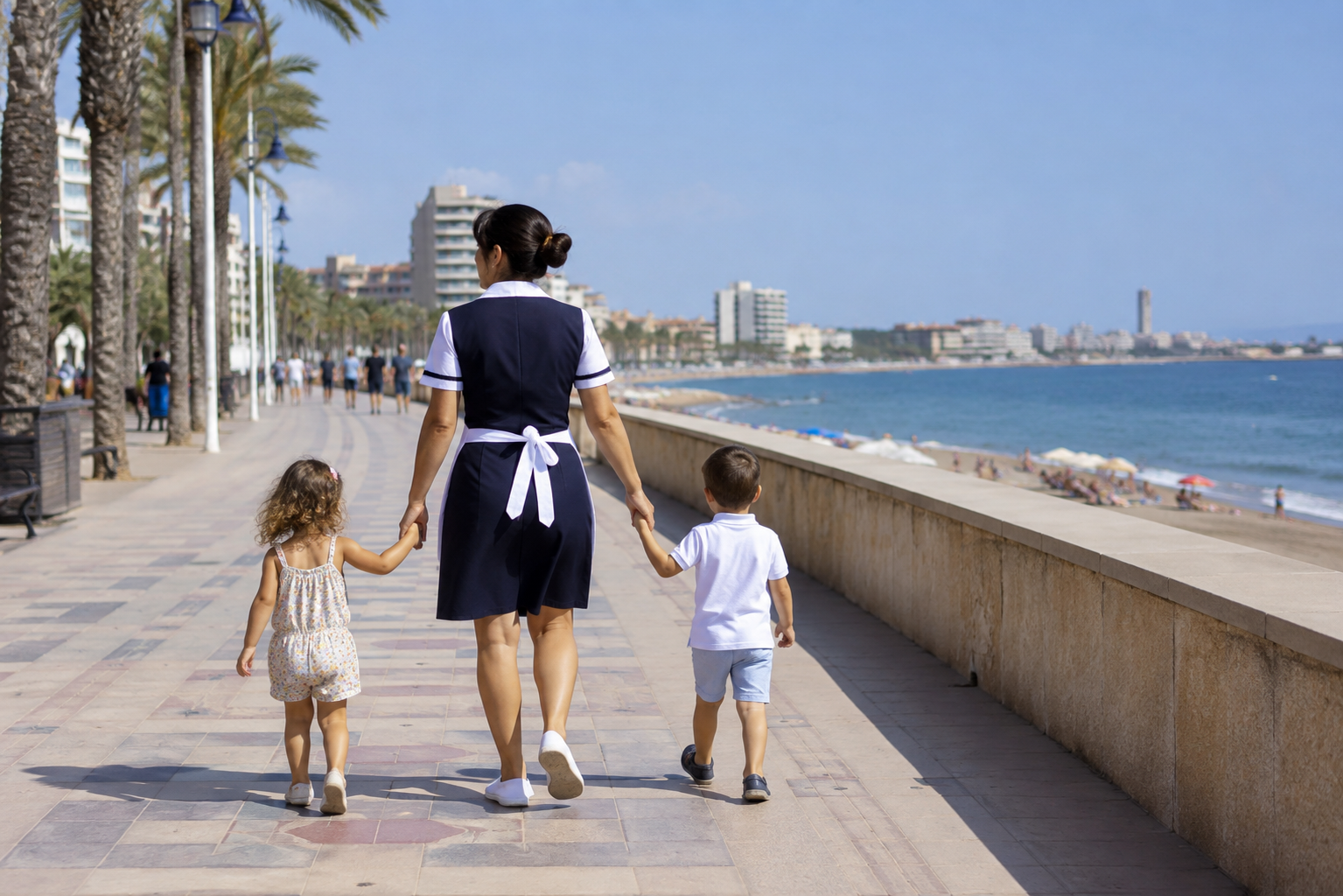
And so, in some families, the domestic worker goes with them.
The logic is brutally practical. Taking three small children to a house by the sea does not make the work involved in caring for them disappear.
There is breakfast to prepare, beds to make, beach bags to pack, sunscreen to apply, wet towels to wash, lunches and dinners to organise and children to supervise.
Without help, a holiday for the children can simply mean moving the parents’ workload to somewhere with a sea view.
Bringing a nanny or live-in domestic worker changes the equation. She takes on part of the routine, allowing the parents to go out for dinner, spend time with friends or simply sit on the beach without continuously negotiating who is looking after whom.
The children are on holiday – and, crucially, so are their parents.
Sometimes one pair of hands is not enough
In some well-off households, summer brings another layer of support.
A live-in employee may travel with the family while a second person is hired locally for part of the holiday, perhaps to help with cleaning, cooking or laundry.
To a northern European visitor, two domestic workers in a holiday home may conjure images of an exceptionally wealthy household.
In Spain, such arrangements are certainly privileged, but they are not confined exclusively to multimillionaires. Some comfortably middle-class and upper-middle-class families simply allocate far more of their income to household support than an equivalent family in northern Europe would consider normal.
It is a revealing difference.
Domestic service is not only more affordable; it is culturally more familiar.
The uniform that stops foreign visitors in their tracks
There is another detail that can be particularly striking to newcomers: the uniform.
In traditional and wealthier households, domestic employees can still be seen wearing recognisable work clothes or uniforms – a dress or coordinated outfit, sometimes with an apron.
It is an image that in Britain or Germany can seem to belong to another era.
In Spain, it has not entirely disappeared.
Domestic and housekeeping uniforms remain readily available from specialist retailers and large stores. Their continued presence is a small but telling reminder that paid domestic work has retained a visibility in Spanish society that has largely vanished from everyday middle-class life elsewhere in Europe.
Many contemporary domestic workers, of course, wear ordinary clothes. Spain is not living in Downton Abbey. But the persistence of the uniform in some homes says something about the continuity between older traditions of domestic service and the modern household economy.
The women behind the system
Today, the story of domestic work in Spain is inseparable from migration.
A significant proportion of those working in private homes are migrant women, with Latin American workers particularly visible alongside women from other parts of the world.
A shared language can make Latin American workers particularly attractive to families looking for childcare or care for elderly relatives, where communication and trust are essential.
But the arrangement contains an uncomfortable paradox.
The woman caring for one family’s children may have children of her own, sometimes thousands of miles away. The employee who makes it possible for another woman to pursue her career must herself find a way to reconcile work and family life.
Domestic help is therefore not simply a story about convenience. It sits at the intersection of class, migration, gender and care.
A luxury – or simply a different way of spending money?
For a German or British visitor, seeing a family with a daily housekeeper can lead to an obvious conclusion: they must be rich.
Sometimes they are.
But not always as rich as the arrangement might suggest.
A comparable family in northern Europe may pay for a cleaner for three hours a week and spend the rest of its disposable income elsewhere. A Spanish household may decide that daily domestic support is worth sacrificing other expenditure for.
There are obvious limits to the comparison. Paid household help remains a privilege in Spain, and the vast majority of lower-income households have no such option.
Yet among those who can afford it, the cultural threshold for employing someone at home appears markedly lower.
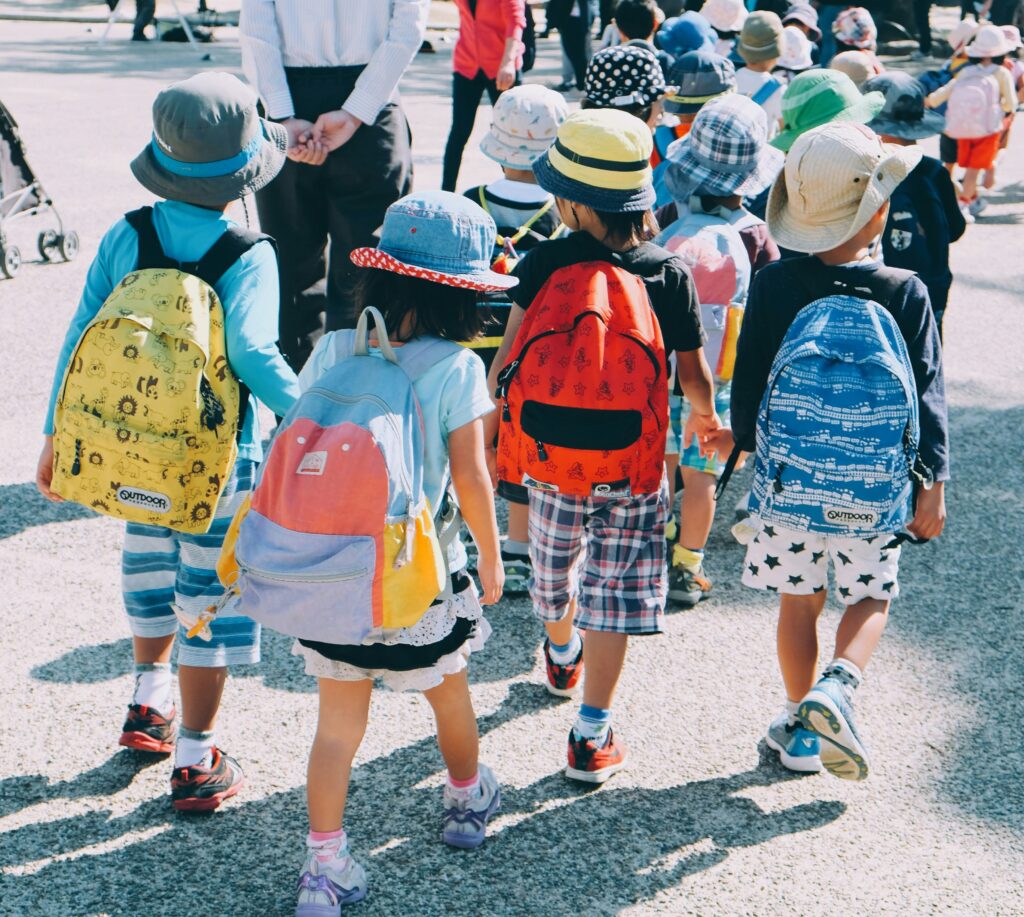
And nowhere is that contrast more visible than during the Spanish summer: a family heading towards the beach, children in tow – and the woman who helps keep their everyday life running walking alongside them.
To an outsider, it may look like the trappings of great wealth.
In Spain, it can simply be another way of organising family life.