US buyers now account for the largest share of foreign property interest in Jaén, overtaking Britons and Germans. With Renaissance towns, vast olive groves, wild landscapes and property prices far removed from the coast, this overlooked Spanish province may finally be having its moment.
Spain Expat Press Editorial Team
For decades, the international property map of Andalusia has been remarkably predictable. Foreign buyers headed for the Mediterranean, gravitating towards Marbella, Estepona, Málaga and the whitewashed towns scattered along the Costa del Sol.
But look north, beyond the beaches and into the Andalusian interior, and something rather unexpected is happening.
Americans are beginning to take an interest in Jaén, one of Spain’s least internationally known provinces.
According to data from Spanish property portal Idealista for the first quarter of 2026, 6.8 per cent of searches for homes for sale in Jaén province came from abroad. Among those international searches, the United States ranked first, followed by the United Kingdom and Germany.
The shift is particularly striking because Germans had previously been the leading source of overseas interest in the province. They have now been overtaken by Americans.
This is not, it should be stressed, evidence of Americans buying up Jaén. Idealista’s figures measure online property interest rather than completed transactions. Foreign buyers still account for fewer than two per cent of actual property purchases in the province.
But searches often reveal where attention is beginning to turn – and Jaén, for so long overshadowed by Andalusia’s celebrated cities and coastline, is suddenly appearing on a rather different map.
Andalusia without the crowds
There is something wonderfully counterintuitive about Jaén.
This is Andalusia without beach clubs, superyachts or sprawling international resorts. There are no fashionable Mediterranean promenades and relatively few places where English has become the unofficial second language.
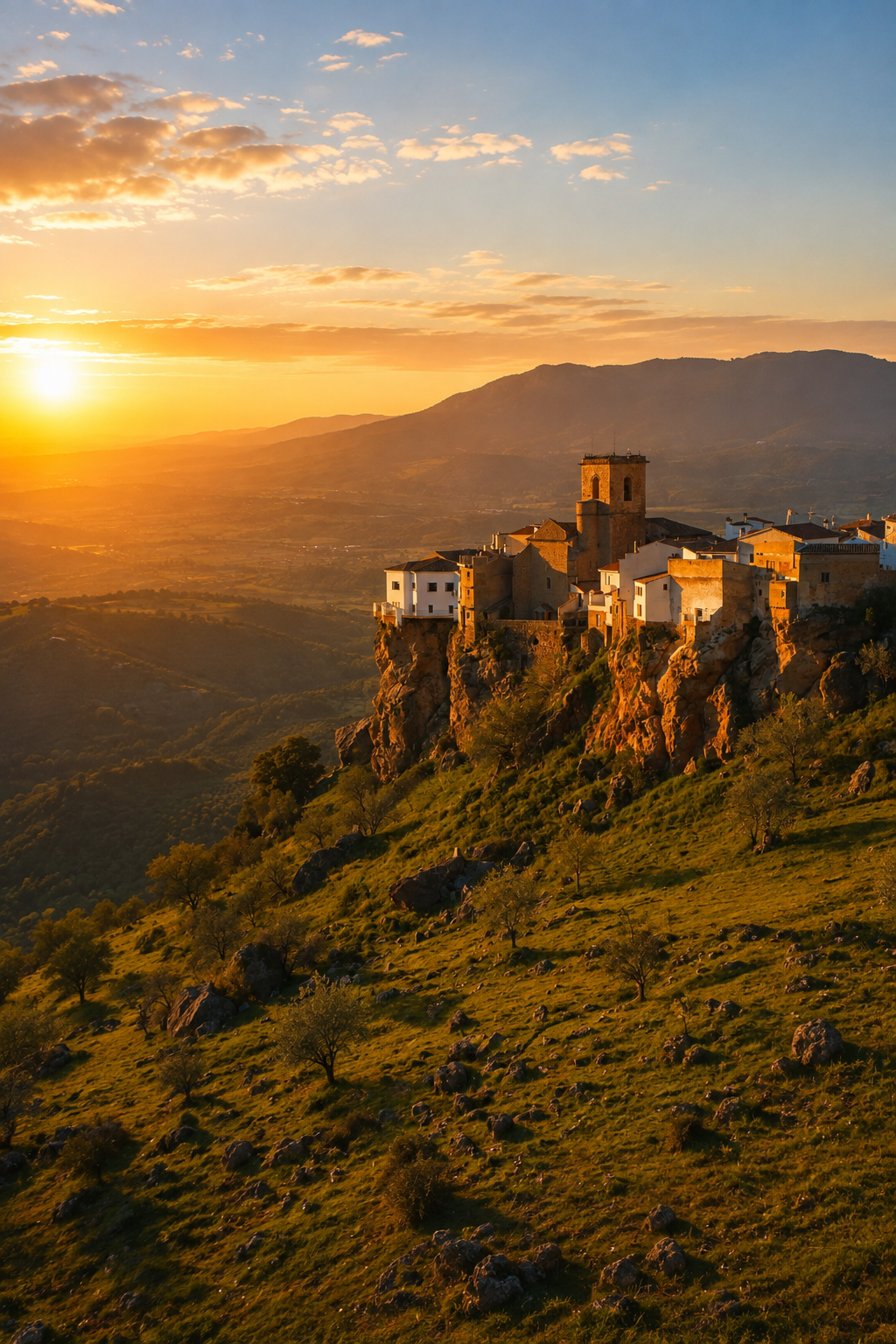
Instead, there are Renaissance palaces, mountain villages, castles, immense natural parks and olive trees – an almost unimaginable number of olive trees.
For travellers accustomed to Seville, Granada or the Costa del Sol, Jaén can feel like discovering another version of southern Spain.
And for potential property buyers, there is another obvious attraction: prices remain considerably removed from those found in Spain’s most sought-after coastal markets.
Úbeda and Baeza: Renaissance Spain at its finest
Two of the province’s great treasures are Úbeda and Baeza, neighbouring towns whose extraordinary Renaissance architecture earned them UNESCO World Heritage status.
Both are places made for wandering.
Honey-coloured stone palaces line elegant squares; churches and convents appear around quiet corners; old townhouses hide behind heavy wooden doors.
Úbeda, in particular, possesses a grandeur that seems almost surprising for a relatively small inland Andalusian town. Its Plaza Vázquez de Molina is surrounded by some of the finest Renaissance architecture in Spain.
Baeza is smaller and more intimate, with narrow streets, historic university buildings and stone façades that seem to change colour as the afternoon light moves across them.
Neither has anything approaching the international profile of Seville or Granada.
That is precisely the point.
Then there is Cazorla
Travel east and the landscape changes dramatically.
Cazorla sits beneath mountains at the edge of the Sierras de Cazorla, Segura y Las Villas Natural Park, one of Spain’s largest protected areas.
The town tumbles down the hillside beneath the ruins of its castle, surrounded by forests, valleys and mountain roads.
This is a part of Andalusia better suited to hiking boots than designer sandals.
Deer, wild boar and birds of prey inhabit the surrounding countryside, while rivers and waterfalls cut through a landscape that bears little resemblance to the dry Mediterranean image many foreign visitors associate with southern Spain.
Úbeda, Baeza and Cazorla are not identified by Idealista as the particular places Americans are searching for – the portal’s data does not provide that municipal breakdown for Jaén. Rather, they illustrate the extraordinary variety found within a province that remains largely unfamiliar to international buyers.
A sea of 60 million olive trees
And then there are the olives.
Jaén’s landscape is dominated by more than 60 million olive trees, arranged across hills and valleys in seemingly endless geometric rows.
Seen from above, the effect is extraordinary: a green, man-made landscape stretching towards the horizon.
The province is one of the world’s great centres of olive-oil production, and its best extra-virgin oils have increasingly become part of Spain’s high-end gastronomic culture.
Oleotourism – visiting estates, mills and olive groves much as one might visit vineyards in Tuscany or Bordeaux – is also growing.
For visitors and prospective residents alike, it adds another dimension to Jaén’s appeal: this is not simply somewhere cheaper to live, but a region with an unusually strong sense of place.
When the Spanish coast becomes too expensive
Economics inevitably play a part.
Property prices in many of Spain’s internationally popular coastal areas have risen sharply. Prime areas of the Costa del Sol, the Balearics and Costa Blanca now require budgets unimaginable in much of inland Spain.
Jaén belongs to a different property world.
For someone who does not require a Mediterranean view or a home within walking distance of the beach, the difference in what a budget can buy can be substantial.
That does not mean Jaén is about to become the next international property hotspot. More than 93 per cent of current property demand still comes from within Spain, and foreign purchases remain a tiny proportion of transactions.
But perhaps that is part of its appeal.
Why Americans are looking beyond the obvious Spain
The growing interest from the United States also reflects a broader shift.
American buyers and property hunters have become increasingly visible in several Spanish markets, joining the British, Germans, French, Dutch and Belgians who have traditionally dominated foreign demand.
And the American audience is far from homogeneous.
It includes affluent buyers looking for European second homes, remote professionals able to work internationally, future retirees and the enormous Spanish-speaking population of the United States.
Previous analyses of US property searches in Spain have also shown substantial use of Spanish rather than English, suggesting that Hispanic Americans form an important part of this emerging market.
For some, the appeal may be straightforward economics. For others, it is the idea of living somewhere that still feels unmistakably Spanish.
Jaén offers both.
Spain’s next discovery?
It would be premature to declare Jaén Spain’s next property boom.
The numbers simply do not support that conclusion – at least not yet.
What they do reveal is something subtler and arguably more interesting: the international idea of where to live in Spain may be broadening.
The country’s Mediterranean coastline will continue to exert its enormous pull. But as prices rise and some destinations become increasingly crowded and internationalised, there is room for another kind of Spain to attract attention.
A Spain of stone houses rather than beachfront apartments; mountain trails instead of marinas; Renaissance squares instead of resort promenades.
And, almost everywhere you look, olive trees.
Perhaps the most intriguing thing about Jaén is that it does not feel like the next Costa del Sol. It feels like somewhere that has no particular desire to become it.