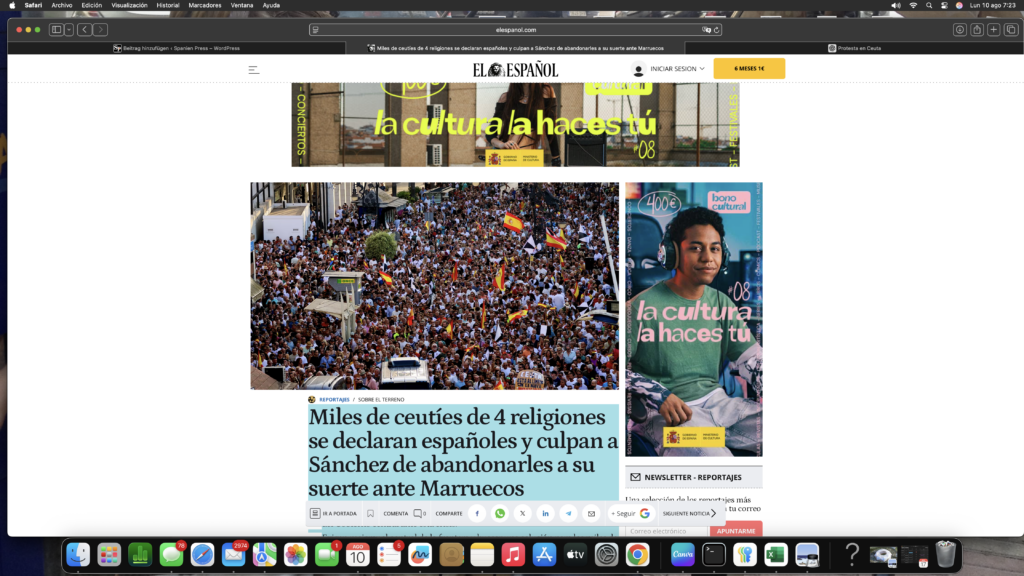
Madrid has unveiled a comprehensive package of measures for the autonomous city. Following the severe crisis at the end of July, the government aims to stabilise the economy, strengthen public services and restore confidence among businesses and workers.
Spain Expat Press Editorial Team
by Marlon Gallego Bosbach
The Spanish government approved a comprehensive support package for Ceuta on Tuesday. The Council of Ministers adopted a Royal Decree-Law that will mobilise more than €309 million over the remaining four months of 2026. The sum is equivalent to around 16 per cent of the autonomous city’s gross domestic product.
The package addresses the consequences of the severe crisis that followed the mass influx of migrants at the end of July. At the same time, it is intended to boost economic activity in Ceuta and ease the burden on businesses, workers and public institutions.
Economy Minister and Deputy Prime Minister Carlos Cuerpo said after the Council of Ministers meeting that the main objective was to restore “confidence and calm” in the city. According to the government, the measures are intended to address both the demands of the social partners and the needs of the autonomous city.
€309 million for four key areas
The funds are distributed across several major areas. The largest allocation is for the reception of minors and humanitarian assistance, with €118 million earmarked for this purpose.
A further €90 million will be allocated to security. Another €21 million is earmarked for essential public services such as healthcare, education, the justice system and water supply. The government is providing a further €80 million to support businesses and workers.
The package therefore takes a broad approach: alongside addressing the immediate consequences of the migration crisis, it also aims to limit the economic impact on Ceuta as quickly as possible.
€36.6 million for businesses and self-employed workers
A particularly important component is the direct financial support for businesses. A €36.6 million fund is being established for this purpose.
According to the government, around 2,600 self-employed workers and 1,400 businesses in Ceuta affected by the events are expected to benefit from the fund. Applications can be submitted via the website of the Spanish tax authority from 14 September. The first payments are expected to be made as early as October.
Madrid’s main aim is to prevent the crisis from causing lasting damage to the local economy.
€14 million for trade and tourism
Local consumption is also set to receive targeted support. The government is providing €14 million for this purpose. Measures include consumer and tourism vouchers, as well as institutional advertising campaigns. The aim is to attract more visitors to Ceuta while also boosting sales for local shops and businesses.
A further €2 million will be used to strengthen the city’s international economic and tourism profile. One million euros has been earmarked for the “Ceuta Exporta” plan, organised through ICEX, with another €1 million allocated to international tourism promotion.
Tax relief and stronger employment incentives
The package also includes permanent tax relief measures. The government estimates the annual relief at around €12 million. One key change concerns corporation tax: the tax allowance for resident companies that maintain their workforce is set to increase from 50 to 60 per cent. Improvements are also planned for income tax for self-employed workers.
Employment is also set to receive greater support. The reduction in employers’ social security contributions will be increased to 75 per cent. This is intended to make it more attractive for businesses to create and retain jobs.
ERTE scheme aims to prevent redundancies
For businesses particularly hard hit by the crisis, the plan also provides for a reinforced ERTE scheme. Companies that make use of this mechanism can benefit from a full exemption from employers’ social security contributions.
At the same time, the affected workers are to be protected. They will be able to receive unemployment benefits without the corresponding periods counting towards their accrued contribution periods. The government aims to prevent temporary economic difficulties from immediately resulting in permanent job losses.
Up to €50 million in state-backed loan guarantees
Another element of the package concerns business financing. The state is providing an ICO guarantee facility of up to €50 million.
The aim is to make it easier for businesses to access bank loans. Additional funding is also being provided for a so-called Sociedad de Garantía Recíproca, which is intended to make financing more accessible, particularly for smaller businesses.
For businesses facing liquidity problems in the wake of the crisis, this could provide important support.
€118 million for minors and humanitarian assistance
The largest single allocation in the package concerns migrant reception and humanitarian assistance. A total of €118 million has been earmarked for this purpose. Part of the funding will go directly to Ceuta, while the remainder will be administered through the Ministry of Inclusion, Social Security and Migration.
The government is responding to the exceptional strain placed on the reception system following the mass influx at the end of July.
€90 million for security
The security forces will also receive substantial additional funding. A total of €90 million has been allocated to this area, supporting the Policía Nacional, Guardia Civil and other security personnel deployed in Ceuta.
The funding is intended to cover additional personnel, logistical and operational costs arising from the exceptional situation in Ceuta.
A further €21 million for public services
The government is also providing €21 million to strengthen essential public services in Ceuta. The funding will support healthcare, education and the justice system, as well as water supplies and psychosocial support.
The plan also includes sending additional healthcare professionals to Ceuta and strengthening schools and courts with additional staff and organisational support. Part of the funding will also be used to improve the city’s water supply and support its desalination plant.
Government aims to restore “normality”
With the package of measures, the government is seeking to restore economic and social normality following the severe crisis. The scale of the programme is considerable: €309 million is equivalent to around 16 per cent of Ceuta’s GDP.
At the same time, the package goes beyond short-term crisis relief. Through permanent tax cuts, employment incentives and improved access to finance, Madrid aims to strengthen the city’s economic foundations over the long term.
However, the president of the autonomous city of Ceuta, Juan Jesús Vivas, recently stressed that financial assistance alone would not be enough. The crucial issue, he said, was for the city to return to normality and for the consequences of the migration crisis to be effectively addressed.
First aid payments expected to arrive as early as October
For businesses and self-employed workers, the crucial phase will begin in just a few days. Applications can be submitted from 14 September, with the government planning to make the first payments in October. Madrid is therefore aiming for a swift implementation of the programme.
For Ceuta, the key question now is whether the substantial government funding will actually be enough to cushion the economic damage of recent weeks while providing lasting relief for public services and security infrastructure.
One thing is already clear: with more than €309 million, the Spanish government has unveiled one of the most extensive short-term support packages ever for the autonomous city.