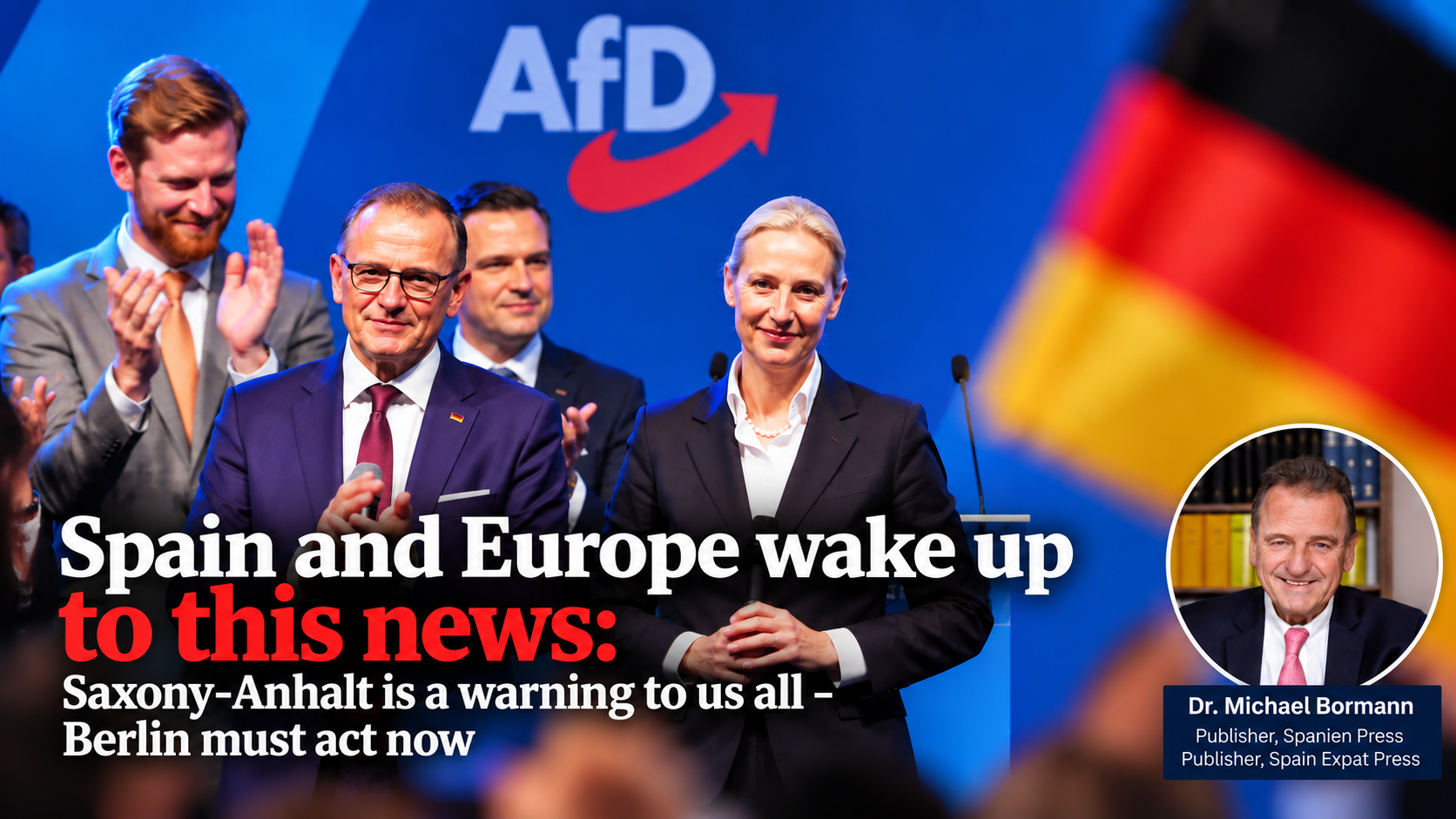
Europe – and Spain with it – has woken up to a political result in Germany whose significance extends far beyond the borders of Saxony-Anhalt. The AfD’s historic success has immediately focused attention on Berlin and on a question that can no longer simply be dismissed as a regional German matter: what is changing in Germany, and how will its government respond?
Dr Michael Bormann, Publisher of Spanien Press/ Spain Expat Press
The scale of the result should, of course, be kept in perspective. This was an election in one of Germany’s smaller federal states, not a federal election determining the composition of the Bundestag. Yet it would be a serious mistake to treat what happened in Saxony-Anhalt as an isolated regional phenomenon.
Saxony-Anhalt may be small. The political message delivered by its voters is not. It is a warning to Berlin – and one being watched closely across Europe, including here in Spain.
What is particularly striking is the dramatic loss of support suffered by parties of the left in what was once one of their strongholds. At the same time, the CDU appears to have lost a substantial degree of trust among conservative voters.
The principal beneficiary has been the AfD.
Anyone genuinely seeking to prevent the party from making further gains at federal level must therefore stop talking only about the AfD’s strength and begin addressing the reasons behind its success.
In my view, four clear conclusions follow.
There must be consequences at the top
Chancellor Friedrich Merz has lost considerable trust through political U-turns and promises that, in the eyes of many voters, have not been kept. Those who expected him to deliver a credible conservative change of direction are among those who now feel disappointed.
In my view, his political authority has been damaged to such an extent that Germany needs a fresh start at the top.
Friedrich Merz should draw the consequences and resign as Chancellor this week.
That is a strong demand. But extraordinary political developments sometimes require equally clear political consequences.
The AfD’s relationship with Russia must move to the centre of the debate
The distinctly Moscow-friendly positions found within significant sections of the AfD deserve far greater public scrutiny.
This should not be reduced to slogans or moral lectures. It is a fundamental question about Germany’s future foreign and security policy.
Conservative, economically minded and security-conscious voters in particular have a right to know what a fundamental change in Germany’s policy towards Russia could mean for the country, its European partners and its international alliances.
The argument should be factual. But it needs to take place.
If Germany wants conservative voters back, it must actually deliver conservative policies
On migration and internal security, announcements are no longer enough. What matters is whether the state consistently enforces the laws already in place.
Illegal migration must be effectively restricted. Legally binding decisions requiring people to leave the country must be enforced. Foreign nationals convicted of criminal offences should, where the law permits, be deported consistently.
This should not simply be characterised as a question of left versus right. It is ultimately about the credibility of the state.
A state governed by the rule of law risks losing public confidence when it establishes rules but leaves its citizens with the impression that it is either unable or unwilling to enforce them.
Less ideological symbolism, more attention to everyday concerns
The federal government should move away from what many voters regard as excessive gender and identity politics.
People expect their government to address the issues that affect their lives directly: security, migration, the economy, energy costs, housing, education and public services that actually work.
Politics must once again give people the sense that their concerns are being heard, rather than appearing to tell them which social and cultural debates they ought to consider important.
Saxony-Anhalt is one of Germany’s smaller states. The signal sent by this election is anything but small.
Anyone who simply records another AfD success and then carries on as before has failed to understand the message.
If Germany’s established parties genuinely want to prevent the AfD from continuing to grow at national level, they must confront an uncomfortable question: why are increasing numbers of voters turning to it?
The answer cannot simply be another campaign against the AfD. It must also involve addressing the political conditions that have allowed the party to prosper.
And that requires consequences – not at some distant point in the future, but now.
Dr Michael Bormann
Publisher, Spanien Press/Spain Expat Press