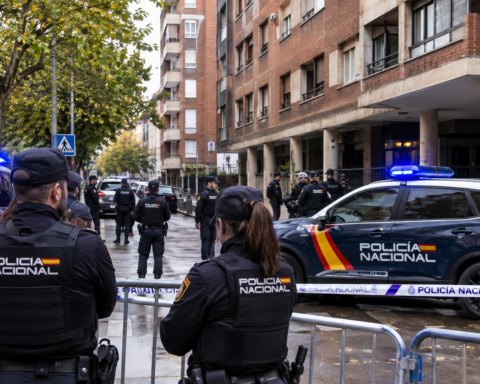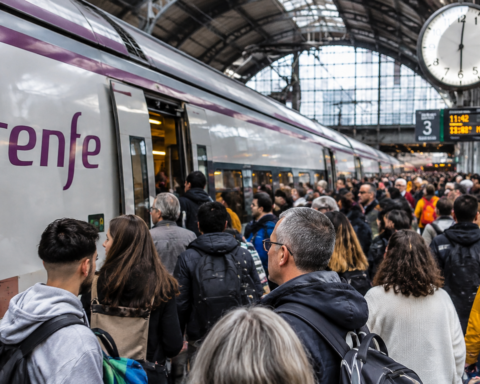
An emotional farewell in Toledo Cathedral, 69 lives lost and grieving families demanding answers and accountability. King Felipe VI and Queen Letizia stood alongside the bereaved yesterday, offering their personal condolences. But one prominent figure was missing: Spain’s Prime Minister, Pedro Sánchez. Instead of attending the funeral, he travelled to Catalonia to record a podcast with popular YouTuber Jordi Wild – a decision that has sparked political controversy.
Spain Expat Press Editorial Team
An emotional farewell to 69 victims
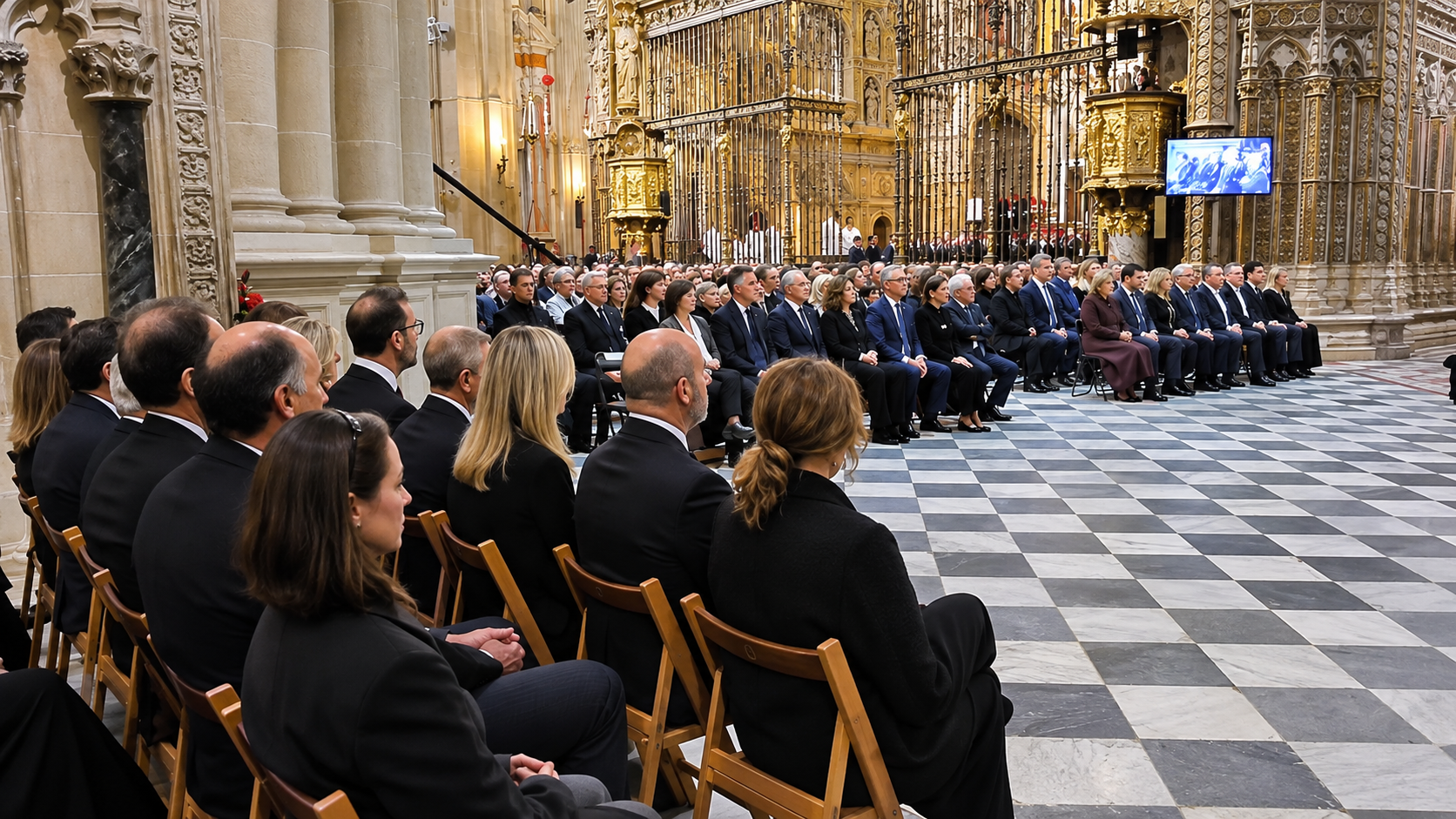
Yesterday, Tuesday 10 November, relatives, survivors, emergency workers and political representatives gathered at Toledo Cathedral to bid a final farewell to the 69 people who lost their lives in the devastating railway disaster near Urda.
The funeral Mass was celebrated by the Archbishop of Toledo, Francisco Cerro Chaves, with around 150 relatives of victims and injured passengers in attendance.
The atmosphere was one of profound grief. For many families, it was another painful moment following the tragedy that had struck just two weeks earlier.
Yet amid the sorrow, one demand stood out: the circumstances surrounding the disaster must be fully investigated, and anyone found responsible must be held accountable.
The King and Queen greeted with applause
King Felipe VI and Queen Letizia attended the funeral in person and were welcomed with applause.
The royal couple expressed their condolences and offered support to the families during one of the most difficult moments of their lives.
Particularly moving were their personal encounters with grieving relatives. Their presence was widely seen as an important gesture of compassion and national solidarity.
As families mourned their loved ones, however, Spain’s Prime Minister was conspicuous by his absence.
Pedro Sánchez did not attend.
⚫️ Los Reyes consuelan uno por uno a los familiares del accidente de Urda
👉 Como ya hicieran en la misa funeral de las víctimas del accidente de Adamuz y de la dana, los Reyes consuelan uno a uno a los familiares a las víctimas del accidente de tren de Urda https://t.co/z8z4e0xbFy
— EL ESPAÑOL (@elespanolcom) November 10, 2026
Sánchez misses the funeral – and records a podcast instead
The Prime Minister’s absence attracted considerable attention.
While the funeral for the 69 victims was taking place in Toledo, Pedro Sánchez travelled to Manresa, in Catalonia, where he had a recording scheduled for The Wild Project, the popular podcast hosted by Spanish YouTuber Jordi Wild.
The revelation that the Prime Minister had chosen to fulfil a media engagement on the very day of the national mourning ceremony prompted sharp criticism.
It is important, however, to distinguish between the confirmed circumstances and the precise timing. Reports established that the podcast recording was scheduled for the same day, although the extent to which the recording itself overlapped with the funeral service has not been conclusively documented.
Nevertheless, critics have questioned the Prime Minister’s priorities.
The Spanish Government was represented at the funeral by several ministers, but Sánchez himself stayed away.
Why did the Prime Minister not attend?
Sánchez explained his absence by referring to the religious nature of the ceremony.
He maintained that he generally does not attend religious services, preferring secular commemorations instead.
That explanation, however, has been challenged by his political opponents.
Critics pointed out that Sánchez has attended religious funerals and other church ceremonies during his time in office.
The opposition argues that these precedents raise questions about the consistency of his decision.
Nevertheless, there is no legal obligation for a Spanish Prime Minister to attend a religious funeral. The controversy therefore centres primarily on the symbolic importance of a head of government’s presence following a national tragedy.
Feijóo attends with senior party figures – Abascal also absent
While Sánchez did not attend, Alberto Núñez Feijóo, leader of the conservative People’s Party (PP), was present at the ceremony.
He was accompanied by more than a dozen senior representatives of his party.
Emiliano García-Page, the Socialist president of the Castilla-La Mancha regional government, also attended.
The Spanish Government was represented by several ministers, including Economy Minister Carlos Cuerpo.
Santiago Abascal, leader of the right-wing Vox party, was also absent.
The contrasting decisions taken by Spain’s leading political figures became the subject of considerable public discussion.
However, it was the absence of the serving Prime Minister that attracted the greatest political scrutiny.
Opposition criticises Sánchez
Representatives of the People’s Party accused Sánchez of prioritising a podcast appearance over personally attending the funeral.
His critics argued that, given the scale of the disaster, the Prime Minister should have stood alongside the bereaved families.
In their view, his absence sent an unfortunate message to both the relatives of the victims and the wider Spanish public.
Other political figures, however, urged restraint, warning against turning a funeral into an opportunity for partisan confrontation.
Socialist regional president Emiliano García-Page also stressed that the focus should remain on the victims and their families.
The controversy illustrates how even moments of collective national mourning have become entangled in Spain’s increasingly polarised political climate.
Spain’s second major railway disaster of the year
The tragedy has been particularly devastating because Spain has suffered two major railway accidents on the same high-speed rail corridor within a matter of months.
In January, 46 people lost their lives in a railway disaster near Adamuz, in Andalusia.
The subsequent tragedy near Urda claimed another 69 lives.
Together, the two accidents have resulted in 115 deaths.
The disasters have reignited concerns about the safety of Spain’s railway network.
Questions have been raised about infrastructure, potential safety shortcomings, inspection procedures and whether the accidents could have been prevented.
Until the investigations are completed, however, possible causes and responsibilities must not be presented as established facts.
Families demand answers and accountability
For the families of those who died, the political controversy is secondary to their search for answers.
They want to know what happened, why it happened and whether mistakes or failures contributed to the disaster.
Their message is clear: if responsibility is established, there must be consequences.
Behind each of the 69 deaths is a person whose life was suddenly cut short.
Parents, children, partners, siblings and friends have been left facing a loss that can never be undone.
For them, no political explanation or public debate can diminish the enormity of their personal tragedy.
A day Spain will not easily forget
The images from Toledo Cathedral are likely to remain etched in the country’s collective memory: grieving families, the compassion shown by the King and Queen, and a solemn farewell to those who lost their lives.
Yet the Prime Minister’s absence will also form part of the public debate surrounding the ceremony.
The fact that Pedro Sánchez had a podcast engagement in Catalonia on the same day that the victims were being remembered in Toledo has raised questions extending well beyond the funeral itself.
For his critics, attending in person would have represented an important gesture of leadership, responsibility and respect.
Others argue that the Government was adequately represented by several ministers and that the religious character of the ceremony was a legitimate consideration in the Prime Minister’s decision.
Regardless of the political controversy, the central demand from the victims’ families remains unchanged.
Sixty-nine people have lost their lives. Their families are asking for more than expressions of sympathy. They want the truth, a thorough investigation and, wherever failures are established, accountability.