Road blockades, clashes with police, injured protesters and major disruption across Spain. Yet what makes this general strike particularly extraordinary is its political dimension: after almost eight years of Socialist government, ministers are openly supporting industrial action that opposition parties claim is directed against them. With the conservative People’s Party and Vox ahead in several opinion polls, the strike has become a major political controversy just weeks before the general election.
Spain Expat Press Editorial Team
A general strike unlike any other?
Spain woke up on Wednesday, 11 November 2026, to a nationwide general strike that quickly brought disruption to major cities, industrial centres and transport networks.
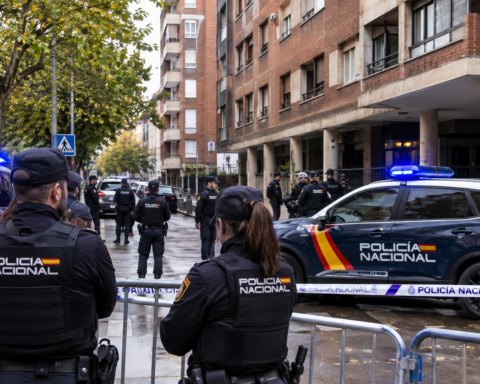
Within hours, pickets had blocked roads, police had intervened at several locations, and key sectors of the economy were reporting substantial stoppages.
The country’s two largest trade unions, Comisiones Obreras (CCOO) and Unión General de Trabajadores (UGT), called the 24-hour strike to demand affordable housing, higher wages and better public services.
These are familiar grievances in a country where rising property prices and living costs have placed increasing pressure on households.
But this is no ordinary industrial dispute.
Traditionally, general strikes are intended to exert pressure on the government of the day. This time, however, members of the government are openly encouraging participation.
And that government, led by Socialist Prime Minister Pedro Sánchez, has been in power since June 2018.
The opposition argues that the strike is less about holding the current administration accountable than about mobilising voters against a potential change of government.
A strike against the opposition – in the middle of an election campaign?
The timing could hardly be more politically sensitive.
Spain is due to hold a snap general election on 29 November, just 18 days after the strike.
Several recent opinion polls place the conservative People’s Party (PP) ahead of the governing Spanish Socialist Workers’ Party (PSOE), with parliamentary projections suggesting that PP and the right-wing Vox party could secure a majority together.
A survey published on 9 November by polling company 40dB for El País and Cadena SER projected more than 190 seats for PP, Vox and UPN combined. An absolute majority in Spain’s Congress of Deputies requires 176 seats.
Polling projections are not election results, but they provide an important backdrop to the political controversy surrounding the strike.
Deputy Prime Minister and Labour Minister Yolanda Díaz has publicly encouraged people to take part in the industrial action.
Senior Socialist figures have also linked the mobilisation to the wider political debate ahead of the election.
The opposition accuses the unions of using social grievances to mobilise voters against PP and Vox.
The unions reject accusations that the strike is merely a party-political exercise. They insist that their demands are directed at employers and public authorities across Spain, and that preparations began before the snap election was announced.
Nevertheless, the government’s support for a general strike taking place during its own administration has raised an obvious question: who, precisely, is the protest intended to pressure?
Most Spaniards suspect political motives
Public opinion suggests that doubts about the strike’s timing extend beyond the opposition parties.
According to a survey conducted by polling institute DYM for the newspaper 20Minutos, approximately 68 per cent of respondents believe the general strike was organised with the intention of influencing the 29 November election.
Only 13.9 per cent considered the timing appropriate, while roughly one-third believed the industrial action should have taken place earlier.
Significantly, suspicions about electoral motives were also recorded among supporters of the governing parties.
According to the survey, 56.1 per cent of PSOE voters and 50.5 per cent of Sumar voters believed there was an electoral dimension to the strike.
Yet the same polling also revealed a more nuanced picture.
Some 49 per cent of respondents considered the strike itself justified, compared with 39.1 per cent who opposed it.
In other words, many Spaniards appear to distinguish between supporting the unions’ social demands and questioning the political timing of the mobilisation.
That distinction is crucial to understanding the controversy.
Nearly eight years of Socialist government – and the problems remain
Perhaps the most contentious aspect of the strike is that the issues prompting today’s protests are hardly new.
Spain’s housing crisis has been developing for years.
In Madrid, Barcelona, Málaga, Marbella and other economically attractive areas, property prices and rents have risen beyond the reach of many ordinary workers.
Young people increasingly struggle to leave the family home, while households on average incomes face mounting pressure from housing costs.
At the same time, many Spaniards complain about the cost of living, inadequate wages and shortcomings in public services.
The Sánchez government has introduced measures intended to address some of these problems, including housing legislation and increases in the minimum wage.
Nevertheless, affordable housing remains a major unresolved challenge.
Responsibility for housing and public services is shared between Spain’s central government, autonomous communities and local authorities. Private market conditions and wider economic developments also play important roles.
Even so, the political question remains unavoidable.
Why have Spain’s two largest trade unions chosen this particular moment, after almost eight years of Socialist government, to organise the country’s first general strike of this scale in 14 years?
For PP and Vox, the answer lies in the approaching election.
The unions maintain that the mobilisation is a legitimate response to longstanding social problems and was planned independently of the electoral timetable.
There is no conclusive evidence that the strike forms part of a formally coordinated PSOE election campaign. However, the explicit support expressed by government figures has undoubtedly given the industrial action an additional political dimension.
Madrid: Police clashes, pepper spray and injuries
While the political arguments intensified, the first hours of the strike were marked by confrontations on the streets.
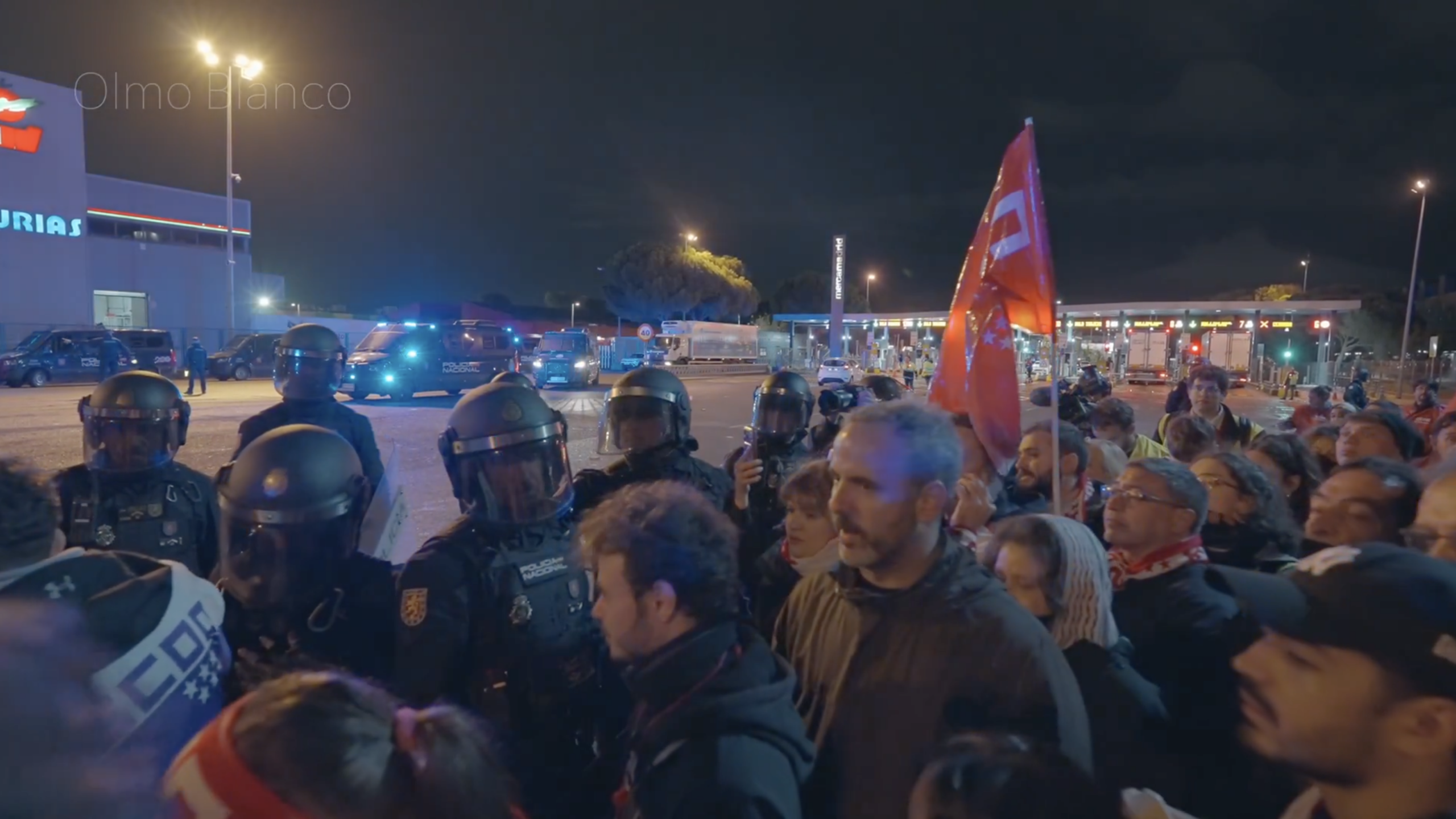
At Mercamadrid, the capital’s enormous wholesale food market, approximately 1,000 demonstrators gathered during the early hours.
According to CCOO, police officers used batons and pepper spray against pickets.
The union reported that 13 people required medical attention for bruising and eye irritation.
CCOO announced its intention to pursue legal action over the police intervention and reported that one participant had been arrested.
Further confrontations took place outside depots belonging to Madrid’s municipal transport operator, EMT.
On the M-30 ring road, demonstrators briefly blocked traffic during the morning rush hour. Police cleared the obstruction after approximately ten minutes.
Trade union representatives accused officers of interfering with the constitutional right to strike.
The circumstances and proportionality of the police interventions have not yet been independently established.
Tensión en Mercamadrid durante el arranque de la huelga general https://t.co/e5soENv2tE
— Olmo Blanco (@rebonico) November 11, 2026
Andalusia: Clashes in Málaga and major disruption at Algeciras
The effects of the general strike were also felt across southern Spain.
In Málaga, pickets moved through the city centre overnight, prompting some businesses to close temporarily and several restaurant terraces to be cleared.
The most serious confrontation occurred outside a depot operated by the city’s municipal transport company, EMT.
Police intervened to ensure that buses operating the legally required minimum services could leave the premises.
Union representatives reported that several demonstrators had been injured.
Officers also intervened at MercaMálaga, the city’s wholesale market, to allow lorries to depart.
Elsewhere in Andalusia, the Port of Algeciras was particularly affected.
According to CCOO and UGT, strike participation reached approximately 90 per cent during the initial hours.
Algeciras is one of Europe’s most important logistics and container-handling hubs, making disruption there potentially significant for international supply chains and freight movements.
El movimiento de vivienda corta la A-42 a la altura de Plaza Elíptica.
¡Viva la Huelga General! https://t.co/B7YC9FvaHY
— alemvelasco_ (@alemvelasco_) November 11, 2026
Barcelona: More than 30 roads blocked
Catalonia experienced some of the most extensive traffic disruption.
By early morning, regional traffic authorities had reported blockades at more than 30 locations across the road network.
Affected routes included the AP-7 motorway, the A-2 and Barcelona’s B-10 coastal ring road.
Pickets also obstructed access to industrial estates, logistics centres and port facilities.
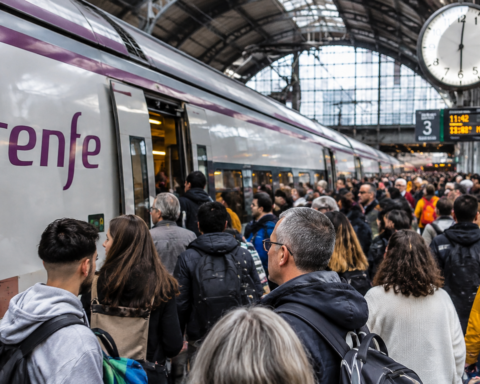
At Barcelona-Sants railway station, demonstrators temporarily blocked entrances used by passengers travelling on commuter and high-speed services.
Catalonia’s regional police force, the Mossos d’Esquadra, deployed approximately 9,000 officers for the day.
One arrest was also reported in Barcelona in connection with burning rubbish containers.
Further major demonstrations were scheduled for the afternoon.
Valencia: Port operations largely suspended
Valencia also experienced significant disruption.
According to union representatives, normal operations at the Port of Valencia were largely suspended, with exceptions for certain hazardous or perishable goods.
The first demonstrations in the region were otherwise reported to have taken place relatively peacefully.
However, unions criticised the minimum service requirements imposed on public transport operators.
In Valencia, these reportedly reached 80 per cent for certain municipal bus services, a level the unions described as excessive.
🇪🇸‼️ | Así es como entienden la huelga algunas personas: rompiendo los coches de quienes libremente acuden a su puesto de trabajo https://t.co/UNN4iS1RJL
— EDATV (@edatvoficial) November 11, 2026
How badly has Spain’s economy been affected?
The unions published their first estimates of strike participation during the morning.
According to CCOO and UGT, approximately 90 per cent of workers in the automotive industry took part, with production reportedly halted at major facilities including Volkswagen Navarra and Seat in Barcelona.
Their preliminary figures indicated the following participation rates:
- Automotive industry: 90 per cent
- Ports of Algeciras and Valencia: 90 per cent
- Meat-processing industry: 85 per cent
- Waste collection: 82 per cent
- Energy sector: 75 per cent
- Healthcare and social care: 38 per cent
- Postal services: approximately 35 per cent
CCOO also reported that electricity demand had fallen by 9.7 per cent compared with the equivalent period the previous day.
The union interpreted the reduction as evidence of the strike’s economic impact.
However, these figures remain preliminary union estimates. Independently verified nationwide participation data were not yet available during the early hours.
The overall economic cost will become clearer as the day progresses.
What does the strike mean for foreign residents and visitors?
For the many British, German, Austrian, Swiss and other international residents living in Spain, the general strike may have immediate practical consequences.
Public transport, rail services, deliveries, municipal services and freight operations may all be affected.
Anyone travelling to an airport, attending an appointment or planning a longer journey should check for disruption in advance and allow additional time.
Not all public services will cease operating. Legally required minimum services remain in place in a number of sectors.
Businesses, self-employed professionals and property owners should also anticipate possible delays in deliveries and other services.
A general strike that has become an election issue
The events of 11 November may ultimately be remembered as much for their political implications as for the disruption they caused.
Spain is experiencing its first nationwide general strike of this magnitude in 14 years.
Yet unlike previous major industrial disputes, the political pressure is not directed exclusively at the government currently in office.
Instead, senior government figures are encouraging participation, while opposition parties accuse the unions of helping to mobilise voters against a possible change of government.
For CCOO and UGT, the strike is a necessary campaign for better living conditions, affordable housing and decent wages.
For PP and Vox, it is an attempt to turn social discontent into an electoral weapon.
The two interpretations have become central to the public debate.
What remains to be established is the extent to which the strike will affect the economy, public opinion and the final stages of the election campaign.
After almost eight years of Socialist government, Spain is witnessing a general strike over housing, wages and public services – with members of that same government encouraging people to take part.
That extraordinary political contradiction has turned what began as an industrial dispute into one of the most contentious episodes of Spain’s election campaign.
As of the morning of 11 November 2026. Reports of incidents and strike participation remain provisional.