The temporary closure of six beaches due to bacterial contamination has sparked a political debate in Málaga over the capacity of the city’s sewage system. While opposition parties accuse the city administration of having underinvested in the sewer network for years, operator Emasa points to the exceptional intensity of the heavy rainfall. A single storm event temporarily generated volumes of water that the system could not fully cope with, even with modern infrastructure.
Spain Expat Press Editorial Team
by Marlon Gallego Bosbach
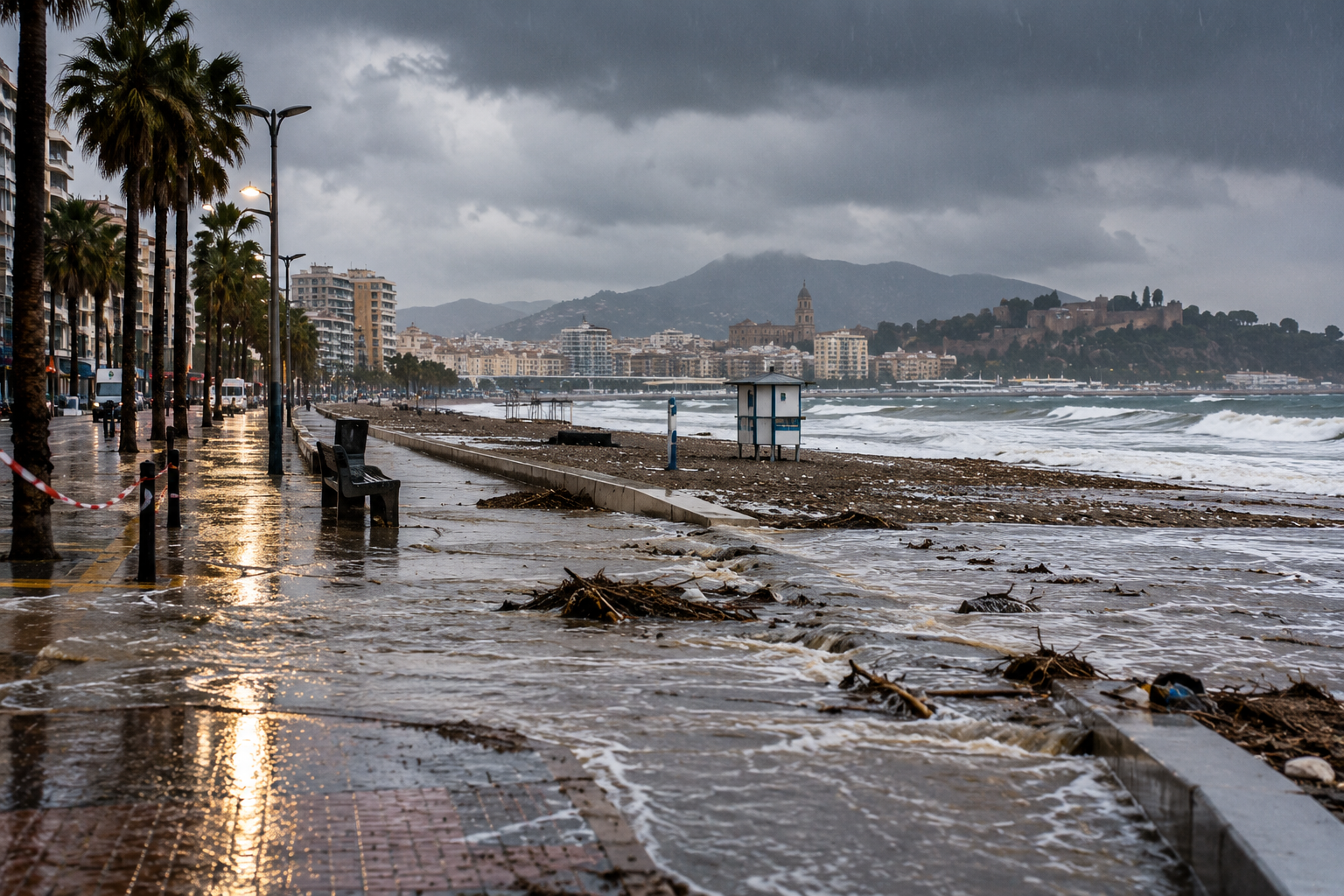
The scale of the problem is particularly clear from the figures cited by Emasa managing director Juanjo Denis at the city council. During the heavy rainfall on the night of the fireworks marking the start of the Feria de Málaga, water volumes of around 100 Olympic swimming pools per hour were temporarily generated. By contrast, the city’s two wastewater treatment plants, Peñón del Cuervo and Guadalhorce, can together process only around three Olympic swimming pools per hour.
If many times that volume enters the sewer network within a short period, the system cannot fully absorb and treat the enormous amounts of water. In such situations, excess water has to be discharged – meaning that contaminated water can also end up in the sea.
Six beaches closed during the summer
The situation was particularly problematic because the contamination occurred during the peak summer season. In total, six beaches in Málaga had to be temporarily closed this summer after tests detected bacterial contamination.
For the opposition, this is a sign that the city needs to act more quickly to expand its wastewater infrastructure. In the city council, the PSOE, Con Málaga and Vox in particular criticised the fact that rainwater and wastewater have not yet been completely separated.
With a separate sewer system, rainwater and domestic or commercial wastewater are carried away through different pipes. This means that, during heavy rainfall, the entire volume of rainwater does not enter the same system as the wastewater.
58 per cent of the network already separated
According to Emasa, the corresponding work in Málaga is already well advanced. Some 58 per cent of the sewer network for rainwater and wastewater has been completely separated, while a further 17 per cent is partially separated. The remaining portion continues to operate as a combined system.
Denis stressed that Málaga already has a comparatively high proportion of separate pipes. Other cities rely more heavily on so-called stormwater retention tanks to manage heavy rainfall.
However, these facilities also have their limits. Environment Councillor Penélope Gómez explained that retention tanks can only absorb part of the water during very heavy rainfall. In her view, they can particularly help to contain the initial minutes of a downpour. If the rain continues for longer and remains intense, water from these facilities can eventually also make its way towards the sea.
City announces multi-million-pound investment
At the same time, the city administration points to substantial investment in its water infrastructure. According to Gómez, numerous projects are currently being implemented or prepared through Emasa and the Gerencia de Urbanismo.
The total value of these measures is said to be just under €50 million. In addition, according to the councillor, the city’s hydraulic infrastructure investment plan amounts to around €100 million.
One key focus will be on further separating rainwater and wastewater pipes. At the same time, additional stormwater retention tanks are to be built to relieve pressure on the sewer system during heavy rainfall.
New management plan for Málaga’s wastewater system
Málaga is also working on a comprehensive management plan for its drainage system. According to Emasa managing director Denis, Spain’s Ministry for the Ecological Transition has called on local authorities to draw up such plans. Málaga has been granted an additional two-year deadline to do so. According to Denis, the new plan is expected to be available within a few months.
The aim is to establish more precisely how the city’s drainage system should be operated and further developed under different weather conditions. With heavy rainfall events occurring more frequently, this issue is becoming increasingly important for Málaga.
Opposition blames years of investment policy
The opposition, however, does not believe the weather is solely to blame. Socialist councillor Begoña Medina described the management of the beaches as “nefasta” and criticised the city administration over its infrastructure policy.
Financial decisions relating to Emasa also became a point of contention. Opposition parties criticised, among other things, the fact that the city had received €75 million from Emasa in the past. In the critics’ view, the money could instead have been used more extensively to invest in the water and wastewater network.
The debate has therefore evolved into a broader dispute over whether Málaga is sufficiently prepared for increasingly frequent extreme weather events.
Bathing water quality is the responsibility of the regional government
Emasa managing director Denis also made it clear that monitoring bathing water quality does not fall within the city’s remit. This responsibility lies with the Junta de Andalucía. The regional government regularly tests seawater quality. If problematic levels of bacteria are detected, the affected beaches can be closed.
This means that part of the responsibility lies outside the city administration, even though the causes of potential contamination may in turn be linked to the city’s wastewater infrastructure.
Málaga faces an infrastructure problem
The dispute over sewage discharges highlights a fundamental problem facing many cities experiencing increasingly frequent heavy rainfall: even a partially modernised sewer network can reach its technical limits when faced with extreme volumes of precipitation.
For Málaga, this means the city has to tackle two challenges at the same time. On the one hand, the existing combined sewer system needs to be progressively replaced with separate rainwater and wastewater pipes. On the other, additional capacity is needed to temporarily handle particularly heavy rainfall.
The city points to total investment of around €100 million, along with a number of specific construction projects. The opposition, however, argues that the measures taken so far are not sufficient. One thing is clear: the six beaches that were temporarily closed have exposed weaknesses in the infrastructure in the middle of the most important tourism season.