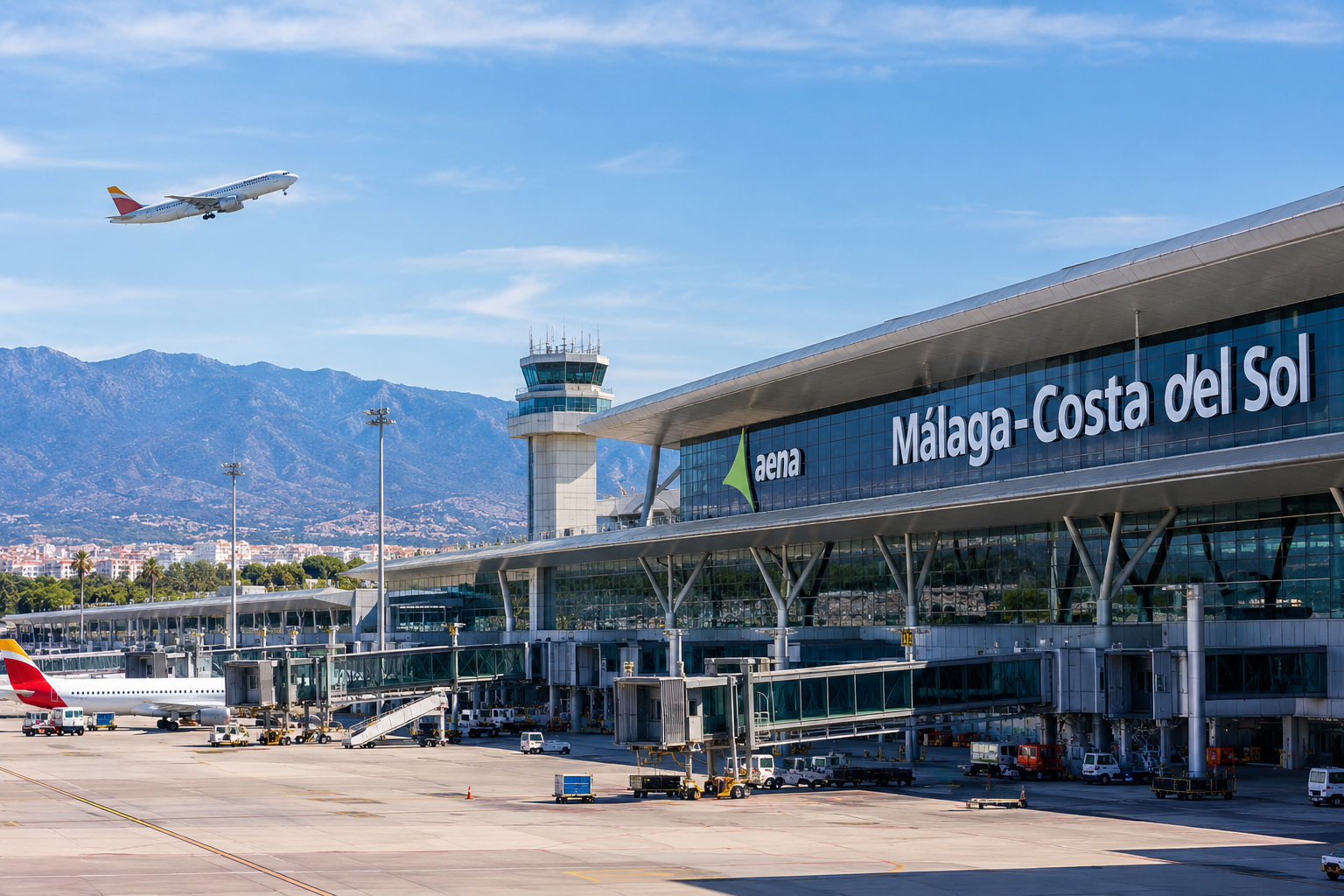
Málaga-Costa del Sol Airport is facing one of the largest redevelopment projects in its history. On Tuesday, the Spanish government approved the new investment program for the airport network. Around 830 million euros have been allocated for Málaga Airport for the period from 2027 to 2031.
Spain Expat Press Editorial Team
by Marlon Gallego Bosbach
The investment is part of the so-called DORA III, the regulated investment framework for Spanish airports. In total, airport operator Aena plans to invest around 13 billion euros in infrastructure over the next five years.
For Málaga, the decision comes at a time when the airport is regularly setting new passenger records and increasingly reaching the limits of its existing infrastructure.
Capacity is set to rise to 36 million passengers
The primary goal of the expansion project is to increase annual capacity. The airport can currently handle around 30 million passengers per year. Once the planned measures are completed, this capacity is set to rise to approximately 36 million passengers, enabling the airport to handle around six million additional travelers annually.
Current figures demonstrate just how strong demand already is. In August 2026 alone, more than 3.05 million passengers used Málaga Airport. This represents a 6.6 percent increase compared to August of the previous year. Málaga is thus by far the most important airport in Andalusia.
Terminal area grows to around 140,000 square meters
A key component of the project is the comprehensive reorganization of the terminal area. The current terminal area of approximately 80,000 square meters is to be expanded to around 140,000 square meters. At the same time, existing parts of the building are to be modernized or replaced with new infrastructure.
Plans include, among other things, the demolition of the old Terminal 1. The existing Docks B and C are also slated for demolition or fundamental reorganization. They will be replaced by more modern passenger areas designed to better prepare the airport for anticipated growth.
New security checks aim to make travel easier
The renovation is also expected to bring noticeable changes for passengers. New security technology is set to speed up processing at the checkpoints in the future.
Among other things, the plan is for travelers to no longer have to remove liquids and electronic devices from their carry-on luggage. The aim is not only to make security screening more efficient, but also to reduce waiting times for passengers and improve processes within the terminal.
In addition, new areas are planned for passport and border controls.
New area for flights outside the Schengen Area
Málaga is no longer solely a destination for European holidaymakers. The airport’s international route network is steadily expanding. Consequently, the expansion project includes a new pier for flights outside the Schengen Area. At the same time, the existing pier is to be adapted and modernized accordingly.
This is intended to enable the airport to better handle the growing number of international connections.
Investments rise to nearly seven times the previous level
The scale of the new investment program becomes particularly apparent when compared to the previous period. Only around 122 million euros had been allocated for Málaga between 2022 and 2026. Now, just under 830 million euros are set to be invested for the years 2027 to 2031. This represents almost a sevenfold increase in the total investment.
This expansion is part of a long-term project. In total, the expansion of Málaga Airport is expected to cost around 1.5 billion euros. Consequently, a portion of the investment will not take place until after 2031.
Málaga is growing faster than its infrastructure
The reason for the massive expansion lies primarily in the airport’s continued growth. Málaga is one of Spain’s most important international destinations and the key air travel hub for the Costa del Sol. Millions of holidaymakers arrive in the province via the airport each year.
At the same time, the number of international connections is also growing. On days with particularly high traffic, the number of passengers handled can already be extremely high. Consequently, the expansion is not intended to wait until the existing infrastructure is permanently overburdened; instead, Aena aims to adjust capacity early on to meet projected growth.
The expansion is to be carried out during ongoing operations
A particular challenge lies in the fact that the airport must continue to operate during the construction work.
Málaga is one of Spain’s most important airports and cannot simply be closed during the peak tourist season. Consequently, construction work must be carried out in stages and organized in such a way as to minimize disruption to ongoing flight operations.
Aena has already begun preparations for the major project. Technical planning was initiated even before the political approval was granted.
830 million euros for Málaga – 1.27 billion for Andalusia
Málaga receives by far the largest share of the investments earmarked for Andalusia. A total of around 1.27 billion euros is allocated for the region’s airports for the period from 2027 to 2031. Of this amount, approximately 830 million euros will go to Málaga, while 235 million euros are designated for Seville and another 95 million euros for Jerez.
The allocation of funds underscores the outstanding importance of Málaga Airport within Andalusian air travel and its pivotal role in the international accessibility of the Costa del Sol.
Airport charges will hardly rise
Alongside the investment program, the Spanish government also made a decision regarding the development of airport charges. Aena had originally proposed significantly higher annual increases.
In contrast, the framework now adopted envisages an average annual increase of only around 0.33 percent through 2031. According to available data, this equates to roughly three cents per passenger per year. With this move, the government aims to combine extensive investments with the lowest possible additional burden on airlines and, ultimately, travelers.
A major project for the future of the Costa del Sol
The expansion of Málaga Airport is more than just an infrastructure project. For the Costa del Sol, the airport is a key component of tourism and economic development. Hotels, holiday rentals, the hospitality sector, car rental agencies, retail businesses, and numerous other industries depend – directly or indirectly – on the region’s international accessibility. The planned expansion is therefore intended to prepare Málaga for a further phase of growth.
With an investment of 830 million euros through 2031 and a total of around 1.5 billion euros for the entire project, Málaga-Costa del Sol Airport is set for a fundamental transformation. Capacity is slated to rise to 36 million passengers, the terminal is set to expand significantly, and the infrastructure is to become more modern and efficient.
For the Costa del Sol, this means one thing above all: the region’s most important gateway is to be made fit for the coming decades.