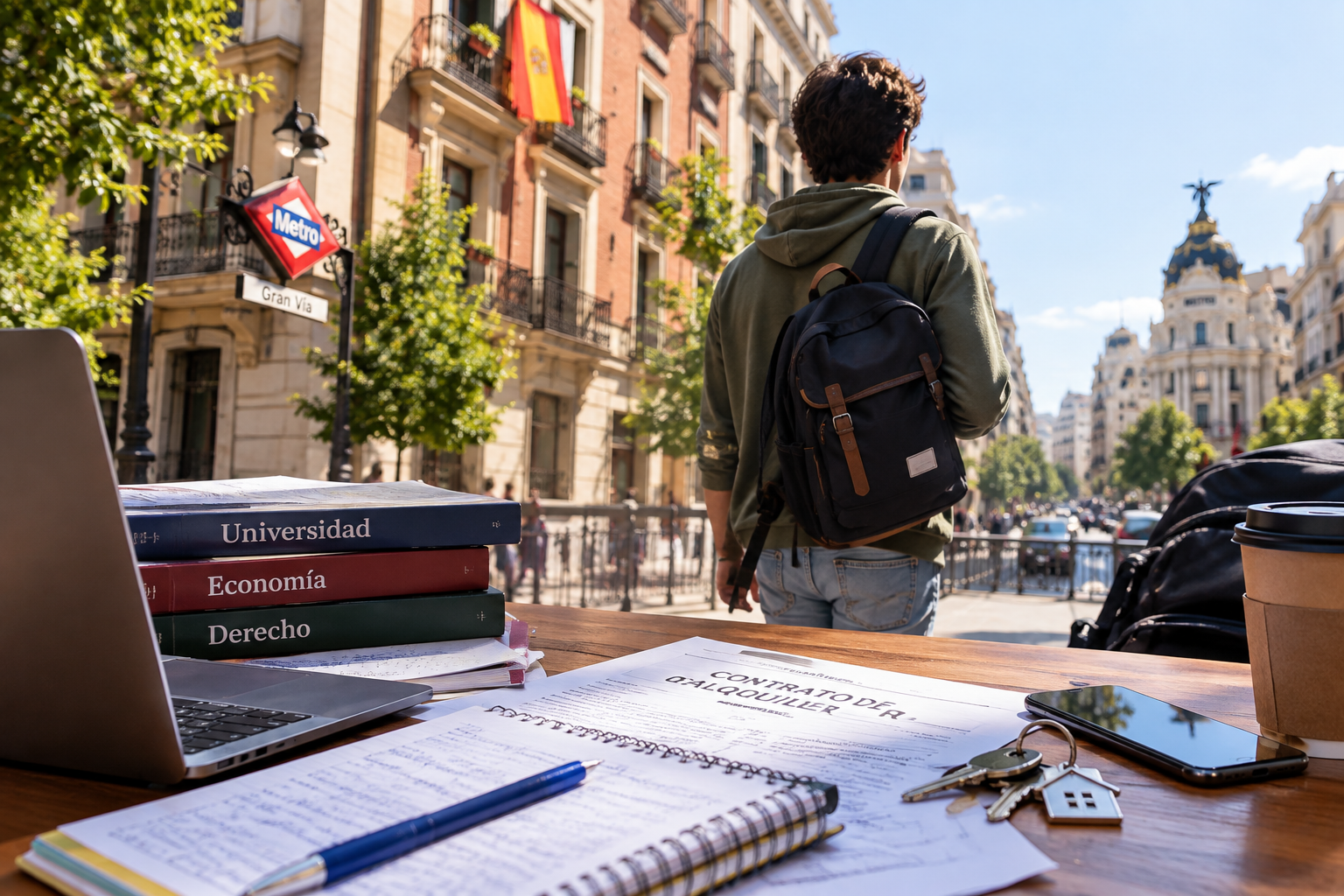
Around 240,000 families could go into debt to fund their children’s higher education—high housing costs in Madrid, Barcelona, and other university cities, in particular, are driving up expenses.
Spain Expat Press Editorial Team
by Marlon Gallego Bosbach
For many young people in Spain, autumn marks the start of not only a new academic year but also a financial adventure. Those who have to move to another city for their studies face high costs for rent, groceries, transport, and tuition. According to an estimate by the financial service provider Justalia, around 240,000 students – or their families – could therefore find themselves in debt to finance their higher education during the 2026/27 academic year. The company projects that approximately 15 percent of households with university students might take out a bank loan for this purpose.
This trend is hitting a housing market that is already strained. Affordable housing is scarce, particularly in Spain’s major university cities. For many families, therefore, the challenge lies not just in the studies themselves, but above all in the question of where their son or daughter can live while studying.
Up to 1,800 euros per month
According to calculations by Justalia, the monthly cost of a university education can range from 800 to 1,800 euros, depending on the university, region, and living situation. In addition to the cost of the education itself, this figure includes, in particular, expenses for accommodation and living costs.
A significant portion of this sum goes towards housing. According to Justalia, the cost of a room or student accommodation ranges from approximately 300 to 1,000 euros per month. For many students, rent can thus account for more than half of their total monthly budget.
Recent data from Spotahome also illustrate the intensity of the current pressure on the housing market. The average price for a room in Spain recently stood at around 425 euros; in Madrid and Barcelona, however, prices already exceed the 550-euro mark. Those who wait until August to start their search face even higher costs: between June and August, prices rose from an average of 550 euros to 614 euros—an increase of just under twelve percent.
680,000 students leave home
The problem is particularly acute for those who have to move to another region to pursue their desired degree program. According to Justalia, up to 680,000 students could leave their family homes to study in a different part of Spain. This additional demand is concentrated primarily in major university cities; Madrid and Barcelona are among the markets most affected, but Valencia, Seville, and Granada are also under pressure.
In addition, there are university cities such as Salamanca, Santiago de Compostela, and Pamplona, where there is also high demand for student housing.
The effect is particularly evident in the market for shared apartments. According to Justalia, the price of a room in a shared apartment has risen by 60 percent over the past five years. At the same time, the supply of suitable apartments and student accommodation is limited.
Madrid and Barcelona particularly expensive
Recent figures from Spotahome show how much costs vary by city. In Madrid, a room booked in June for the start of the academic term cost an average of around 600 euros. Those who waited until August paid around 645 euros.
Barcelona is also among the most expensive markets. There, the average price rose from approximately 675 to 690 euros during the same period. In Valencia, the price moved from 425 to 450 euros.
At the same time, according to Spotahome, the demand for rooms for the start of the academic year in September rose by 22.7 percent over the course of a year. This further intensifies competition for affordable accommodation.
Family remains the most important source of funding
A recent study by the Fundación CYD, based on the European EUROSTUDENT-8 report, also highlights the fact that costs are increasingly falling on families. According to the study, students in Spain spend an average of 1,148 euros per month on housing, food, transport, leisure, and study-related expenses. This places Spain above the European average of 1,112 euros.
The family is the most important source of income in this regard: 48.5 percent of students’ financial resources come from their families. Personal income accounts for 39.7 percent, while public support amounts to just 6.9 percent.
Moreover, nearly a quarter of students – 24.8 percent – report facing serious or very serious financial difficulties in covering material costs.
Students also work alongside their studies
Increasing numbers of young people are therefore trying to cover part of the costs themselves. According to the Fundación CYD, 33.3 percent of students work regularly during the academic year, while another 15 percent work occasionally.
This can reduce the financial burden on families, but it does not solve the underlying problem. Anyone who has to pay several hundred euros for a room – plus the cost of food and other expenses – needs a substantial monthly income, even with a part-time job.
The situation becomes particularly difficult for families whose children cannot study near a university. In such cases, rent, a security deposit, and transportation costs – and often the cost of trips home – are added to the regular expenses of studying.
Banks offer student loans
At the same time, rising costs are bringing student loans increasingly into focus. According to Justalia, some banks now offer loans of up to 80,000 euros to cover the entire duration of studies. Repayment can extend over a period of up to ten years.
Carlos Reina, Managing Director of Justalia, therefore advises families and students to carefully compare loan offers. Crucial factors include not only the nominal interest rate but also – among other things – the annual percentage rate (APR), the loan term, potential repayment-free periods, and additional fees.
Justalia specifically warns against financing ongoing expenses using credit cards. Low monthly installments can mask the fact that the actual debt is being paid down only slowly. With so-called revolving credit cards, this can lead to the accumulation of high interest costs over an extended period.
It is not just tuition fees that are the problem
Current trends thus reveal a fundamental shift in the cost of university studies in Spain. For many families, tuition fees are not necessarily the single largest expense; a far more significant factor is that young people often have to finance a second place to live while studying.
This primarily affects families from smaller towns and regions whose children must move to major university centers for certain degree programs. The higher the rent in the university town, the less money remains for other living expenses.
The tight housing market further exacerbates this trend. Students compete for rooms and apartments with other tenants – in cities where supply is already failing to keep pace with demand.
Spain facing particular financing pressure
A comparison with other European countries also reveals that Spanish students rely heavily on financial support from their families. The latest EUROSTUDENT comparison by the Fundación CYD covers 25 European countries and is based on data from 2021 to 2024. Spain has been included in this international study again after an absence of more than ten years.
According to the data, only 29.1 percent of Spanish students receive some form of public support. The European average is 40 percent. At the same time, the proportion of students reporting financial difficulties is substantial, at 24.8 percent.
For many families, financing a university education thus becomes a long-term undertaking – and in some cases, potentially leads to debt that persists for years after graduation.
University studies become a housing issue
This trend highlights just how closely intertwined the issues of education and housing have become in Spain. Students who can afford their studies but cannot find affordable accommodation in their university city face a fundamental problem. Particularly in cities like Madrid, Barcelona, Valencia, or Seville, an inexpensive room can make a decisive difference to a family’s overall financial situation.
For the 2026/27 academic year, Justalia therefore anticipates around 240,000 students—or their families—who might require a loan to finance higher education. This figure is an estimate by the financial service provider and not an official statistic regarding loans actually taken out.
One thing is certain, however: the cost of studying in Spain is increasingly determined by housing conditions. And as long as affordable rooms and apartments remain scarce in major university cities, the financial pressure on students and their families is likely to remain a key issue.