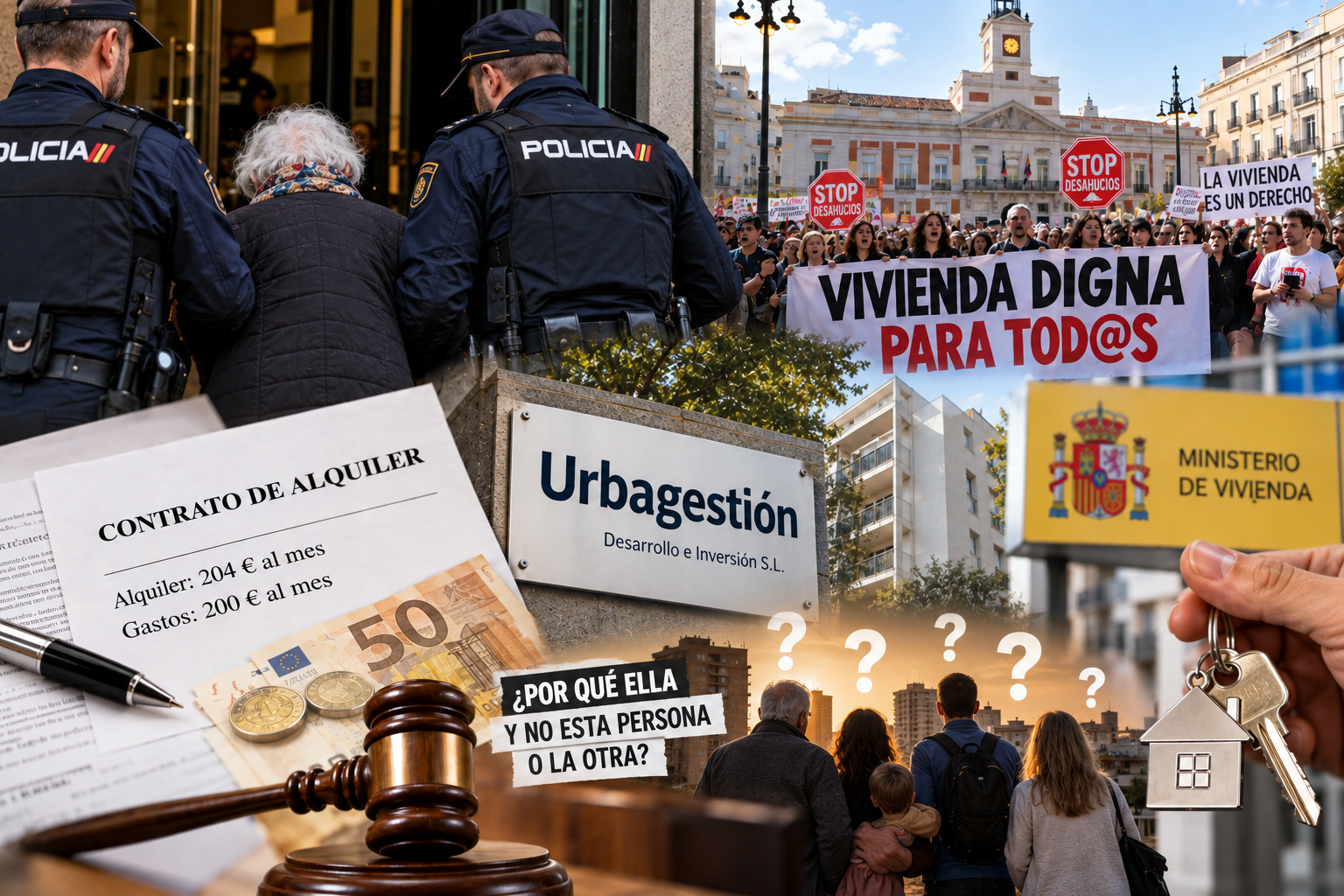
The 87-year-old woman whose eviction and subsequent death sparked outrage across Spain had previously held senior positions in companies involved in property investment. According to newly published reports, one of those businesses had share capital equivalent to approximately €5.7 million in 1994. The revelations raise uncomfortable questions about the political narrative surrounding her case, the Spanish government’s accusations against her landlord and the response of the tenants’ union that turned her into a national symbol.
Spain Expat Press Editorial Team
The case of María del Carmen Abascal, widely known as MariCarmen, has taken an unexpected and distinctly ironic turn, even after her death.
The 87-year-old pensioner, whose eviction from her Madrid home and subsequent death made her a symbol of the campaign against property speculation in Spain, had herself held senior positions in companies involved in property investment and rental activities decades earlier.
The information, first reported by the Spanish news outlet OKDIARIO and subsequently covered by Crónica Diaria, is said to be based on documents filed with Madrid’s Commercial Registry.
It reveals a previously little-known chapter in the professional life of a woman whose story has dominated Spain’s housing debate in recent weeks.
The reports come after nationwide demonstrations, fierce political arguments and accusations directed at Urbagestión, the small property company that owned the Madrid flat from which MariCarmen was evicted on 23 September.
The irony is difficult to overlook. While one property business was publicly portrayed as an example of ruthless speculation, the woman who became a figurehead of the campaign against the industry had previously helped manage investment companies operating within that same sector.
From a symbol of the housing struggle to a former property company director
According to the published investigation, María del Carmen Abascal Martín served for several years as the sole administrator of FIEBA S. A., a company associated with investment activities.
On 1 July 1994, she was also appointed to the board of JINUR S. A., a company whose stated business activities included property investment, the commercial exploitation of real estate through lettings, and transactions involving land and development sites.
MariCarmen also held the position of deputy secretary to the board.
According to the company records cited in the investigation, JINUR had share capital of 950 million Spanish pesetas in 1994, equivalent in nominal terms to approximately €5.7 million.
An important distinction must be made, however. That figure represented the company’s share capital, not MariCarmen’s personal wealth.
The published information does not establish whether she owned shares in the company, what proportion she might have held or whether she retained any property investments at the time of her eviction more than three decades later.
She ceased to hold the deputy secretary position in July 1995.
Nevertheless, the information adds an unexpected dimension to a story that had largely been presented to the Spanish public as a confrontation between a vulnerable elderly tenant and a profit-driven property company.
Who, then, is the real ‘property vulture’?
One of the most controversial episodes in the case involved Spain’s Housing Minister, Isabel Rodríguez.
Referring to Urbagestión, the company that owned MariCarmen’s flat, Rodríguez described it as a “pyme buitre, muy carroñera” — roughly translated as a particularly predatory small or medium-sized business.
The expression quickly became one of the defining phrases of the political dispute.
Urbagestión rejected the characterisation, insisting that it was a small family-run company employing seven people and that the eviction had been carried out following binding court decisions.
Its representatives also maintained that they had attempted to reach an agreement with MariCarmen and that, following the eviction, arrangements had eventually been made to allow her to return to the property.
That return never took place.
MariCarmen died on 7 October, before the agreement could be implemented.
The newly reported details of her professional background now introduce an uncomfortable contradiction into the political narrative.
While the government condemned a small company as an example of the excesses of the property market, the woman at the centre of the controversy had previously held management responsibilities in businesses whose activities included property investment and rental income.
This does not mean that the conduct of those companies was comparable to Urbagestión’s actions. Nor does it establish that MariCarmen was financially secure during the final years of her life.
It does, however, challenge the simplicity of a narrative that divided those involved into victims and speculators.
And it raises another question: why had this part of her biography received so little public attention?
And what does the tenants’ union have to say?
Particular attention is now turning to the Spanish tenants’ union, the Sindicato de Inquilinas, which supported MariCarmen during her housing dispute and helped transform her into a prominent symbol of the campaign against property speculation.
As of 22 October, no publicly documented response from the organisation to the newly reported details of her former company positions has been identified.
The union had previously commented on her death in particularly forceful terms.
Its spokeswoman, Alicia del Río, declared that “el rentismo ha terminado de matar a MariCarmen” — effectively accusing a system built around extracting rental income of having ultimately killed her.
The organisation also campaigned for a so-called MariCarmen Decree, calling for measures including indefinite tenancy agreements, rent freezes and stronger protection against evictions.
Against that background, the reports concerning MariCarmen’s earlier involvement in property investment companies are likely to attract considerable attention.
Was the tenants’ union aware that she had previously held senior positions in businesses involved in property investment and lettings?
If it was not, does this information alter its interpretation of the case?
At present, there is no verified answer to either question.
Nor would the absence of an immediate public response demonstrate that the union had deliberately concealed information.
Nevertheless, a statement would be of considerable public interest, given the central role MariCarmen’s story has played in its campaign against the commercialisation of housing.
A company with millions in share capital and a small family business
The financial scale of JINUR S. A. is another notable aspect of the newly published information.
While Urbagestión describes itself as a small family-run company, the business on whose board MariCarmen served during the 1990s had substantial registered share capital for the period.
The 950 million pesetas recorded in 1994 represented a significant sum.
However, it would be misleading to compare that historical share capital directly with Urbagestión’s present-day assets, or to attribute it to MariCarmen personally.
Serving on a company’s board does not necessarily mean being its owner or principal shareholder.
Equally, there is no sufficient evidence to suggest that MariCarmen herself was a millionaire.
What the reports do indicate is that her relationship with the property industry was more complex than the public narrative surrounding the protests had suggested.
The woman who became a symbol of opposition to property investors had previously held positions of responsibility within businesses operating in that market.
How a personal tragedy became a political symbol
The eviction of MariCarmen, who was 87 and suffered from serious mobility problems, caused widespread distress in Spain.
Images of an elderly woman being forced to leave the home in which she had spent much of her life prompted public sympathy and demonstrations demanding stronger housing protections.
Following her death, the case acquired even greater political significance.
Tenants’ organisations presented MariCarmen as an example of the difficulties faced by vulnerable people in an increasingly unaffordable housing market.
The Spanish government cited her circumstances in arguing for stronger tenant protections.
Opposition politicians and property owners’ associations, meanwhile, stressed the importance of respecting court rulings and safeguarding legal certainty.
The newly reported details of MariCarmen’s business career raise questions about how the public narrative developed.
Did the organisations supporting her know about her previous professional activities? Were government officials aware of them? Was her financial position adequately examined before her case became a national symbol of property speculation?
There are currently no sufficiently documented answers.
One essential point must nevertheless be acknowledged: someone who helped manage a property investment company in the 1990s could still have experienced genuine financial hardship three decades later.
The two circumstances are not mutually exclusive.
When politics needs heroes and villains
The MariCarmen case also illustrates the increasingly ideological nature of Spain’s housing debate.
On one side are tenants portrayed as victims of a market in which accommodation has become steadily less affordable.
On the other are landlords and property companies frequently grouped together under labels such as ‘speculators’ or ‘vulture funds’.
The reality is considerably more complicated.
Not every landlord is a major investor. Not every property company operates according to the same business model. And tenants themselves have widely differing personal and financial circumstances.
MariCarmen’s professional history illustrates the dangers of reducing individual lives to convenient political categories.
Someone may have worked in property investment decades earlier and subsequently found themselves involved in a difficult tenancy dispute.
Likewise, a company may legitimately earn income from renting out property while still facing justified scrutiny over its conduct in a particular case.
The proper basis for judgement should be the facts, the circumstances and compliance with the law, rather than political labels.
A revelation that raises questions without diminishing the human tragedy
MariCarmen Abascal died on 7 October 2026, aged 87, following an eviction that shocked Spain.
Her death and the circumstances in which she lost her home remain deeply distressing, regardless of the professional positions she held decades earlier.
Yet the information published on Thursday adds a previously overlooked dimension to her story.
It does not prove that MariCarmen was a millionaire, that she owned property at the time of her death or that claims about her financial vulnerability were false.
It does suggest, provided the reported Commercial Registry records are accurate, that she previously held positions of responsibility in companies involved in property investment.
That information is relevant to understanding her full biography.
It also poses uncomfortable questions for those who transformed a complex legal dispute into a political story with clearly defined heroes and villains.
Perhaps the real contradiction is not that MariCarmen herself was once involved in the property business.
Rather, it lies in the way an otherwise lawful economic activity was portrayed as inherently reprehensible when undertaken by the other party to the dispute.
The pensioner who was elevated into an icon of the campaign against property speculation had herself once been part of the property industry.
The irony is unmistakable.
But the more important question remains: why was such a complicated story presented as though it had only one side?
Editorial note: The information concerning FIEBA S. A. and JINUR S. A. is based on published media reports citing documents from Spain’s Commercial Registry. The original records have not been independently examined for this article. A company’s share capital should not be confused with the personal wealth of its directors. No verified public response from the Sindicato de Inquilinas to these specific reports had been identified at the time of writing.