What happened in A Coruña this week was not protest. It was an attempt to decide by force what the ballot box is due to decide on 29 November
Elsa Ibáñez Ferrer is editor-in-chief of Spanien Press
There is a sentence every child ought to learn at school: democracy is not the system in which my side wins. It is the system in which you can lose peacefully. You vote, you count, and whoever has fewer votes hands over power. That is all. It is also more than much of the world has ever managed.
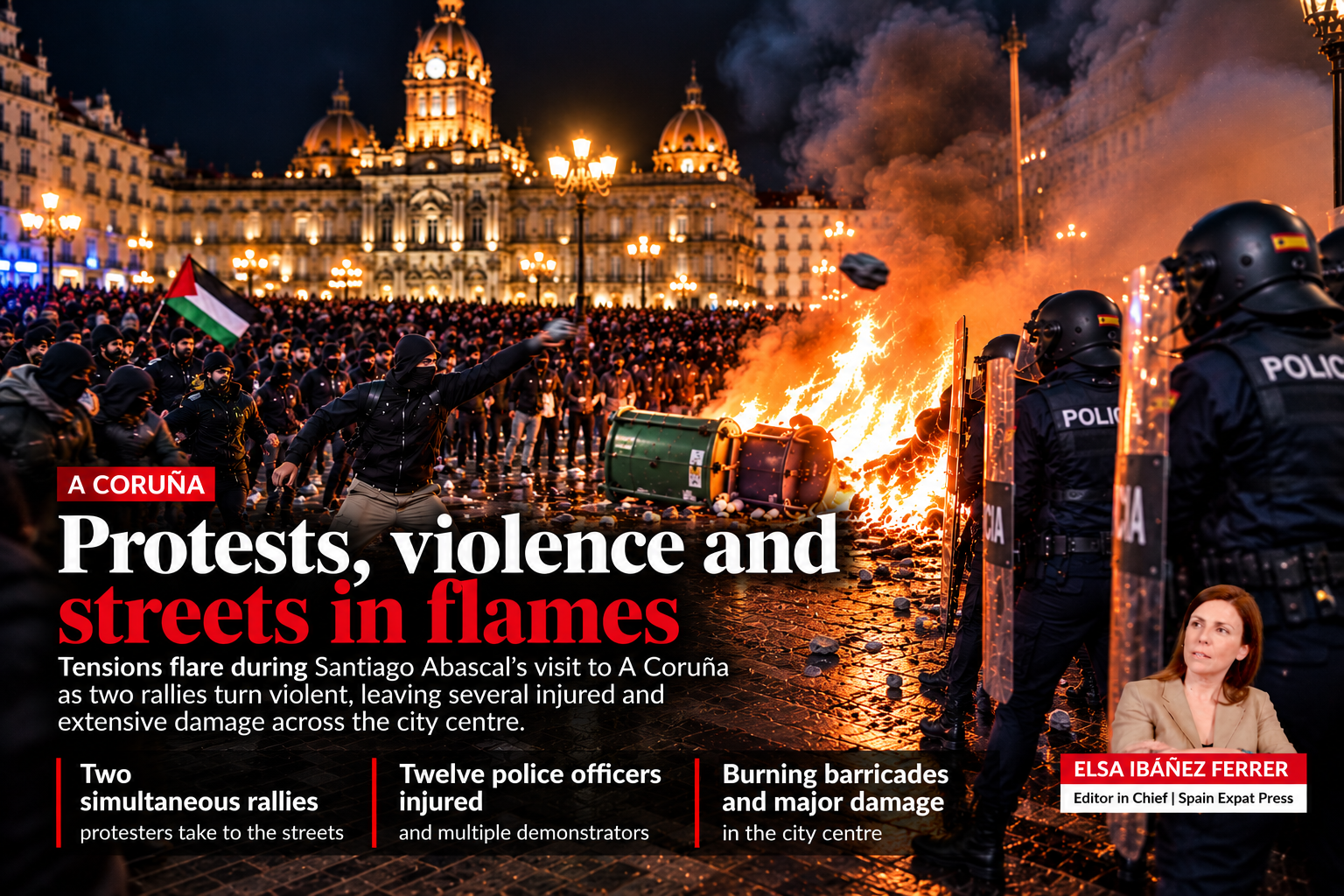
What happened in the Galician port city of A Coruña on Wednesday had nothing to do with that principle. Vox, Spain’s hard-right party, held a campaign rally in the Plaza de María Pita, the square in front of the town hall. Whatever one thinks of Vox, and I think plenty, it is a lawful party which, according to the polls, nearly one in five Spaniards intend to vote for. On the other side of the square, counter-demonstrators were waiting. By the end, according to the police, chairs, tables, sticks, cobblestones and bollards had been hurled at officers. Two arrests, 12 police officers injured, two journalists hit by projectiles. I find myself asking: what exactly did these people hope to achieve with a cobblestone that they could not achieve with a ballot paper?
The answer is uncomfortable. This was not about expressing an opinion. It was about stopping others from expressing theirs. And that is precisely what Europe has learned, for very good reasons, to fear.
Who are the real fascists?
The groups who took to the streets in A Coruña call themselves anti-fascists. That same afternoon, leftwing organisations called a rally “against police repression and fascism”. I want to take that word seriously, precisely because it carries so much weight.
Historically, fascism was never simply a matter of left or right on a ballot paper. It was contempt for the ballot paper itself. It was the conviction of one group that it held the truth, and therefore had the right to intimidate opponents, break up their meetings and rule the streets. Mussolini’s Blackshirts did exactly that. So did the SA in Germany. Britain saw its own version in Oswald Mosley’s stewards at Olympia in 1934. The method was always the same: attack the opponent’s meetings, intimidate, treat the police as the enemy.
Anyone who tries to stop an election rally by force, who throws cobblestones at police officers, and who warns that the streets will know no peace if the result goes the wrong way, should be very careful about whom they call a fascist. In their methods, they stand closer to the original than the people they claim to be fighting. Someone who will not accept democracy and the peaceful transfer of power is not an anti-fascist. They are the very problem they claim to oppose.
“There will be no peace”
What worries me most is that this attitude does not come only from masked fringe groups. Two weeks ago Manuela Bergerot, the spokesperson for the leftwing party Más Madrid in the Madrid regional assembly, told the regional president, Isabel Díaz Ayuso: “There will be no peace on the streets of Madrid.” She was speaking after the death of an elderly woman whose eviction had caused national outrage. She later said she had merely been echoing “the outcry on the streets”.
I believe she does not wish anyone physical harm. But an elected politician who announces the end of peace from her seat in parliament is not describing the mood. She is legitimising it. Politicians’ words have consequences, and in A Coruña we saw how such words land on the street.
On 29 November, the voters decide
Spain goes to the polls on 29 November, after Pedro Sánchez called an early election when his housing decrees were defeated in parliament. After eight years of his government, the polls point to a change. GAD3 puts the conservative Partido Popular and Vox together on 198 seats; Sigma Dos on 203. An absolute majority requires 176. Perhaps it will happen, perhaps not. Polls are not results.
But one thing must be clear before polling day. If the PP and Vox win, they will govern because Spaniards decided so. Not because they seized power, but because they were elected. Just as Pedro Sánchez came to power legitimately in 2018, 2019 and 2023, even though millions of Spaniards had not voted for him. Conservative voters accepted that. They protested, argued, criticised and, in the end, waited for the next election. That is how it works.
I am not asking the parties of the left, from the Socialists and Sumar to Podemos, the Galician nationalists of the BNG and Más Madrid, for anything impossible. Just two sentences, said publicly and before the vote: we will respect the result, whatever it is. And we condemn, without ifs or buts, any violence committed in our name.
Anyone who cannot say those two sentences has forfeited the right to lecture others about democracy.