On October 31st, growing numbers of children and teenagers in costumes roam the streets, while on November 1st, many families commemorate the deceased. Yet, autumn is not celebrated the same way everywhere in Spain: from roasted chestnuts in Catalonia and the chaquetía in Extremadura to the satirically decorated market stalls in Cádiz, each region upholds its own unique traditions.
Spain Expat Press Editorial Team
by Marlon Gallego Bosbach
As the days grow shorter toward the end of October, pumpkins appear in front of doorways, and shop windows transform into ghostly landscapes – Spain, too, prepares for Halloween. Yet, alongside this increasingly popular night of spooks, November 1st – Día de Todos los Santos, or All Saints’ Day – holds a firm place in the Spanish calendar. For many families, this date is primarily associated with remembering loved ones who have passed away.
Although the two celebrations occur close together in time, they have different focuses. While Halloween is primarily associated with costumes, sweets, and entertainment, All Saints’ Day is traditionally centered on visits to cemeteries, flowers, and family remembrance. At the same time, a look at the various regions of Spain reveals that old customs and modern influences have long since begun to blend together.
Halloween is becoming increasingly popular among young Spaniards
In Spain, Halloween – celebrated on October 31st – has long since become more than just a holiday adopted from the United States. In many cities, schools, theme parks, bars, and nightclubs organize events where children, teenagers, and adults dress up as witches, skeletons, vampires, or characters from horror films. Shops and private homes are decorated with pumpkins, spider webs, and artificial tombstones.
For children in particular, collecting candy has become a standard part of the festivities in many places. They go through residential neighborhoods in groups, asking for treats at people’s doors – following the well-known custom of “trick or treat” (often referred to as “truco o trato” in Spanish). However, this practice is not equally common everywhere; it depends heavily on the specific community and the activities organized locally.
For teenagers and young adults, the focus is often on celebrating together. Costume parties, get-togethers with friends, and events at clubs offer opportunities to experience Halloween as a social occasion. Social media also contributes to the fact that elaborate costumes and decorated parties are increasingly becoming a part of the culture of celebration.
However, the growing popularity of Halloween does not mean that traditional customs are disappearing entirely. Instead, both ways of celebrating often exist side by side. In some families, children dress up in costumes on the evening of October 31st, while the following day is spent visiting the cemetery together.
All Saints’ Day: Flowers, cemetery visits, and memories
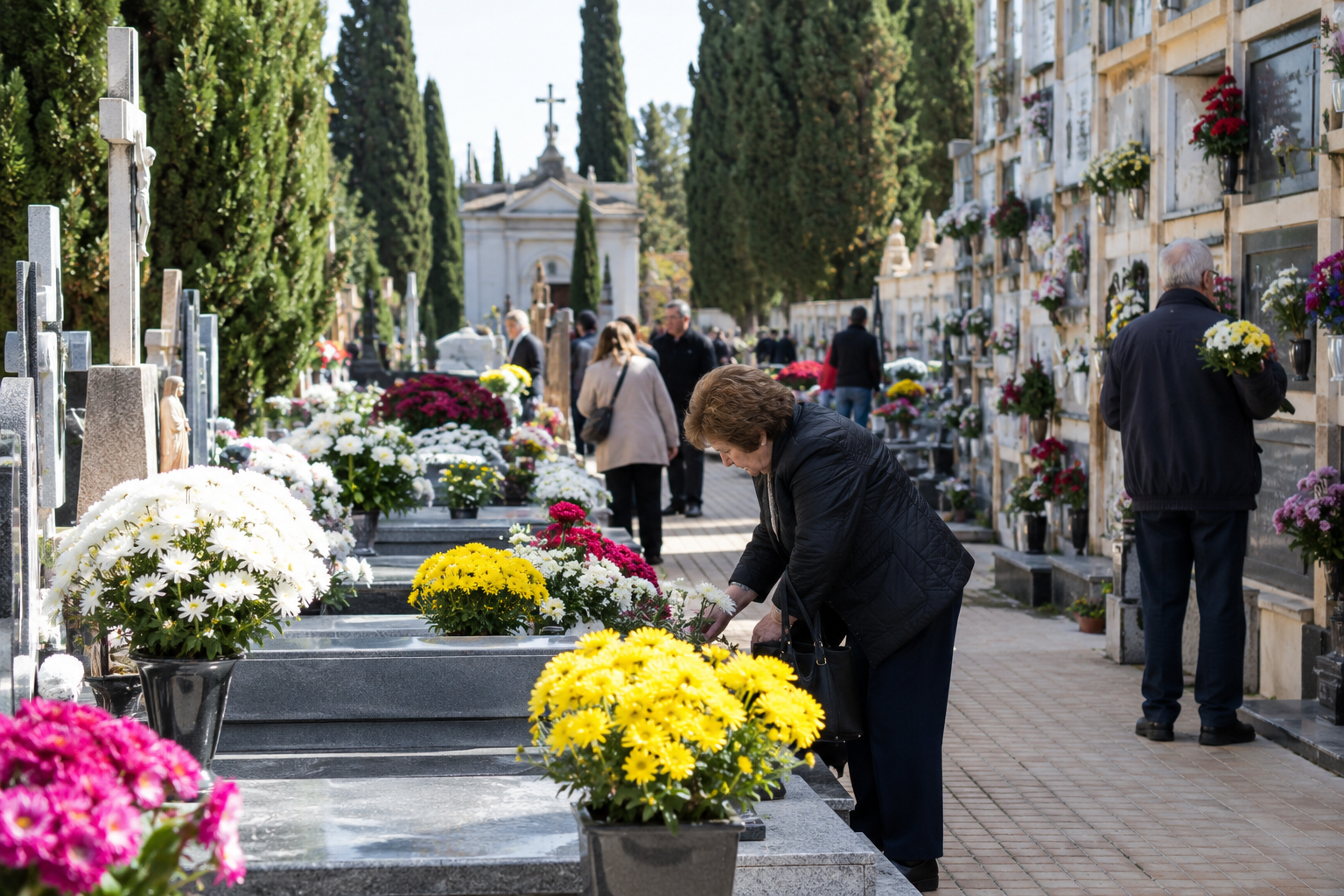
All Saints’ Day (Día de Todos los Santos) on November 1st is a public holiday throughout Spain. For many people, it is one of the most significant dates of the year for remembering deceased family members and friends.
Traditionally, on this day, relatives visit cemeteries to clean graves, refresh decorations, and bring fresh flowers – carnations and chrysanthemums being especially common. As a result, cemeteries are often quite busy around All Saints’ Day. In larger cities, additional transport services are sometimes organized to manage the flow of visitors.
Visiting the cemetery is often a family affair. Several generations come together to tend to the graves and remember those who have passed away. For families with a Catholic background, this may also include attending a church service. Others observe the day as a personal day of remembrance, regardless of their religious convictions.
After visiting the cemetery, many families gather for a meal together. This does not typically involve a standardized, nationwide festive menu; rather, it centers on regional specialties and familiar, traditional dishes. For many Spaniards, the season is also synonymous with traditional sweets from local pastry shops.
Huesos de santo and buñuelos: These sweets are part of All Saints’ Day
In the days leading up to November 1st, the display windows of Spanish pastry shops fill with sweets specifically associated with All Saints’ Day. Two classics are huesos de santo and buñuelos de viento.
Huesos de santo – literally “saints’ bones” – are elongated, bone-shaped marzipan sweets. Traditionally, they are filled with a sweet egg-yolk-based mixture. Nowadays, versions with other fillings, such as chocolate or cream, also exist. Their name and shape make them one of the most well-known treats associated with Día de Todos los Santos (All Saints’ Day).
Buñuelos de viento are small, deep-fried dough balls. They are served plain, dusted with sugar, or filled with ingredients such as whipped cream, vanilla custard, or chocolate. Other regional variations also exist. Furthermore, there is a popular belief associated with buñuelos: according to folklore, eating one helps liberate a soul from Purgatory.
In Catalonia, by contrast, *panellets* play a particularly important role. These small sweets are made primarily from almonds, sugar, and egg. Varieties topped with pine nuts are especially popular, though other versions – such as those containing coconut or chocolate – also exist.
However, sweets are not the main focus everywhere. In many regions, the autumn season is associated with roasted chestnuts, sweet potatoes, nuts, and other seasonal produce. In this context, food serves to bridge the farewell to summer, the commemoration of the deceased, and the act of gathering with family and friends.
From the Castanyada in Catalonia to the Chaquetía in Extremadura: Spain’s regional traditions
Although Halloween and All Saints’ Day are known throughout the country, the customs associated with them vary significantly from one region to another. In many places, traditions have been preserved that are linked to the harvest season, autumn, and the commemoration of the dead.
In Catalonia, the Castanyada is one of the best-known autumn festivals. It is celebrated primarily on October 31st and is closely associated with sharing a meal. Families buy roasted chestnuts and sweet potatoes, while panellets – a traditional type of sweet – are served.
The figure of the Castanyera – a traditional chestnut seller – is also part of these customs. In schools, children learn about this figure and engage with regional traditions. Thus, the Castanyada is not merely a culinary celebration, but also a way to pass on cultural customs to the next generation.
Galicia: Samaín and the connection to ancient autumn customs
In Galicia, Samaín is also increasingly being celebrated. The name is linked to ancient Celtic autumn traditions. Among its most well-known elements are hollowed-out pumpkins illuminated by candles, as well as tales about spirits and the realm of the dead.
In some places, events are organized featuring costumes, parades, and activities for children. Roasted chestnuts also play an important role in these autumnal gatherings. Traditions vary from one location to another; therefore, Samaín should not be viewed as a uniform celebration observed in the exact same way throughout Galicia.
Extremadura: The Chaquetía as a communal autumn picnic
In Extremadura, chaquetía is a traditional custom associated with All Saints’ Day. Families and groups of friends often gather outdoors to enjoy seasonal foods together.
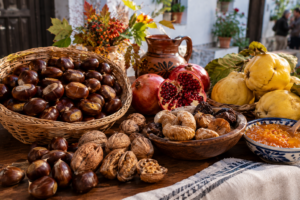
Items such as chestnuts, walnuts, pomegranates, dried figs, and quince jelly are served. In some places, children also go from house to house, collecting fruit or sweets. In this way, Chaquetía links the autumn harvest season with family and community gatherings.
Cádiz: Tosantos with humor and satirical market stalls
A particularly unusual tradition can be found in Cádiz, where the festival of “Tosantos” is celebrated around October 31st. Vendors in the city’s markets decorate their stalls with fruit, vegetables, meat, and fish, often arranging them into humorous or satirical scenes.
In doing so, they address current social and political issues. The decorations are not only eye-catching but also reflect the sense of humor for which Cádiz is known. The tradition dates back to the 19th century and demonstrates that the period around All Saints’ Day is not, everywhere, defined solely by mourning and contemplation.
The Canary Islands: Los Finaos as a remembrance of the deceased
In the Canary Islands, there is a tradition known as “Los Finaos.” The name refers to the deceased. Traditionally, families and neighbors would gather, share stories about loved ones who had passed away, and enjoy seasonal foods such as chestnuts and other nuts.
In some communities, these gatherings are now supplemented by public events that feature music, regional food, and storytelling. While customs may vary depending on the island or locality, the act of remembering the deceased remains a central element.
Further regional variants
Other regions of the country also maintain their own distinct ways of marking the autumn season and commemorating the dead. In the Basque Country and Navarre, for instance, there is the Gaztañerre tradition, which centers on roasted chestnuts and other regional foods. In parts of Andalusia, the Tostón involves the communal roasting and consumption of chestnuts. In Asturias, autumn chestnut festivals – known as Amagüestu – are an integral part of the regional culture.
In the Valencian municipality of Cocentaina, the long-established Fira de Tots Sants (All Saints’ Fair) takes place. Dating back to 1346, the fair brings together trade, craftsmanship, and regional products. It serves as an example of how, in certain localities, this holiday has evolved into a larger social event.
Younger and older generations: Between Halloween and tradition
A comparison across generations also reveals that the way these occasions are celebrated in Spain is undergoing a shift. While older people often associate All Saints’ Day with visiting cemeteries, placing flowers on graves, and engaging in family remembrance rituals, many younger people see Halloween as an additional opportunity to get together with friends and celebrate. For many, costume parties, elaborately decorated homes, and spooky attractions have become part of the festivities at the end of October. As a result, the way the days surrounding November 1st are observed in Spain is changing.
However, it cannot be inferred from this that all young Spaniards reject traditional customs, or that all older people view Halloween critically. In many families, the two occasions are combined: children take part in Halloween activities while also visiting cemeteries with their parents or grandparents, or learning about regional sweets.
This shift is also linked to the prominent presence of Halloween in films, on social media, in advertising, and in the retail sector. Elaborate costumes and decorations make the holiday attractive to many young people. Traditional customs, meanwhile, are frequently passed on within families, in schools, and through local events.
Two festivals that coexist in Spain
In Spain, Halloween and All Saints’ Day are not necessarily in competition with one another. They serve different purposes and, in many places, are celebrated side by side. While Halloween is primarily about entertainment, costumes, and communal activities, November 1st remains an important day of remembrance for many families.
At the same time, this regional diversity shows that Spain has far more to offer than the Halloween customs familiar from international media. Whether it’s chestnuts and panellets in Catalonia, Samaín in Galicia, la Chaquetía in Extremadura, or the Tosantos markets in Cádiz – the days surrounding November 1st reflect the country’s culinary and cultural variations.
For many Spaniards, therefore, the two go hand in hand: a sociable evening at the end of October and a day when the family gathers to remember those who are no longer with us.