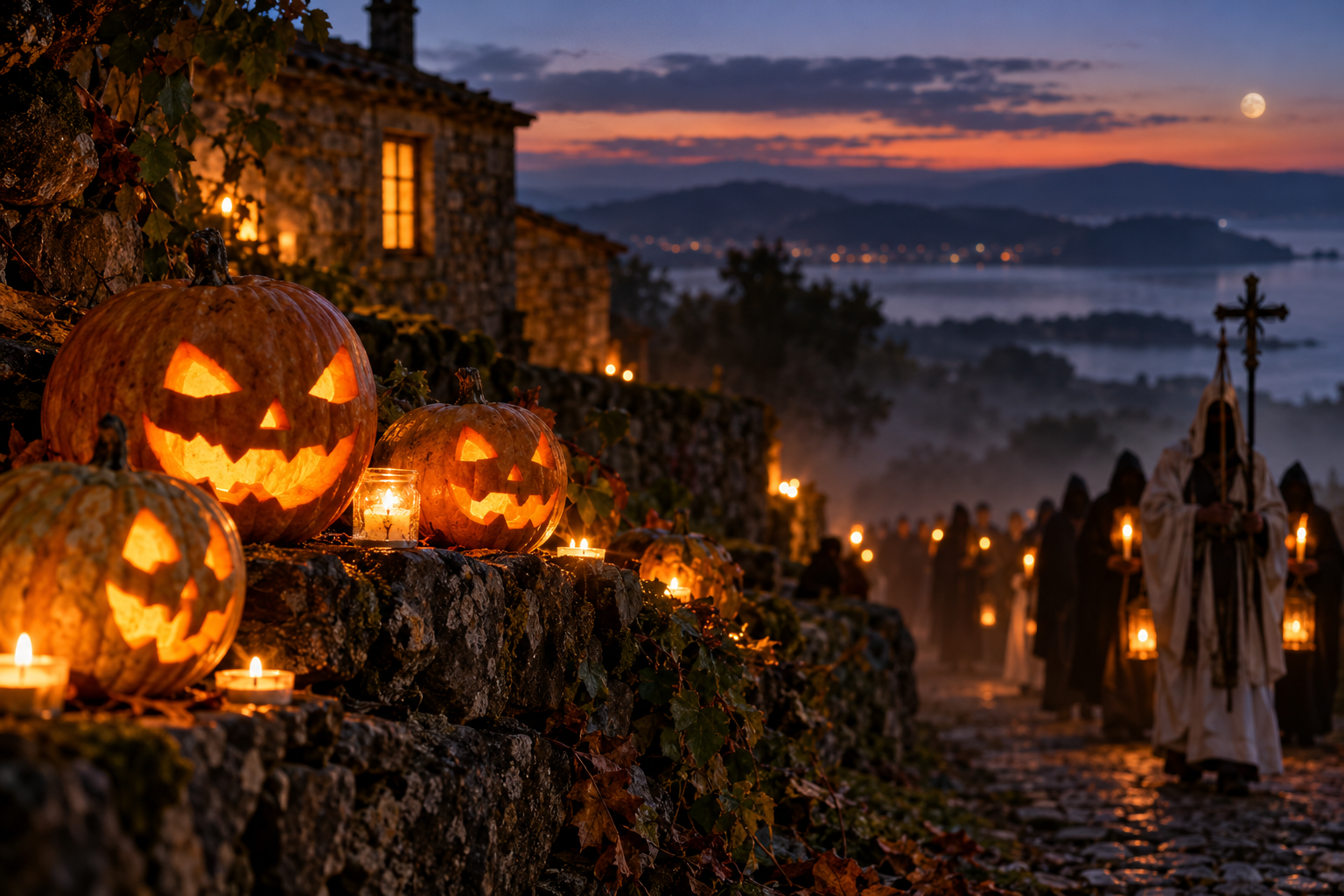
Carved pumpkins, flickering candles and tales of wandering souls were part of autumn life in Galician villages long before Halloween became popular in Spain. Many of these old customs have since faded from memory.
Spain Expat Press Editorial Team
Travel through Galicia at the end of October and you may come across a celebration that looks remarkably like the American version of Halloween. Children carve frightening faces into pumpkins, candles illuminate village streets, and stories of ghosts and restless spirits are brought back to life.
Yet behind these familiar scenes lies a much older cultural heritage.
In Galicia, the celebration is known as Samaín, a name derived from Samhain, the ancient Celtic festival traditionally associated with the end of the harvest and the beginning of winter, particularly in Ireland.
For farming communities, this seasonal change was significant. The days grew shorter, work in the fields slowed, and families prepared for the colder months ahead.
It was also a time surrounded by beliefs about death and the supernatural. According to ancient traditions, the boundary separating the living from the dead became less distinct, allowing spirits to return to the human world.
Fires and candles were lit, while food and various rituals formed part of the customs associated with remembering the dead.
Exactly how these celebrations were observed in ancient Galicia remains uncertain. What is well documented, however, is the region’s long-standing tradition of honouring the deceased and its remarkable collection of ghost stories and supernatural legends.
Carved pumpkins were once a familiar sight in Galician villages
One of the most surprising aspects of Galicia’s autumn traditions is the use of hollowed-out pumpkins.
Today, illuminated pumpkins are almost universally associated with American Halloween celebrations. Yet similar customs existed in parts of Galicia long before the modern festival became popular in Spain.
Children would carve frightening faces into pumpkins, place candles inside them and leave them outside houses, on walls or beside dark country lanes.
Sometimes the aim was simply to frighten unsuspecting neighbours. On other occasions, it was a seasonal pastime passed down through generations.
Depending on the area, these carved figures were known by different names, including caliveras and calacús.
Comparable traditions existed in Ireland, where turnips were originally used to create lanterns.
When Irish emigrants arrived in North America during the nineteenth century, they discovered that pumpkins were larger, easier to carve and widely available.
Over time, the pumpkin became the preferred material for the famous jack-o’-lantern, now one of Halloween’s most recognisable symbols.
The existence of similar customs in Galicia does not mean that American Halloween originated there. It does, however, demonstrate how related traditions developed across different parts of Europe and survived within local communities.
The Santa Compaña: Galicia’s mysterious procession of the dead
Few legends capture Galicia’s fascination with the supernatural quite like the Santa Compaña.
According to local folklore, a ghostly procession of departed souls wanders through forests, villages and isolated country lanes after dark.
The figures carry candles and move silently through the night. In some versions of the legend, the procession is led by a living person condemned to accompany the dead.
Encountering the Santa Compaña was traditionally considered a terrible omen.
Some believed it foretold the death of a relative, while others associated it with approaching misfortune.
For generations, these stories were told around the fire during long winter evenings, particularly in rural communities where oral traditions remained an important part of everyday life.
The relationship between the living and the dead also influenced domestic customs.
In certain areas, families would leave food on the table overnight or keep the hearth burning in remembrance of deceased relatives.
The dead were not regarded as entirely absent. Through memory, storytelling and popular belief, they remained connected to the household.
Whether these practices can be traced directly to pre-Christian Celtic beliefs remains a matter of historical debate.
What is beyond doubt is that Galicia has preserved an exceptionally rich collection of traditions concerning death, spirits and the supernatural.
How Halloween acquired its name
As Christianity spread across Europe, older customs gradually became intertwined with religious observances.
In Western Christianity, 1 November became All Saints’ Day, while 2 November was